Did drought or heat have greater effect on crop yields this harvest?
 © GNP
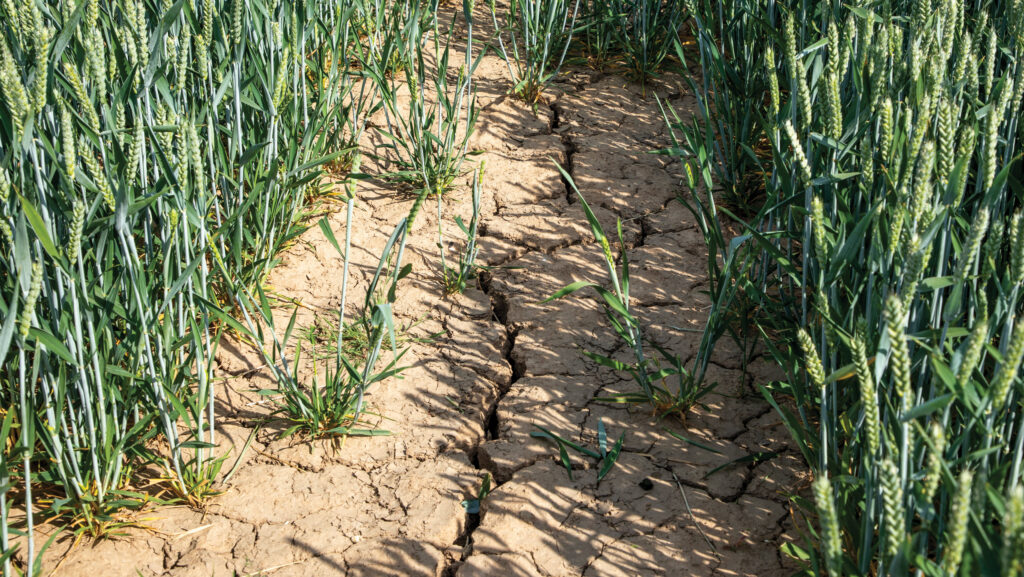
© GNP This summer’s prolonged period of low rainfall and repeated heatwaves have seen cereal yields struck down as stressed crops senesced rapidly.
Drought is often viewed as the primary limitation to cereal production during late spring and early summer, but heat stress can, in fact, be more damaging.
See also: Drought conditions drive farming change in central Europe
While the two stress factors often occur simultaneously, they affect crops in different ways and have different effects on yield.
The key distinction is that drought primarily limits crop function, whereas heat can permanently damage reproductive development.
Drought stress
Drought stress occurs when insufficient soil moisture limits the crop’s ability to absorb water. In response, plants close their stomata to conserve moisture, reducing photosynthesis and biomass accumulation.
Consequently, grain fill becomes restricted because less energy is available to support developing grain.
Dr Danni Robb, research and knowledge exchange assistant at Ceres Research (the research arm of Ceres Rural), highlights losses of up to 2.6t/ha, according to UK research.
However, because drought limits physiological activity rather than directly destroying reproductive tissue, crops retain some capacity to recover if moisture arrives before grain filling has finished, she explains.
Heat stress
Heat stress, on the other hand, has a more direct effect on grain formation and has a more disproportionate effect on yield and quality than drought alone.
When temperatures become excessive – particularly during flowering and grain fill – grain number is reduced, grain size declines and crops senesce more rapidly, which shortens the grain-fill period.
Excessive heat directly affects pollen viability and fertilisation, leading to irreversible damage to grain formation and protein development due to plant cell damage.
“Global research from the Nature Climate Change and BMC Plant Biology journals indicate yield losses of 20-50% with high temperatures at critical growth stages,” says Danni.
“Yield affects can exceed that of drought when temperatures breach critical thresholds above 35C, due to reductions in grain number and size, and accelerated crop senescence,” she says.
This explains why relatively short heatwaves during flowering can reduce yield more severely than several weeks of drought. Even if rainfall follows, crops cannot replace grains that failed to develop because of heat damage.
Heat stress is exacerbated when soil moisture is limited, as the plant struggles to use water to reduce leaf temperature via the transpiration process. As a result, drought and heat together create significantly greater stress to crops than either factor alone.
What about night-time temperatures?
Night-time temperatures can also significantly influence yield. Danni points to an Australian study that suggests night temperatures of about 20C between the crop booting and maturity phase significantly reduce wheat yield compared with cooler nights of 15C.
“Warmer night-time temperatures increase maintenance respiration. As a result, a greater proportion of the sugars produced through daytime photosynthesis is used to sustain plant tissues. This reduces the amount available for grain filling, potentially lowering grain weight,” she says.
Plant hormonal defence mechanisms in response to drought
As water availability declines, wheat activates a series of hormonal defence mechanisms to conserve water.
One of the plant’s key responses is the production of abscisic acid, which signals the stomata to close to reduce water loss through transpiration. This indirectly limits carbon dioxide uptake, so photosynthesis, biomass accumulation and grain fill slows.
Drought also increases oxidative stress within plant tissues, reducing crop growth and yield.
On the other hand, growth-promoting hormones such as gibberellic acid support stem extension, leaf area development and grain production.
Experimental work suggests that maintaining higher gibberellic acid activity under drought can improve physiological performance, including antioxidant enzyme activity, protein content and grain formation.
Future crop management
This season has highlighted how managing crops for both drought and heat resilience is just as important as managing for disease or nutrition, if not more so. So, what can be done to mitigate these effects?
Future resilience depends on the 1% changes you can make across the farm that add up, says Danni, but there is “no one-stop shot to solving this”.
Resilience will likely depend on selecting varieties with stronger rooting characteristics and earlier canopy development to support crops through periods of drought, with stay-green traits that help maintain photosynthesis.
These factors are increasingly defining yield and quality outcomes, she explains.
Promoting soil biology and including organic manures and other soil amendments in the rotation is key to boosting soil organic matter levels to enhance soil’s water-holding capacity.
“This year we’ve really seen the benefits of what organic manures can do in terms of their buffering capacity.
“We’ve seen crops 1t/ha ahead in some areas, where the focus has been on improving soil fertility with the addition of organic material through the season to build in resilience earlier. Whatever we can do to get that crop in the best place possible before a heatwave hits – because it will again – will help us out,” explains Danni.
What does this mean for future growing cycles?
UK wheat generally requires about 500-700C days to reach physiological maturity.
“If we assume the average is 600C days with an average temperature of 15C during grain filling, that equates to about 40 days to fill grain. If we increase that by 1C, it reduces to 37.5 days, and if we increase it by 5C that gets us to about a 30-day grain-filling duration,” says Danni.
A difference of 10 days is quite severe, limiting the period in which the crop is pushing starch and protein into the grain.
“For agronomy, that means moving from simply maximising biomass to protecting the duration and efficiency of grain filling.
“Every additional day a healthy flag leaf remains actively photosynthesising during grain fill could become increasingly valuable, making canopy longevity and resilience key determinants of yield stability under a warming climate,” she says.
Other crop effects?
Danni believes that because winter barley is earlier maturing it has somewhat escaped the heat this year. However, spring barley may start to suffer more if we get drier springs.
Crops of oilseed rape generally seem to be less affected. However, research shows high heat stress at flowering and pod set can still increase pod abortion, decrease the number of seeds per pod and final yields. Getting establishment right to begin with will really set the crop up for the season.
Balancing disease risk and heat
Disease management remains important during hot summers. If growers are to experience another heatwave next year, what lessons can we learn from this season?
“High temperatures can influence both crop physiology and pathogen development. Heat stress and disease pressure should not be considered in isolation,” says Dr Danni Robb, research and knowledge exchange assistant at Ceres Research.
Prolonged periods above 30C generally suppress yellow rust development, with active pustules often drying out during sustained hot weather, but brown rust behaves differently.
Although daytime temperatures above 25C slow disease development, warm, humid nights and periods of leaf wetness favour infection.
“Where brown rust is established, the disease can accelerate the loss of green leaf area at the same time that drought is limiting the crop’s ability to maintain grain fill,” explains Danni.
As a result, even where disease activity slows during extreme heat, existing infections can compound the effects of moisture stress and hasten canopy senescence, she says.
When assessing fungicide requirements, the risk of adding further stress to drought-affected crops needs weighing up to maintain productivity and profitability.