How to tackle large cover crops before spring drilling
 © GNP
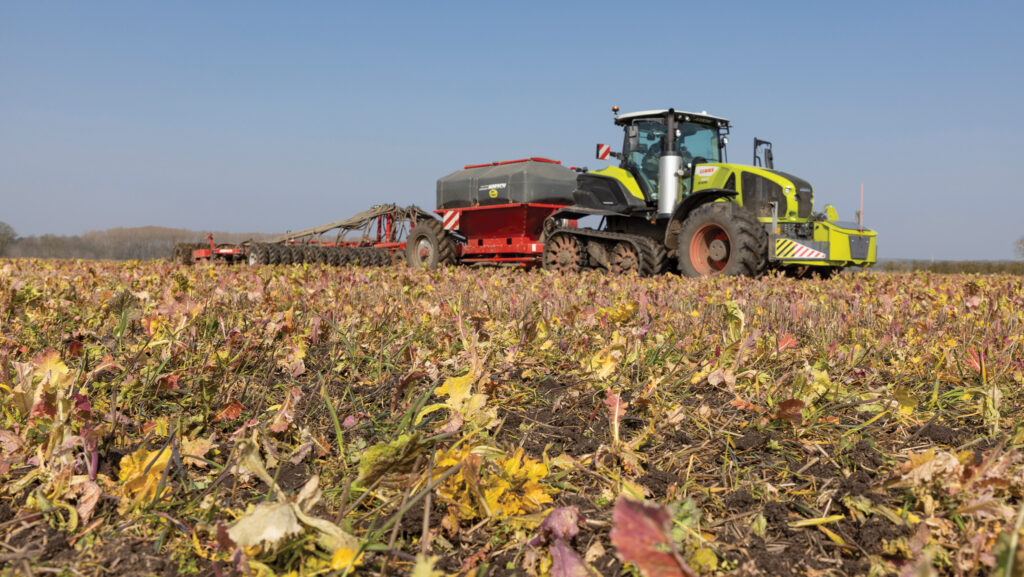
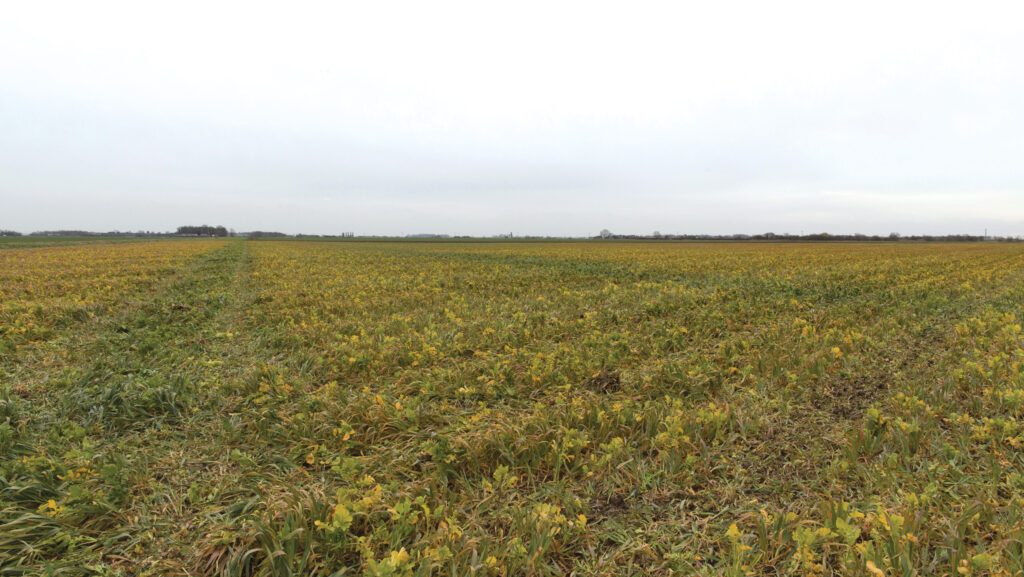
© GNP Some of the biggest overwinter cover crops seen in the past 15-20 years will need careful management ahead of spring drilling to maximise yields of the following crop.
Oxfordshire-based Agrii agronomist Iain Richards says these large cover crops are the result of an early harvest and timely rain in late July.
“There were good conditions for those able to drill in late July or early August.”
See also: Two new generation SDHI fungicides at risk of cross-resistance
Reduce canopy size
For those facing large biomass canopies, Agrii’s conservation and regenerative liaison manager Steve Corbett recommends grazing or mechanical means to reduce canopy size before finishing off with glyphosate.
“If the soil type is not too heavy and the ground isn’t too wet, sheep are really useful.”
A lot of Iain’s customers’ more forward cover crops were grazed before Christmas.
“Make sure you give grazed crops enough time to recover and start regrowing before finishing off with glyphosate,” he warns.
An alternative to sheep could be either rolling on a frost or cutting down with a knife-roller type machine, Steve suggests.
The latter could be particularly helpful in dealing with woody material, such as radishes and mustards that have already flowered and set seed.
Gary Lander © Agrii
“Using a knife-roller will allow the debris to die off and expose what is underneath to allow for just one hit of glyphosate.”
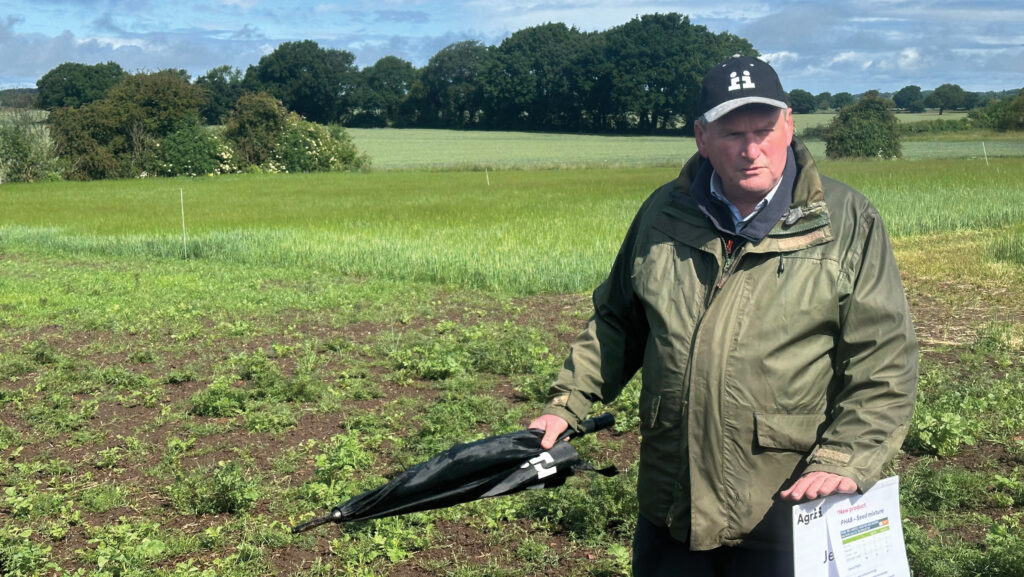
Where growers are using glyphosate, the choice of product, application rate, adjuvants, and/or water conditioner is essential to ensure the cover crop is destroyed as required, advises Agrii field operations specialist Gary Lander.
Adjuvants can significantly reduce drift and, along with water conditioners, improve the speed of action.
Choice of glyphosate product
Farmers should also assess the nature of the cover crop before deciding on glyphosate product choice, says Gary.
“Cover crops with a significant percentage of broad-leaved plants will need a two-spray approach to ensure kill of shaded grassweeds.
“The use of Kyleo (glyphosate + 2,4-D), where the addition of 2,4-D to glyphosate helps give a rapid kill of broad-leaved plants and opens the canopy, may be advantageous.
I would recommend the inclusion of an anti-drift adjuvant like Crusade with Kyleo.”
That can be followed with a straight glyphosate product, he says.
“Water volume is also critical to give good coverage – 125-150 litres/ha is usually optimal – while in all but the softest of water, the addition of a water conditioner such as H2Opti will significantly reduce lock up of the active substances, which can reduce efficacy.
“A combined adjuvant and water conditioner product like Newman’s V7 is also very effective at improving the speed of activity.”
© Agrii
Hit the target
In larger canopies, Gary says using angled nozzles, such as Lechler’s IDTAs, can reduce shadowing with the larger droplets from the air inclusion nozzle resulting in better canopy penetration, reduced drift and more active hitting the target.
“The key is not just getting the glyphosate applied, but considering the target and placing the glyphosate to deliver the optimum performance.”
Check grassweed growth stages before application, Iain adds.
“We know that grassweeds can be quite difficult to kill when they are in stem extension, which could be possible given the good growing conditions.
“It’s important to check growth stages and make sure the dose is appropriate.”
He advises against adding fulvic acid to glyphosate, despite its increasing popularity.
“I know some growers like to use fulvic acid to mitigate against the potential negative effects on soil biology.
“However, my experience of looking at where glyphosate hasn’t worked as well as it should have is that there have been far more problems where fulvic acid was used.
“It burns the top off the plant and doesn’t translocate down to the base of the plant.”
Where cover crop biomass has been reduced by grazing or chopping, lower glyphosate doses may be possible.
Generally, the rate will be driven by the growth stage of any grassweeds, which, if they have been growing under a larger canopy, will likely be smaller, Iain says.
“Occasionally, I have seen small cover crops with well-tillered blackgrass that does need an appropriate dose of glyphosate.”
Before drilling spring barley, check that the grassweeds have been controlled, particularly if no cultivation is planned.
“It’s not just blackgrass and Italian ryegrass; bromes are a big issue in spring barley as there is nothing to control them in the crop.”
Why timing is important
Regardless of canopy size, terminating at least six weeks before drilling spring barley is important, says Agrii’s Steve Corbett.
“Our trials work shows there can be a serious effect on spring barley yields following some species of cover crops,” he says.
“So the biomass needs to be gone and the plants dead before drilling.”
That doesn’t mean the cover crop will have no benefit after termination, he stresses. “The root structure of the cover crop will still benefit soil structure and water infiltration.”
Where growers have been growing cover crops and improving soil health and biology for several years, the need to terminate that far in advance could be reduced, he notes.
“Some will have found that they can drill spring barley ‘on the green’ without a problem, but there are many more growers who won’t be able to do that.
“The allopathic effect of the cover crop breaking down on the next crop is serious, with spring barley most fickle, while spring wheat and spring oats are more tolerant.”
Termination of cover crops ahead of later-drilled spring crops, such as maize, offers a little more flexibility in termination dates.