

Newly drilled maize crops crying out for rain
 © Tim Scrivener
 Maize drilling is largely complete on two contrasting farms in Devon and Lincolnshire, but an exceptionally dry spring is leaving growers urgently waiting for rain to secure crop establishment.
In mid-Devon, dairy farmer Chris Blake has drilled about 120ha of maize to supply forage for his 900-strong herd of Irish Holstein-Friesian cows.
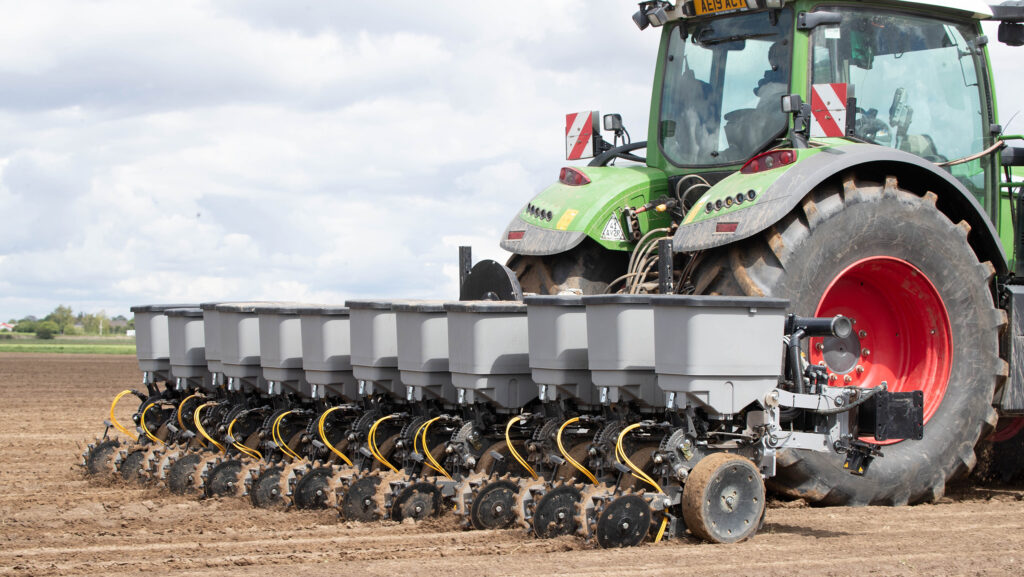
Working with contractor Yeandle Agricultural Contractors using an eight-row Amazone drill, crops were drilled from mid-April, slightly later than usual due to cold soil temperatures.
See also: Maize for anaerobic digestion – how do the numbers stack up?
“The first fields went in on 18 April and the maize is just starting to emerge,” Mr Blake said. “There was enough moisture for germination, but now we’re desperate for rain.”
Rainfall at his farm in the village of Bow, near Crediton, has recently been scarce, with just 20mm recorded during April and no significant rain for more than three weeks.
While earlier-drilled fields benefited from residual moisture following a wet January and February, later-drilled crops are more vulnerable.
To ensure the seeds were drilled into moisture, they were placed slightly deeper than normal – typically below the standard 2.5-3in depth – particularly on lighter land.
Around half of the area is sown with the Grainseed variety Es Myrdal on better soils, with Faith used on more marginal ground.
Despite dry surface conditions, the maize has germinated rapidly, but Mr Blake warned that without rainfall, both maize and grass growth could be severely affected.
“If we don’t get rain soon, we’ll be feeding silage earlier than ever,” he said.
Alongside maize, Mr Blake relies on high-quality first-cut grass silage and grows about 26ha of wheat, which can be harvested as wholecrop cereal silage to help secure forage supplies for his dairy cows if maize yields are compromised.
Deeper drilling
Further north-east in Lincolnshire, Mark Bates is overseeing a much larger-scale maize operation, drilling more than 800ha of maize for his company Holdingham Biogas, all within a 10-mile radius of his anaerobic digestion (AD) plant.
Here too, the dry spring conditions have dictated his maize drilling strategy. “We’ve had to drill deeper to find moisture – 3.5in to 4in in places, compared with a typical 2.5-3in,” Mr Bates explained.
Seed-beds have been carefully managed to retain as much moisture as possible, he added.
Following primary cultivation with a Simba SLD cultivator, land is rolled with a 10m press within 48 hours before drilling immediately after, to minimise moisture loss.
Fields are then rolled again post-drilling to seal in moisture, a practice the business would usually avoid.
“It’s not ideal, but we’re trying to keep every bit of moisture in the soil,” Mr Bates said. “Without that, you end up planting into dust.”
The business grows a mix of Grainseed maize varieties including Wesley, Faith and Es Myrdal, selected to balance maturity and yield across varying soil types, from light sands to heavier fen and clay soils.
Early drilling began on 14 April, and the team is targeting rapid establishment to maximise growing season length and to target an end of September harvest.
Some crops have already emerged with good plant counts, but like Mr Blake, Mr Bates said rainfall now is critical.
“Rain is the main worry, but there is some forecast for the weekend. We’ve got the heat coming too, but without moisture, yields will suffer.”
Last season, the business applied digestate between rows using a self-propelled applicator to maintain crop growth, though this adds cost in an already high-input system.
Measured approach
Grainseed manager Neil Groom said: “Both farms have taken a careful, measured approach to drilling and seed-bed management to give their maize crops the best possible start, but success now hinges on much-needed rainfall.
“I’m a great believer in pre-emergence herbicides, as early weed control is important in the crop to ensure that the maize gets all the moisture and nutrients during its establishment phase.”