Potato trials probe biostimulants, nutrition and IPM
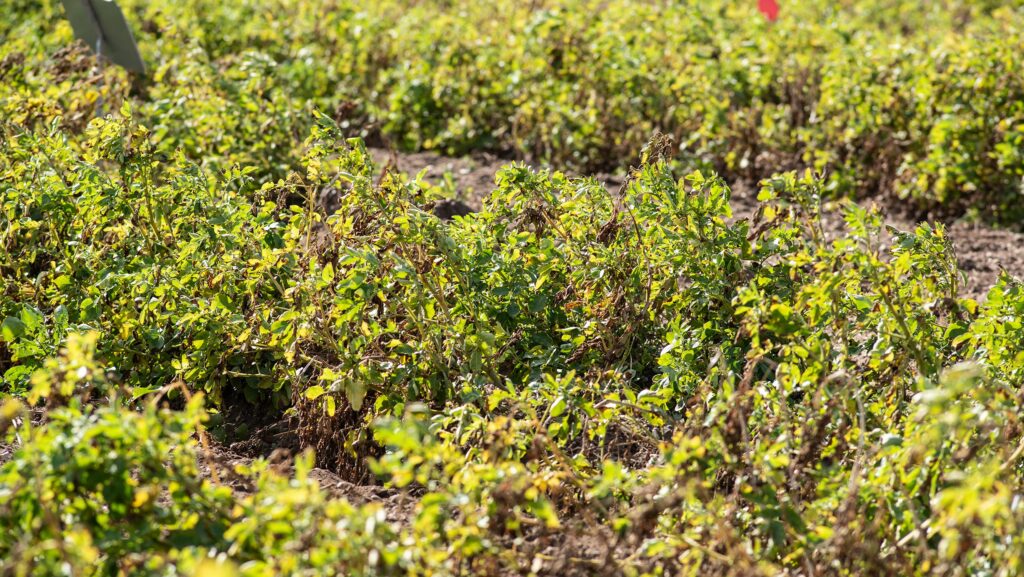 Foliar applied biostimulants © Phil Weedon
 A number of independent trials encompassing nutrition strategies, biostimulants, and the effects of floral tramlines are taking place at the Dyson Farming Research Centre, Lincolnshire.
This is providing potato growers with practical agronomy.
Here is a selection of the latest ongoing research, many of which were supported by the Defra-funded Innovate UK Adopt programme.
See also: Young couple’s pasta start-up champions 100% British spelt
Late potassium for early senescence
Foliar potassium is frequently used at the start of crop development, but applications later in the season are not so common.
Dyson Farming Research (DFR) is investigating whether an application of foliar K as crops begin to senescence can increase tuber dry matter and the rate of senescence.
“If successful, this could benefit the processing sector, where increased dry matter is important for a marketable crop.
The trial follows published scientific research showing potassium can offer promising results,” says DFR crop research scientist Christine Jones.
Biostimulant programmes
A range of foliar biostimulant programmes are being put to the test, a number of which were included in trials in 2025 and showed a positive financial response, mainly in terms of heat and drought stress protection rather than stimulating growth, explains Christine.
Trial plots are two rows wide by 12m, allowing detailed measurements.
- BioNature programme – Including stabilised liquid nitrogen in efficient amine form to boost root growth and stress tolerance
- Biimore – A bacterial fermentation of sugarcane molasses, rich in primary and secondary compounds which influence gene expression, including enhanced photosynthetic efficiency
- Bridgeway – A plant-derived amino acid and peptide biostimulant providing the exact building blocks required for protein synthesis, saving the plant metabolic energy
- Califite Extra – A complex of calcium phosphite which simulates rooting and exudation
- Quantis – Based on amino acids and peptides to enhance plant performance during drought and heat
- Super 50 Prime – Seaweed extract that reduces oxidate stress, helping protect photosynthesis and tuber set during crops stress.
- Status – This pairs a patented phytohormone technology with pidolic acid to increase chlorophyll content, absorption of light, and nitrogen assimilation
In-furrow biostimulant trials
Separate biostimulant trials are taking place this season using in-furrow applications.
- Symposium – bacteria and fungi-based biostimulant
- Serenade SoilActive containing Bacillus bacteria
- TuberTonic containing Pseudomonas
- RootGrow containing mycorrhizal fungi
- PGRP – plant growth promoting rhizobacteria.
This experiment with microbial products, also includes foliar application of endophytic bacteria as Blue N and Vixeran.
Seaweed extracts
“A challenge with seaweed extracts is that the starting material can be very variable, depending on growing conditions,” says Christine.
“In this trial we are testing Litora Core, a product produced from farmed seaweed, which could offer greater consistency.”
Molecular nutrition
A novel trial looking at nutrition at a cellular level represents a cutting-edge shift in modern agronomy.
The nanoproduct product Supramolecule-N sees tiny nanomolecules attach to nitrogen in foliar nutrient sprays to promote uptake and nutrient use efficiency in the plant.
“That’s the theory, and we are testing the science in the field,” says Christine.
Low-emission experiment
A low-emission experiment is looking at replacing conventional nitrogen with low-emission alternatives.
Those being put to the test are CCm, Re-Genus fungal pellets, Agrii Fortis chicken manure pellets, Soil Worx Dynamo pellets and Fertawool wool fleece pellets.
These are applied at manufacturer recommendation rates and made up with artificial N to provide a total farm standard of 200kg N/ha.
Measurements were taken through the season, including NDVI scans to gather information on growth.
Low-input nutrition
This experiment brings together treatments from some of the other trials, looking at combinations of soil and foliar applied nutrients and microbes applied in-furrow.
The aim is to determine the optimum combination for achieving yield with minimum inputs.
Floral tramlines
As part of an IPM strategy, floral tramlines are being tested as a means of attracting natural predators into the crop.
Hoverflies are a particular target, as the larvae of various species are effective predators of aphids, whereas the adults feed on pollen and nectar.
Different flower species are being tested, as are lures based on volatile organic compounds which may signal the presence of aphids to their predators and so could be an alternative or addition to floral resources in recruiting hoverflies into the crop.
Acoustic monitoring devices are deployed to detect movement of hoverflies into the crop from surrounding habitats.
This report is from Farmers Weekly’s Arable Insights Live: Potatoes event on 17 September at Dyson Farming Research, Lincolnshire