Potato trials show little benefit from NUE products
 © GNP
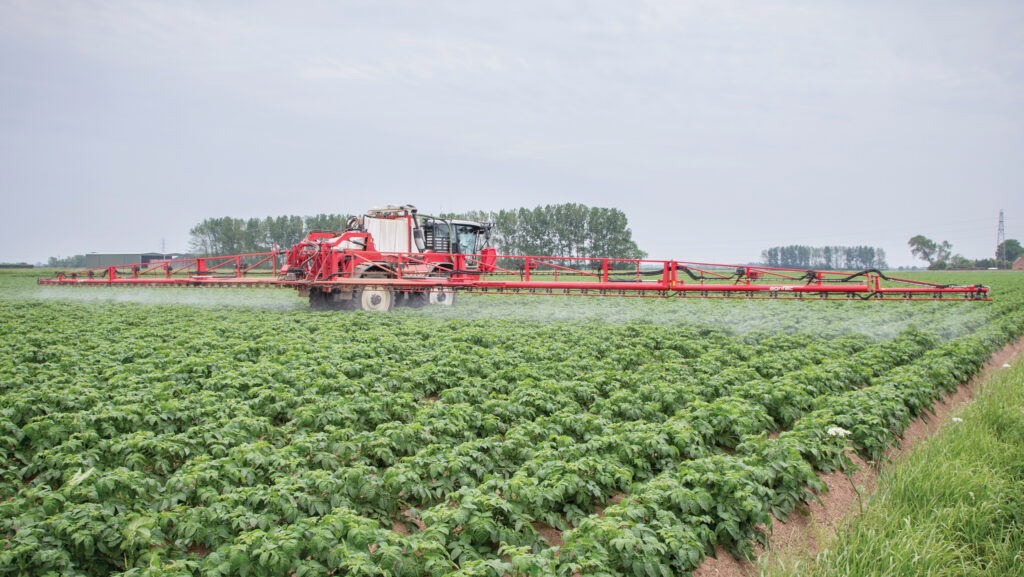
© GNP Nitrogen use efficiency (NUE) products appear poorly matched to potato physiology and provide little benefit to the crop, according to independent Niab work carried out through the Cupgra Reference Crop programme.
At the 2023 Cupgra Conference in Cambridge, a delegate scoping exercise looked for insights into grower and agronomist attitudes to their use in potatoes.
Products were grouped by mode of action, including nitrification and urease inhibitors, photocatalysts and biological nitrogen fixers.
See also: The role of cover crops in nitrogen management for potatoes
The subsequent discussions showed that interest in these products is high, but opinions on their value very mixed, according to Niab potato research specialist Dr Sarah Roberts.
“Some people think they are the bee’s knees, other people think they’re a scam, so this prompted us to include examples of the products in the Reference Crop work in 2024 and 2025 to get some independent data,” she adds.
The Reference Crop is a long-running Cupgra-funded field experiment that measures how potato varieties respond to different nitrogen rates and agronomic inputs, providing independent data to guide fertiliser and crop management decisions.
© GNP
2025 trial
The 2025 trial tested four products; Didin, which works by controlling the release of fertiliser nitrogen, and three others that work by capturing atmospheric nitrogen: R-Leaf, BlueN and Vixeran (see “Trial products tested in the Cupgra Reference Crop”).
All were applied according to manufacturer guidance; Didin before planting alongside ammonium nitrate, BlueN and Vixeran at about 30-40% ground cover and R-Leaf as four foliar sprays once ground cover exceeded 80%.
Each product was tested with two ammonium nitrate rates; 90kg/ha intended to create nitrogen stress, and 220kg/ha being an optimal rate for a determinate variety like Innovator.
The protocol was important because products are marketed in different ways.
Some are positioned as adding extra nitrogen on top of a standard programme, while others are suggested as a partial replacement for fertiliser nitrogen, so a low and high rate gave the best chance of teasing out a response.
No response
Unlike 2024, when late planting and dull conditions limited nitrogen responsiveness, 2025 provided a clearer test, says Sarah.
The Reference Crop responded to applied nitrogen, with the 220kg/ha treatment yielding 78.6t/ha, and the 90kg/ha rate producing 71.8t/ha. However, none of the additional NUE products improved yield at either nitrogen rate.
“What convinces me that they are not providing anything practically useful is that in the 2025 data we did see a yield increase between the 90kg nitrogen treatment and the 220kg nitrogen treatment in Innovator, but we didn’t see any increase from the products themselves.
“That tells me they didn’t provide anything extra,” Sarah notes.
Total nitrogen uptake also increased with fertiliser rate, rising from 175kg N/ha at the lower rate to 246kg N/ha at the higher rate, but there was no difference between ammonium nitrate-only plots and those with NUE products added.
Plant tissue nitrogen concentrations told the same story. Higher ammonium nitrate rates lifted haulm and tuber nitrogen concentrations, but the NUE products did not.
The trial report concludes that the products supplied either no additional nitrogen or amounts too small to be taken up and measured in a practically useful way.
Timing problem
Sarah says the trial’s key message for growers is about timing.
The Reference Crop work has repeatedly shown that potatoes take up nitrogen quickly after emergence.
In the 2025 trial, the pattern of nitrogen uptake was unaffected by nitrogen rate or the NUE product added, with maximum rate of uptake occurring about 22 days after emergence.
It is this physiological characteristic of potatoes that creates a challenge for products that release N slowly.
“They’re generally drip-feeding nitrogen throughout the season, and often they start midway through that rapid nitrogen uptake phase, so they’ve kind of missed the boat.”
This does not mean the same products could not have value in other crops, she adds.
“Unlike cereals, which have a much longer period of active nitrogen uptake, potatoes don’t work like that.
“So I think there is an inherent mismatch between this style of ‘low and slow’ nitrogen delivery and potato physiology.”
R-Leaf highlights the practical dilemma. Applying it earlier might better match the crop’s nitrogen demand, but foliar products need enough canopy to intercept the spray.
In the Cupgra trial, the first application was not made until there was more than 80% ground cover.
Niab is now exploring earlier use of R-Leaf, starting closer to 30% ground cover, in a separate Innovate UK project with Crop Intellect and Branston.
“The aim is to answer the question: does R-Leaf work, but was simply being applied too late to be useful to potatoes? We’ll see,” says Sarah.
Reliability questions
The work also illustrates the difficulty of manipulating biological systems in commercial potato crops.
For bacterial N fixers such as BlueN and Vixeran, conditions around application may influence colonisation.
In 2025, warm, dry conditions and low-level water stress around application may have reduced stomatal opening and made leaf colonisation more difficult.
That is not just a research problem, because in commercial crops the ideal crop growth stage may coincide with suboptimal weather, irrigation timing or plant stress.
Didin presents a different issue. As a nitrification inhibitor, it slows the conversion of ammonium to nitrate, potentially reducing nitrate leaching and nitrous oxide emissions.
However, in a crop that needs nitrogen quickly, slowing availability may not be helpful unless the main risk is nitrogen loss.
In 2025, dry conditions reduced leaching risk, leaving little protective benefit to capture.
Practical message
Overall, Sarah says growers and agronomists must question how and when an NUE product works before investing and assuming it can replace ammonium nitrate in potatoes.
“Ask the people selling any similar product: when is the nitrogen being provided and how is that nitrogen being provided?
“If it’s a drip-drip-drip supply, it’s probably not going to do potatoes much good, because it misses that early N uptake period.”
The findings do not rule out potential benefits linked to carbon credits or other environmental schemes, particularly where product use is rewarded beyond direct fertiliser replacement, but on crop nitrogen supply and yield, the trial found no measurable benefit.
Instead, Sarah says the more reliable route to improving nitrogen use efficiency is to avoid factors that limit crop growth and waste the nitrogen already applied.
“Looking after your soil and making sure plants are growing in the right conditions is really important.
“Compaction is a particular risk and forcing a crop in early can massively limit yield potential, no matter how much nitrogen you apply.”
Trial products tested in the Cupgra Reference Crop |
||
|
Product (manufacturer) |
Type |
How it works |
|
Didin (Omex) |
Nitrification and urease inhibitor |
Contains dicyandiamide, which slows the conversion of ammonium into nitrate in the soil. The aim is to reduce nitrogen losses through leaching and nitrous oxide emissions, helping retain nitrogen in the rooting zone for longer |
|
R-Leaf (Crop Intellect) |
Photocatalyst |
Uses titanium dioxide to catalyse the sunlight-driven conversion of atmospheric nitrogen oxides into nitrate on the leaf surface |
|
BlueN (Corteva) |
Biological nitrogen fixer |
Contains the bacterium Methylobacterium symbioticum, which colonises leaf tissues through stomata and converts atmospheric nitrogen into ammonium using plant-produced methanol as an energy source |
|
Vixeran (Syngenta) |
Biological nitrogen fixer |
Contains Azotobacter salinestris strain CECT 9690, an endophytic bacterium capable of colonising leaves and roots, fixing atmospheric nitrogen and converting it into ammonia that can be absorbed by the plant |
|
Note: All products were tested alongside both reduced (90kg N/ha) and conventional (220kg N/ha) ammonium nitrate programmes in the determinate variety Innovator. |
||