Tips on making every kg of fertiliser count next spring
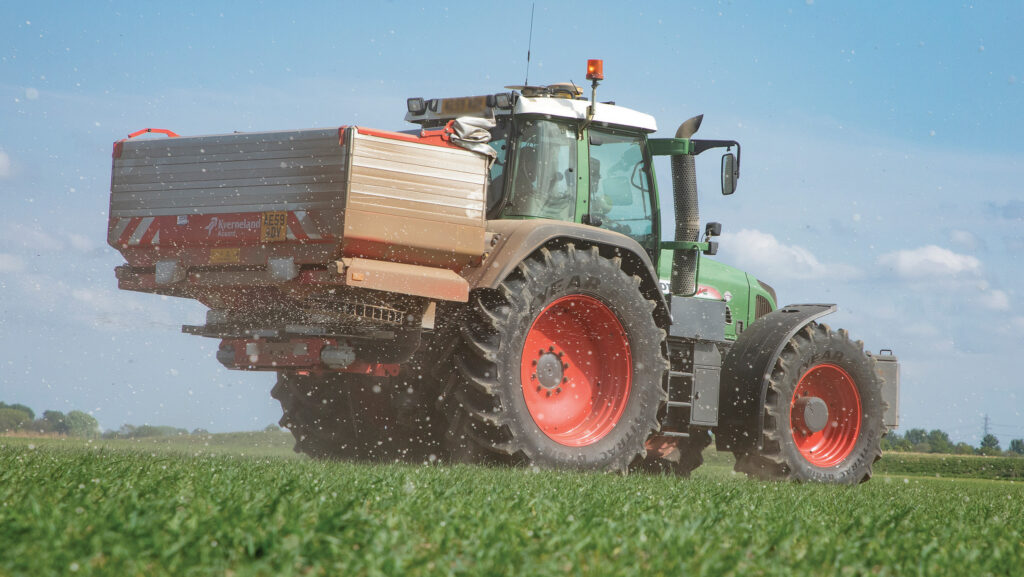 © GNP
Nitrogen fertiliser is the biggest input cost on most arable farms, so with continued pressure on margins and price volatility, could variable rate applications help more growers get the most from every pound spent?
Hutchinsons crop nutrition specialist, Rob Jewers, believes the answer is yes, especially where there are high levels of variation in soil and crops.
See also: Low-carbon fertiliser: What products are in the pipeline?
Variable applications are not just about trying to save large amounts of fertiliser, he says.
“Yes, some could make savings, but others may use similar amounts [to a flat rate], or maybe even slightly more to feed crop potential.
“The biggest win is from targeting nitrogen more effectively to the parts of a field that will respond best to it.”

Rob Jewers © Hutchinsons
In doing so, farmers are ensuring enough nitrogen is applied to maximise yield potential, while reducing the risks of over-applying on areas where it cannot be utilised fully, and is more likely to be lost to the environment, such as through leaching.
Marginal gains add up
A recent Adas report suggested in-field variable rate nitrogen typically delivers only modest yield and financial benefits of 0.05t/ha and £10/ha, respectively.
However, Hutchinsons farm business consultant, Rebecca Mahony, insists that even small gains can collectively make big improvements to overall profitability.
“A 1% or 2% improvement in yield or cost saving might seem small on its own, but stacking marginal gains together can be transformational for farm businesses.”
She cites the example of a typical 400ha arable farm, with a traditional cereal and break crop rotation, where a 5% improvement in yield, combined with a 5% reduction in fixed costs, and 5% cut in variable costs, reduced the total cost of production by £15/t, equivalent to an extra £53,000 on the bottom line.
“Every business is different, but on many farms, there is definitely an opportunity to utilise inputs – of which nitrogen fertiliser is one of the biggest – more efficiently.”
Winter wheat gross margin predictions for 2027 (see table below) show fertiliser typically makes up 56% of total variable costs, an increase of 10% from 2026, with nitrogen accounting for 70% of total fertiliser cost, she notes.
“Therefore, applying nitrogen efficiently is crucial to farm profitability, and variable rate application can help maximise its benefits,” she says.
Start simple
Variable applications do not have to be complex and involve lots of expensive kit, Rob says.
“At a basic level, you could just apply different rates to individual fields, or part-fields. Others may want the tools that let them identify and address variations across a field.
“It’s about doing what’s right for your business with the resources available.”
Rob highlights four steps to help growers start planning variable nitrogen applications next spring:
- Test soil nitrogen – Soil Mineral Nitrogen (SMN) testing, usually done between January and early February, provides a guide to the level of residual nitrogen in the soil, and the starting point for spring fertiliser strategies.
- Ensure pH and other nutrients are in balance – do not just vary N without considering other nutrients, notably, phosphate, potash, and sulphur, as well as organic matter. Basic soil testing will help, but for more detailed analysis, consider TerraMap high definition scanning.
- Set realistic targets – be realistic about yield potential and likely N requirements at a field/intra-field level, analysing yield maps for past performance. Also assess this season’s established plant population and highlight any areas of concern – examine potential reasons for poor establishment (such as drainage issues), as this may inform N decisions in the spring.
- Benchmark Nitrogen Use Efficiency (NUE) to gauge the effectiveness of current strategies and monitor the impact of management changes. A basic NUE calculation is to compare the starting N level (SMN), total N applied through the season, and the amount taken away in grain and straw. Consider grain analysis over winter to assess actual crop nutrient offtake.
Early N benefit
Rob says trials and experience over many years show it is nearly always best to apply a good base level of nitrogen early in the season, which for many winter wheat crops could mean getting the first 100-160kg N/ha on by mid-March, depending on the season.
He favours a flat rate for the first application, before looking to vary second and third doses according to crop requirements.
“Often this is based on NDVI (normalised difference vegetation index) satellite imagery, which is the most accessible way of identifying variations in crop biomass in-season. NDVI doesn’t give an actual reading of nitrogen, but it shows how crops are developing.”
Other hand-held, or tractor-mounted sensors, such as Yara’s N-Tester, and N-Sensor, are also options that can help build a picture of crop development as the season progresses, he notes.
No regrets from variable N move
It is three years since Alex Wilcox started using variable rate nitrogen applications at Hill Farm on the Norfolk/Cambridgeshire border.
Alex, a Hutchinsons agronomist who farms with his wife Joanna and their three sons, grows winter milling wheat, winter feed barley, spring malting barley, spring beans and sugar beet across 240ha of Fen silty clay.
“We’re on high yield potential soils and use a lot of organic manures, so applied nitrogen rates have always been at the lower end of the scale compared with other growers, typically at 220-240 kg N/ha for milling wheats and 100 kg N/ha for malting barley.”
The move to variable applications was a natural next step towards using inputs even more efficiently on the farm, he says, and was spurred on when they signed up to the Sustainable Farming Incentive’s variable rate nutrients option (PRF1).
“In the last two years, we’ve seen the best yields ever for wheat and barley, despite challenging growing conditions. It’s not all down to variable nitrogen, but it is part of it,” says Alex.
While there was also a slight saving in the amount of fertiliser used in both seasons, worth about £3,000 each time, Alex’s son Finlay says the biggest benefit is the improved crop uniformity within fields. They have also noticed less lodging in winter barley.
Change of kit required
To allow variable applications, Finlay acknowledges they did have to change the farm’s fertiliser spreader and one tractor, as the previous equipment was unsuitable. These were replaced with a second-hand 2017 Fendt 724 and a 2015 Kverneland spreader, both of which were good value, he says.
“We made an investment and I’m confident it was the right thing to do,” notes Alex.
Nitrogen application plans are prepared in Omnia, with variations primarily based on NDVI imagery available within the platform – pictures are taken roughly every three days, and users select the clearest image available closest to the planned application date.
Typically, Findlay increases rates on thinner areas for the first two applications, to support tiller retention, cutting back on thicker parts. By the final application, yield potential is determined, so his aim is then to feed more on the high potential areas of crop, and cut back on poorer areas.
“By the time we get to the third application, fields generally look pretty even,” he notes. This is often clear to see in NDVI imagery taken at the start and end of the spring (see images).
Finlay concludes: “Joining the SFI was the catalyst for starting variable rate applications, as we could get paid £27/ha for something that benefits our farm. Having now seen the benefits, I’m confident it’s something we’d continue doing, even if we weren’t getting paid through the SFI.”
Winter wheat gross margin variable cost breakdown |
||
|
|
2026 |
2027 |
|
Seed (£/ha) |
83.00 |
78.75 |
|
Fertiliser (N, P, K) (£/ha) |
329.00 |
478.93 |
|
Sprays (£/ha) |
310.00 |
295.15 |
|
Total variable cost (£/ha) |
722.00 |
852.83 |
|
Fertiliser as a percentage of total variable costs |
45.57 |
56.16 |
|
Source: Hutchinsons Gross Margin guide |
||