How a colour sorter investment helps secure milling premiums
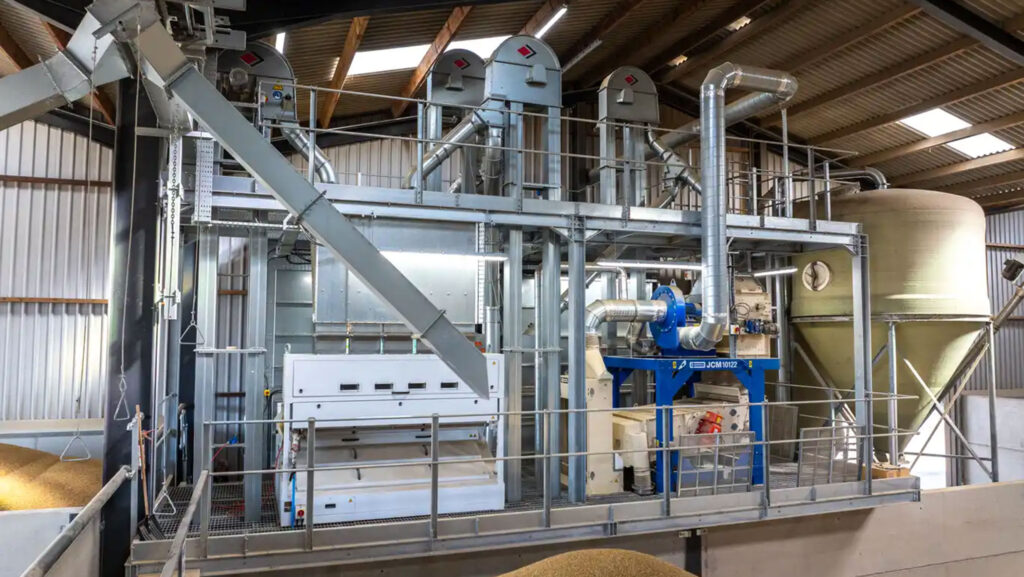 The colour sorter uses jets of air to remove impurites from the sample © McArthur BDC
 The investment in a new colour sorter is helping the Wright family improve grain quality at their Leicestershire farm.
With profit margins getting tighter, Wright’s Agriculture wanted to invest in new grain-handling equipment to protect margins and reduce risk of costly grain rejections.
“Our aim is to extract the highest possible value from crops, which usually means growing for the human consumption market,” says Eric Wright.
Described by Eric as a “Swiss army knife” for the business, the colour sorter was established ahead of the explosion of ergot which greeted growers during harvest 2024.
See also: Young couple’s pasta start-up champions 100% British spelt
“We were very fortunate to have the system up and running to clean ergot-infested crops and achieve milling standard. Without the plant, it would have been a tricky season,” says Eric.

Eric Wright and Scott McArthur © MAG/Emma Gillbard
The project was supported through a rural development grant, which contributed 40% towards the colour sorter and new grain handling facility, up to a cost of £750,000.
The grant covered the shed, storage, intake systems, the sorter itself, but drying equipment was not eligible.
Tenant to contract farming
Wright’s Agriculture has expanded considerably over the years.
The business, which started as a tenanted dairy farm more than 80 years ago, has transitioned into 5,000ha of tenanted arable and contract farming.
In 2011, a 100% bank loan enabled the family to purchase a 50ha farm.
Later that year, the tenanted farm was lost for residential development, and Eric and his family were forced to move the entire arable business within 12 months.
The new farm was to become their flagship site for contract farming.
“We run the business by spotting opportunities. We’ve got to be ready to act when they arise,” says Eric.
Over the past 15 years the yard has slowly been developed, with 30,000t of grain storage now on-site, alongside drying and cleaning facilities.
Nearly all of the arable area is combinable crops. The team run four John Deere combines and a fleet of John Deere tractors, employing 17 full-time workers.
With such a large contract-farming area based in and around suburban Leicestershire, resilience and adaptability are essential.
Cropping includes winter wheat, winter barley, winter and spring oats, and maize.
The colour sorter
The colour sorter marks the latest investment of this three-generation business.
Husband and wife Eric and Helen, working alongside Eric’s parents, Bill and Sarah, now offer grain cleaning and storage services to other farms and grain merchants, which is helping diversify income streams.
The colour sorter features a large hopper and five channels that use jets of air to remove impurities from the sample.
Eric is very pleased with the machine’s performance, which he uses to remove ergot, grassweeds and other impurities.
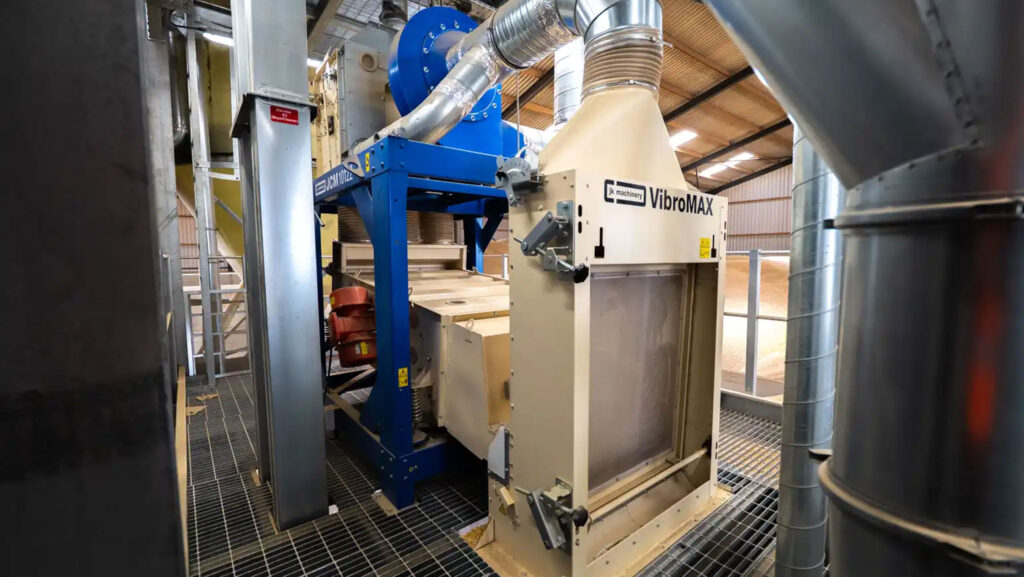
Grain goes through a sieve cleaner, before the colour sorter © McArthur BDC
Bushel weights for milling oats need to be a minimum of 50-52kg/hl, while the new setup can lift this by 5-7kg/hl, helping secure milling premiums.
Equipment setup was critical to maximise grain flow and cleaning efficiency.
This is why Eric worked closely with grain systems integrator McArthur BDC, which provided a 3D modelling walk-through of the plant, enabling the team to visualise and refine the design before construction.
Importantly, a JK Machinery VibroMAX sieve cleaner was installed ahead of the colour sorter. This acts as a pre-cleaner which allows the colour sorter to operate at greater precision.
Scott McArthur, project division director, notes the sieve cleaner removes the majority of impurities, allowing the colour sorter to focus on finer separation work.
“Many arable farmers investing in grain storage and intake systems are now considering colour sorters and designing shed spaces with colour sorters in mind to add long-term value to crops in future,” he says.
Scott continues: “When the sorter is in operation, some grain is inevitably lost with the rejects and must either be reprocessed or diverted through a secondary clean.”
Eric’s preferred setup, depending on the crop, uses four channels for the primary clean and the fifth for secondary cleaning to reduce grain losses.
The sorter has a listed output of 4t/hour a lane. But thanks to the sieve cleaner boosting efficiency, Eric can achieve 20t/hour output using just the four lanes.
Rejected grain falls through the lines before being blasted back into the fifth lane for secondary cleaning, then transferred into the rejection bin.
Where crops are relatively clean, all five channels can be used for maximum throughput, notes Scott.
Last year, the colour sorter operated an average of 6.5 days a week. This year, usage has fallen to 2-3 days a week.
Batch drying can take place ahead of the cleaning system, which performs particularly well with smaller loads.
Eric says the colour sorter is capable of drying, cleaning and transferring grain through the intake pit system and storage bays.
Plans for the future
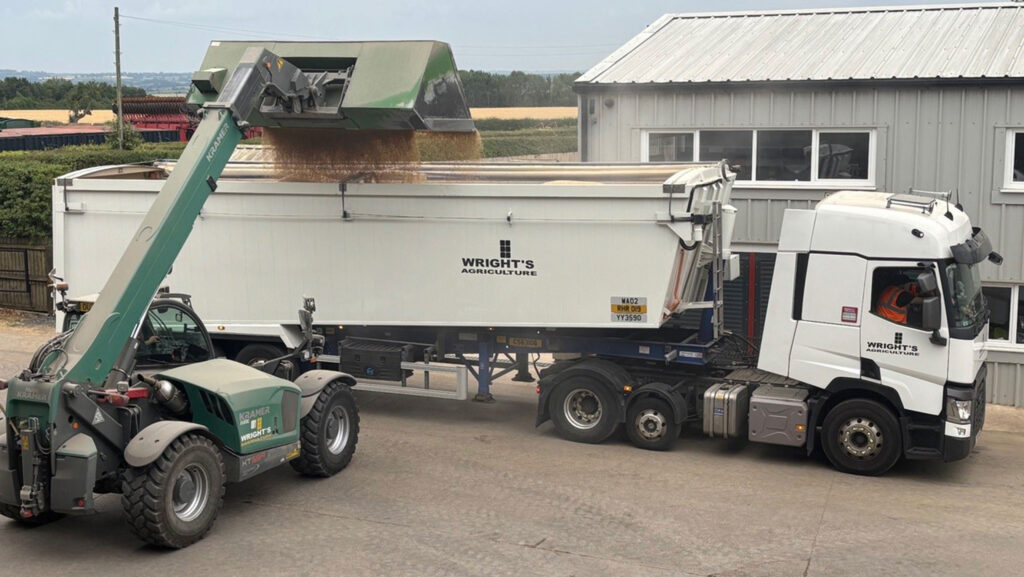
Wright’s Agriculture has invested in its own grain haulage lorries © Wright’s Agriculture
Wright’s Agriculture is hoping to further future-proof the business further with the addition of a haulage enterprise.
One of their long-term combine drivers, Mark Lines, worked away from the farm as a lorry driver during the winter months, so the team thought it would be an opportunity to offer him a full-time role to help lead a new transport operation.
The farm is also building accommodation and kitchen facilities for harvest workers on-site.
This year’s crops are showing strong potential, and the team are optimistic for harvest which is just around the corner.