

Advertiser content
Why delaying weed control costs more than you think
When we talk about the cost of weed control, it’s tempting to focus on the price of the herbicide.
In reality, the true cost is often paid through lost yield potential, reduced input efficiency, narrower spray windows and more complex programmes later in the season.
Broad-leaved weeds have historically been “managed by default” in many cereal crops. Held in check by residual chemistry and cold winter conditions. Increasingly, that safety net is no longer there.
© Corteva Agriscience
What’s changed, and why broad-leaved weeds matter earlier than they used to
Several factors are now shifting the balance:
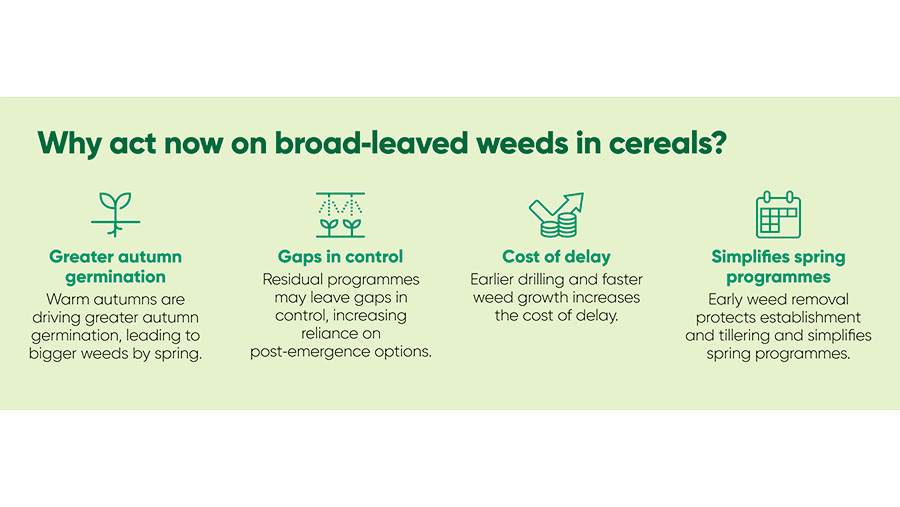
- Warmer autumns enable greater autumn germination, leading to larger weed biomass going into spring, which makes control harder and less reliable.
- High seed return from previous seasons and earlier drilling have extended the germination window, increasing pressure from overwintered weeds.
- Residual protection is not lasting as long, because warm, moist conditions speed up herbicide breakdown. Today’s residual options also have a narrower spectrum too, leaving gaps for difficult broad-leaved weeds to slip through.
- Changing cultivation practices, including reduced tillage and no till systems, are encouraging germination from shallower seed and favouring tap-rooted species.
The result is that in many fields, broad-leaved weeds are no longer just a spring tidy up issue – they are an autumn to spring yield robber.
The real costs growers face (beyond the price of the can)
When broad‑leaved weeds establish early and overwinter, the costs multiply:
- Yield potential is lost early
Early germinating weeds compete with cereals for light, nutrients, moisture and space during establishment and tillering – the very stages where yield potential is built. - Fertiliser efficiency is reduced
Well established weeds are perfectly placed to intercept applied nutrients in spring, meaning some of the fertiliser investment is supporting larger weeds as well as the crop. - Later weed control programmes become complex and riskier
Untreated, large, overwintered weeds often force growers towards higher rates and more complex tank mixes; all of which increase costs, reduce reliability and have the potential to cause crop damage.
As Hugh Guinan, Corteva Field Technical Manager for cereal herbicides, explains:
“Getting ahead of broad-leaved weeds in cereals early is essential to limit the impact of competition for resources and ultimately yield.
“There are also benefits to overall costs, as it is often cheaper to target smaller weeds with lower rates early in the season, compared with later applications on larger weeds that may require higher rates and deliver compromised control.
“Removing weeds early also simplifies later season tank mixes and product selection.”
Which weeds are driving the biggest hidden cost?
Increasingly, the most problematic broad-leaved weeds in cereals include those with a significant autumn or early spring germination period, such as mayweed, groundsel, poppy, cleavers, cranesbill, chickweed, fumitory, umbelliferous species, volunteer beans and volunteer oilseed rape.
If germinating over the winter these species are most likely to be large by spring, when control becomes more difficult and costly.
Groundsel
High seed return and a rapid lifecycle mean populations build quickly. Once plants move beyond the early rosette stages into stem extension and flowering, herbicide performance is significantly reduced, making delayed decisions expensive, both in season and for future weed pressure.
Poppies
With long lived seed and increasing herbicide resistance, poppy is a classic example of a weed where poor control in one season becomes a cost multiplier for many years to come.
Volunteer beans
Dense patches can smother cereals during establishment and tillering, shade other weed targets, complicate spray performance and act as a bridge for disease carryover – all adding hidden cost to crop management.
Managing the true cost with early post emergence control
In this shifting spring weed landscape, post emergence herbicides based on Arylex™ active, such as Zypar® and Spitfire®, offer a practical way to manage a broad spectrum of challenging broad-leaved weeds and avoid both the direct and indirect costs of late intervention.
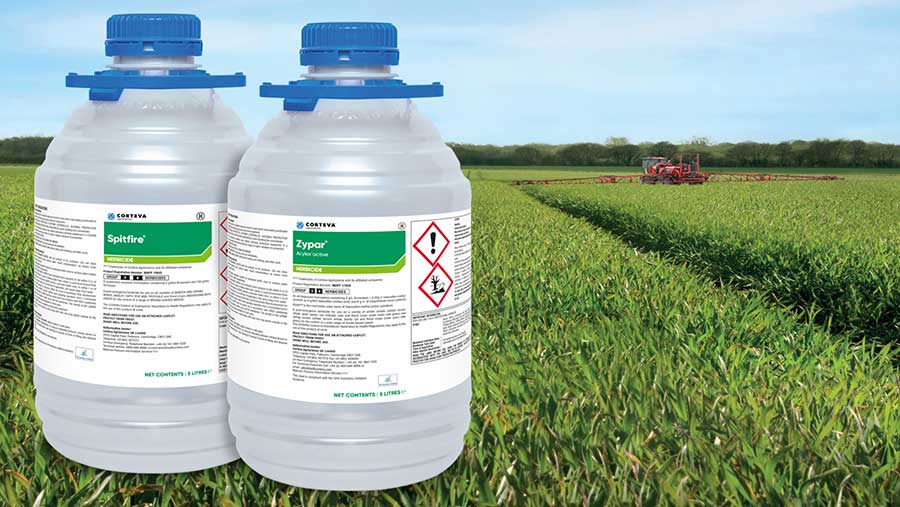
Corteva Spitfire® & Zypar® © Corteva Agriscience
These products are well suited to both late autumn and early spring timings, providing:
- Reliable control of a wide range of difficult broad‑leaved weeds
- Flexibility in timing and dose rate
- Consistent performance in cool or fluctuating conditions
- The opportunity to remove weeds early and simplify later programmes
By targeting weeds when they are small and actively growing, growers can protect yield potential, improve fertiliser efficiency and reduce reliance on heavier, corrective treatments later in the season.
© Corteva Agriscience
From discovery to field performance: Corteva’s commitment to grower focused innovation
Bringing new crop protection chemistry to market requires sustained investment and a deep understanding of how farming systems are evolving.
At Corteva Agriscience, innovation is built around significant, ongoing commitment to research and development, ensuring new actives such as Arylex™ are not only effective, but fit for today’s agricultural landscape.
From discovery and formulation through to regulatory approval and extensive field testing, Corteva’s R&D teams work to deliver solutions that perform under real-world conditions, support resistance management and align with changing agronomic practices.
This long-term investment gives growers confidence that new chemistry is backed by rigorous science, practical stewardship and the support of a leading global R&D organisation focused on protecting yield potential now and into the future.
Learn more about Corteva’s solutions for cereal growers, or contact your local Corteva area manager or our hotline team.
Sign up to receive Corteva technical emails for in‑season updates, plus the chance to win in our monthly prize draw at corteva.com/uk/signup
USE PLANT PROTECTION PRODUCTS SAFELY. Always read the label and product information before use. For further information including warning phrases and symbols refer to label.
Provided by
Corteva Agriscience™ is a world-leading crop protection and seeds business focused on delivering the solutions UK and Irish agriculture needs to succeed.
For more information see our website Corteva Agriscience