

Advertiser content
Preventative flock health management cuts antibiotic usage
In its environmental blueprint for Welsh livestock farming, Perfecting the Welsh Way, red meat body Hybu Cig Cymru lists optimising animal health as one of the simplest and most effective ways to get the best output from sheep and cattle while lowering greenhouse gas emissions.
Farmers Weekly visited one farmer whose business is gaining from that approach.
Preventative flock health management has cut antibiotic usage in Gwyn Johnson’s flock to an all-time low.
© Hybu Cig Cymru – Meat Promotion Wales
He has achieved this by shifting farm spend from treating sick animals to vaccinating and screening for diseases in combination with scrupulous hygiene at lambing, attention to detail, simple husbandry measures and culling persistently lame animals; lameness rates in the breeding flock are consistently below 3%.
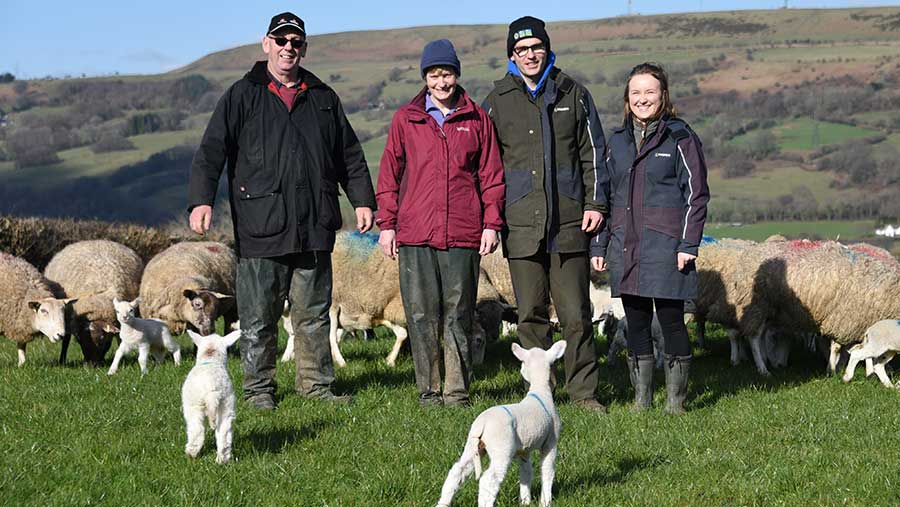
“We only treat a very small percentage of sheep with antibiotics in a year, ’’ says Mr Johnson, who runs a flock of 500 breeding ewes at Maes Bach Farm on the outskirts of Pontypridd with his father, Clive.
“We have always been low users of antibiotics, we have never used them as a firefighting tactic because we want them to work for us when we need them. It makes more sense to spend that money on vaccinating.’’
© Hybu Cig Cymru – Meat Promotion Wales
As a consequence, recent testing to establish the effectiveness of antibiotics found that two of the main products used are 99.9% effective.
The Johnsons are currently transitioning from a Suffolk x Glamorgan Welsh flock to a maternal self-replacing flock using New Zealand genetics.
That alone has increased scanning percentage from 150% to 180%, although with 150 yearlings in the flock it is 162% for the 2022 lambing season.
Over the last three years, since getting involved with HCC’s Stoc+ animal health planning project, the flock management strategy has been refined to prevent disease.
The project can provide support for diagnostic testing and two vet visits a year, helping to create a stronger relationship between Mr Johnson and his vet.
It means he can go a step further with diagnostics than he might otherwise – he is currently screening for Border disease.
Health planning is beneficial too, says Mr Johnson.
“Our vet, Tom Searle, knows our farm and what we want to achieve, we are now at the stage where we are only perfecting things, not making big changes.’’
This has been achieved by assessing antimicrobial resistance and wormer testing, and screening for iceberg diseases.
As a 2012 HCC Scholar, Mr Johnson studied anthelmintic resistance in New Zealand and has since adopted strategies that protect the effectiveness of drenches for when they are needed.
© Hybu Cig Cymru – Meat Promotion Wales
“As well as faecal egg counting and no routine drenching, any animal we buy is quarantined and treated for worms, liver fluke and scab and screened for Border disease,’’ he says.
Once animals are yearlings they receive no further wormer treatments – they must adapt and become resilient to worm challenges and dilute any resistant worm populations on pasture with susceptible worm species, he adds. This prolongs the lifespan of wormer chemical groups.
Ewes are vaccinated against clostridial diseases, footrot, enzootic abortion and toxoplasmosis.
Health planning is imperative, Mr Johnson believes, “For a farm to be successful at health planning, you need a farmer who realises the benefit of improving and an enthusiastic vet to signpost and guide. The partnership only works if both are keen and willing to make improvements and to keep progressing.’’
The flock lambs indoors from 1 March over four weeks, with all ewe lambs weighed at birth and given an EID tag. There is constant care available during lambing with Gwyn, father Clive, mother Janette and wife Rachel available.
The shed is kept clean and dry with regular disinfection and by using plenty of straw.
At eight weeks, any ewe lamb that fails to hit a minimum daily liveweight gain of 250g joins the fattening group.
“Some will be growing at more than 400g a day by then so if an animal isn’t achieving 250g we don’t want to retain her because that growth is directly correlated to the maternal ability of the ewe, we don’t want replacements with low maternal traits,’’ says Mr Johnson.
All ewe lamb replacements must be from a ewe at body condition score (BCS) 3 and above at scanning and lambing.
Lame ewe lambs and those with dags are sold too. “Those are the animals that take up most of your time and generally need treatments and antibiotics,’’ Mr Johnson observes.

© Hybu Cig Cymru – Meat Promotion Wales
All lamb production is from grass. Most lambs are sold from July to September and all by December, with the final few – if needed – sold as stores through Raglan or Sennybridge markets. The vast majority of lambs would be sold deadweight at an average of around 19kg.
In 2021 the flock recorded a lambs sold rate of 150%.
Footrot in ewes has been targeted by using the industry’s five-point plan, removing the persistent offenders and treating the one-off cases rapidly.
“Last year we removed an extra 20 ewes from the flock which increased our culling rate to 15% but that should fall now we have a young flock coming through,’’ says Mr Johnson.
He doesn’t cull on age – if ewes are at the correct BCS and have good teeth and udders they stay in the flock; it is not uncommon to have six or seven year olds still producing lambs.
Planning for lambing starts at turnout the previous year, through condition scoring and making high quality forage.
At scanning for 2022 lambing, 97.4% of ewes were at BCS 3 or above – ewes are condition scored at weaning, tupping, scanning and lambing.
Silage, produced from leys with a high percentage of white clover, analyses at an average of 14-15% crude protein and 11ME.
“We still have to make up the shortfall with concentrates but not to the extent that we would if we were making poorer ME silage,’’ Mr Johnson explains.
A sample of ewes from each group are metabolic profiled three weeks before lambing and the diet adjusted if needed.
Forage and grazing is shared with a small number of Charollais steers – bought as 6-10-month-old weaned calves and reared entirely outdoors until they are sold the following April.
Historical use of sewage pellets raised phosphorous (P) and potassium (K) levels and that means that only straight nitrogen (N) is applied, at 50kg/acre before lambing and 100kg/acre in split dressings for the rest of the season. Soil pH averages 6.2.
Liming the ground forms part of a long-term strategy to keep the farm productive with the soil tested regularly. In the last 15 years in excess of 800 tonnes of lime has been spread over the farm.
The business has its own plough and will continue to reseed silage fields with Italian ryegrass and clover with traditional cultivation but has recently invested in a grass seed direct drill to top up leys in permanent pasture and to prolong life of short term cutting leys and avoid disturbing the soil carbon sink. Any potential compaction is addressed with a sub soiler.
“We are well placed as grassland farmers as we can increase sequestration and maintain carbon sinks. Also by keeping the farm productive we can reduce inputs as well as improving animal health,’’ says Mr Johnson.
Animal health is very important, but it has to be part of a full rounded package including good grassland management and good nutrition.
Provided by
Hybu Cig Cymru is the red meat levy body for Wales and works on behalf of the red meat industry in Wales.