More farms to market overall, with regional variations
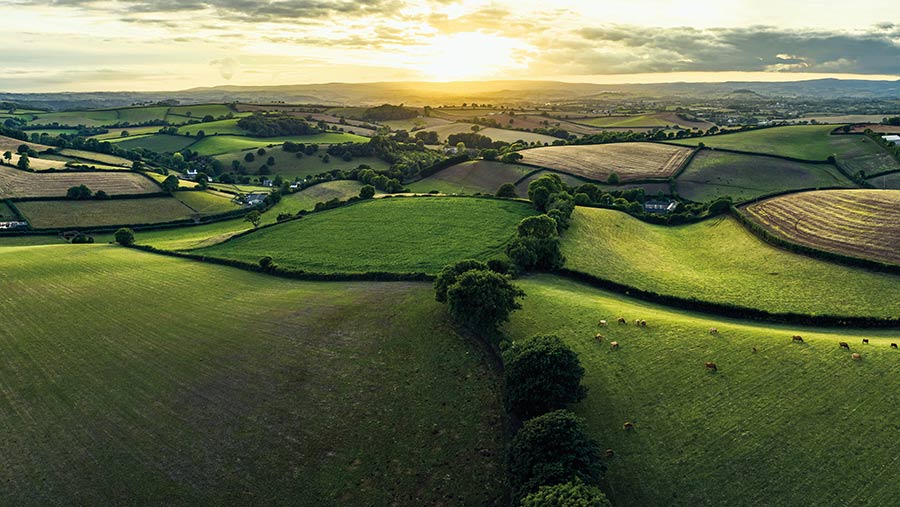 © Maciej Olszewski/ Adobe Stock
 Sales activity is picking up, with agents preparing for more farms and land to come on to the market next spring. However, it is a mixed picture across the UK.
Farmers Weekly’s Land Tracker shows that until mid-July, fewer acres were advertised for sale than in the same period in 2021.
It has, however, steadily gathered pace since then and by the end of October was up 18% on 2021, at 72,378 acres.
Carter Jonas has received instructions on sales valued at around £20m, and those could come on to the market as early as this month as a consequence of the government’s Autumn Statement.
Speaking to Farmers Weekly before the 17 November statement, Andrew Chandler, who heads up the firm’s rural agency, said if capital gains tax (CGT) was brought in line with income tax, as some anticipated, this would sharpen minds, with some of his clients keen to achieve a sale promptly.
See also: How overage agreements work in farmland sales
Some of these are off-market deals, he said. “We have a farm in central south-east England that is coming up for sale, and a nice offering in Hampshire – more of a country house and diversification opportunity.’’
The company also has bare land – small parcels and at scale – on its books for sale in the spring or earlier.
“We have a fair few bits of land in the North East, and the South West continues to go from strength to strength,’’ said Mr Chandler.
“Our Wales team is also handling the sale of two decent size blocks of land.’’
The reasons for the planned sales are multiple.
“Death, divorce, succession, the wrapping up of trusts, people with an eye on CGT and sector changes, they all have a part to play,’’ said Mr Chandler.
The increase in activity is not experienced in all regions though. Agencies operating in Sussex indicate little or no farmland being offered for sale going forward.
Russell Parkes, head of the rural agency at Batcheller Monkhouse, said demand was still by far outstripping supply in West Sussex and the adjoining counties.
“We can never really predict the future but unless there is a huge downturn in farm incomes and a big change in inheritance tax, that situation will continue,’’ he said.
Eastern England
It is a similar situation in Lincolnshire.
Charlie Bryant, a partner in Brown & Co, said there was more activity in Norfolk, Suffolk and Essex, with enquiries from landowners planning to sell, but that Lincolnshire remained relatively quiet.
The situation could change relatively quickly though. “It sometimes only takes one deal to happen in an area for a domino effect, as we saw in 2006,’’ said Mr Bryant.
“That situation continued until 2013, after which the market stabilised and waned somewhat, but once again we are seeing it moving forward in some regions.’’
Scotland
In Scotland, activity is “very, very slow’’, according to Bell Ingram, and that is backed up by applications to the Agricultural Mortgage Corporation (AMC), for which Bell Ingram is an agent.
“The number of deals for farms being purchased is very slow this year and continues to be,’’ said Malcolm Taylor, who specialises in farm and estate management at Bell Ingram.
He believes that uncertainty ahead of next year’s Supreme Court ruling on whether a second referendum on Scottish independence can go ahead is a factor at play.
“Political uncertainty is definitely making people sit tight,’’ said Mr Taylor.
He does have concerns of possible forced sales next year though, with at least one bank reviewing the serviceability of some loans.
“One of the banks has made it quite clear that borrowers in the agricultural sector need to get their borrowing into healthier shape and are checking there is enough value for the levels of security.’’
In regions where sales are picking up, vendors may have to dial down their expectations on price.
Mr Chandler said Carter Jonas had trimmed its anticipated percentage increase in values.
“While there is demand for land, we are not saying that prices are going to go up and up, sales have to be at the right price, the right offering, the right location,” he said.
“We are still seeing a stable market in the rural sector, but pinning a price and hoping to get it is no longer the case. We have had clients who have overpitched it slightly on what can be achieved.’’