Cattle markets move in opposite directions
 © Tim Scrivener
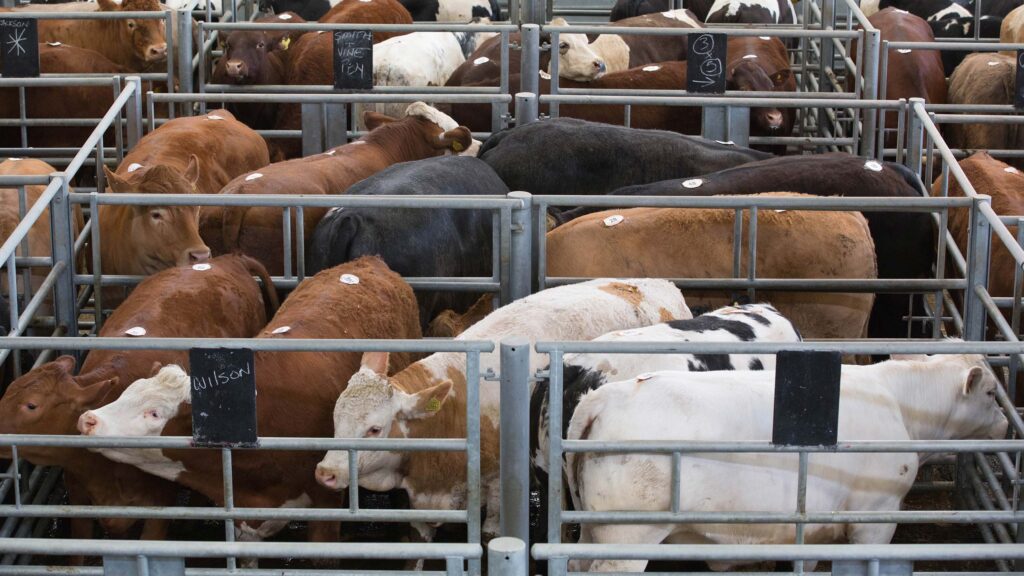
 Cattle markets moved in opposite directions across Northern Ireland and Great Britain this week, with prime cattle values easing slightly in NI while GB prices made gains.
In Northern Ireland, throughput has been recovering, according to the Livestock and Meat Commission (LMC).
In the week ending 8 August, 6,641 head were slaughtered, up from 5,767 the previous week.
Even so, supplies remain tight, with prime cattle throughput in 2026 to date 5.9% below the same period last year, and total throughput 6.9% – or 20,688 head – behind 2025 levels.
See also: Calf prices stay strong as buyers chase depleted numbers
However, LMC is optimistic demand will return towards year end.
“We will likely see more cattle coming to slaughter in the coming months as producers push to access the additional funding from the NI beef carbon reduction scheme [worth an additional £75/head if they slaughter cattle before the 27-month limit],” said Rachel Rainey, agricultural market analyst at LMC.
Prices fell across all grades and weight bands, with steers down 1.1p/kg to 604.9p/kg and heifers 4.4p/kg to 601.8p/kg.
Carcass weights were up, however, with prime weights 11.4kg (3.3%) heavier than the same week last year, partially offsetting the shortfall in numbers.
Total beef production stood at 4,210t, 4.2% below 2025.
“Consumer spending is lower at this time of year due to pressure on budgets; we expect this to change again in the coming months, which will improve demand and, therefore we hope, prices too.”
Meanwhile, the AHDB reported higher GB prices.
The prime cattle average rose 1p/kg to 608p/kg, although this remained 32p/kg below 2025 levels.
Steers and heifers both rose 1p/kg, to 610p/kg and 609p/kg, while young bulls increased 2p/kg to 600p/kg.
Prime cattle throughput also increased by 1,100 head to 32,200, above the five-year average of 30,900. Cull cow throughput rose from 9,300 to 9,900, pushing prices down 8p/kg to 482p/kg.
“It’s difficult to pinpoint specific drivers for this change, and we are likely to see more numbers from this point forward due to seasonal uplift,” said Hannah Clarke, lead analyst at the AHDB.
The prolonged dry spell has affected forage supplies, prompting some farmers to streamline herds earlier ahead of winter housing.
With dairy margins already stretched, producers are also acting sooner.
The dry weather has also affected Northern Ireland, albeit to a lesser extent, while improved consumer spending could support demand.
The markets may be moving in opposite directions for now, but that could prove short-lived.