How funding fears are holding back carbon market
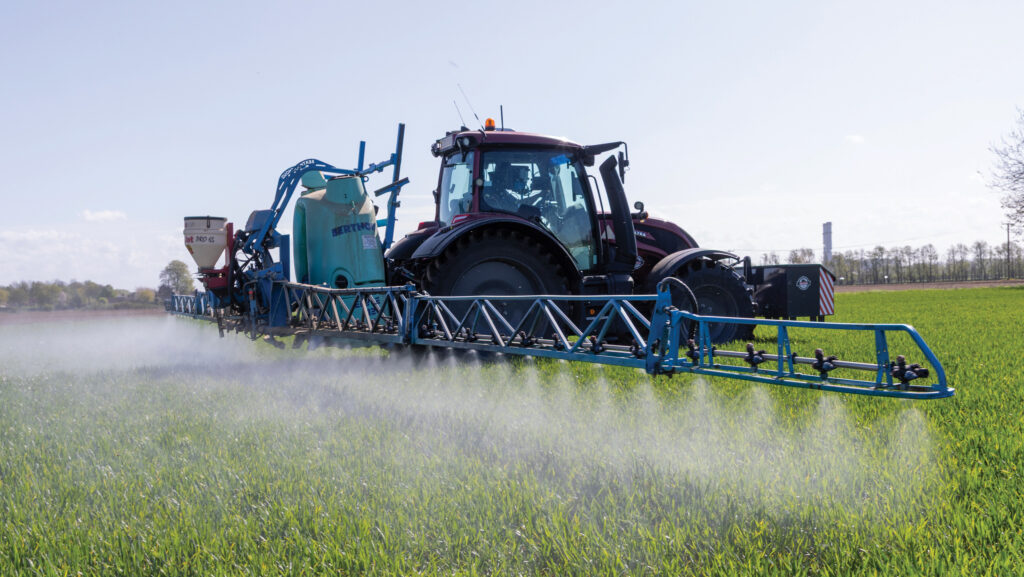 Spraying wheat at T1 © GNP
 Farmers should press on with tracking on-farm emissions data, even as hopes dwindle that sequestering carbon will become a significant income generator, experts have said.
Many of the biggest businesses linked to agriculture, including banks and retailers, remain committed to driving down on-farm emissions to meet their decarbonisation targets, a process known as insetting.
That will see them ramp up demands to further understand the emissions data of their suppliers, including farmers, in the years ahead, with those failing to participate potentially locked out of supply chains in future.
See also: Low-carbon fertiliser: What products are in the pipeline?
Tesco, the UK’s biggest retailer, has committed to reducing forestry, land and agricultural (Flag) emissions by 39% by 2032 compared to a baseline year of 2019.
In a report last year, it said it will achieve this through a blend of actions, including pressing the government for more clarity on sustainability standards and investigating new ways of working with farmers to provide financial security.
It will also conduct on-farm trials of low carbon fertilisers, alternative fuels, state-of-the-art cold storage, and carbon removal techniques.
Other major retailers have made similar Flag commitments, splitting out farm-linked emissions from other emissions to meet the demands of their own standards auditor, the Science Based Targets Initiative.
Major farming supply chain businesses, such as Nestlé and Arla, have also set Flag targets, even as criticism has mounted elsewhere in the sector that politics, short-term financial challenges and other factors are making progress difficult.
In the past 12 months, the NFU has made two out three of its climate change advisers redundant, citing sluggish policy development at a national and global levels as factors in this decision.
Backdrop: US-led turmoil in broader carbon market
Away from insetting, the more high-profile offsetting market has seen its share of challenges that have stifled investment in emissions reduction.
Microsoft accounts for 79% of the total metric tons of carbon contracted for removal globally and is spending as much as $10bn (£7.38bn) to achieve this.
The firm sent tremors through the carbon market this month when it was reported to be pausing further deals.
Emissions rise
The technology giant, which is seeing its emissions rise sharply as it builds power-hungry data centres, later told Bloomberg that it is continuing “to both build on and support our existing portfolio of both nature-based and technology-based solutions”.
Political pain
The political backdrop has also been challenging.
On the start of his second term in January 2025, president Donald Trump took the US out of a slew of global climate change organisations that the White House said would “end American taxpayer funding and involvement in entities that advance globalist agendas over US priorities”.
A year later, the US energy department terminated contracts worth $3.7bn (£2.73bn), including many linked to carbon capture and storage projects.
This hostile stance led to the EU watering down its own rulebook on environmental, social and governance reporting, after the US linked concessions in this area to progress on a US-EU trade deal.
However, the EU Commission is still consulting on separate rules that will underpin how farmers in the bloc can contribute to carbon removal through changes in soil management, alongside other non-farming industrial methods.
A formal UK government response to a recent consultation on voluntary carbon and nature markets is also expected this summer.
Liz Bowles, chief executive of the advice firm Farm Carbon Toolkit, says while the backlash against measures to combat climate change led by US president Donald Trump has led some businesses to deprioritise the issue, plenty remain committed.
“The Trump effect has led to some businesses deciding they don’t really want to be bothered as they can see the focus is less than it used to be.
“But there are plenty of food supply chain businesses that realise 2030 is not far away.
“So they are really ramping up on demonstrating their farms are reducing greenhouse gases or removing carbon into soils,” says Liz.
Beginning baselining
Yet getting started with baselining – the audit of carbon the land currently stores and the business emits – is not straightforward, with differing methodologies adopted by the different calculators, and high costs for soil testing.
The costs vary enormously, says Liz, depending on the number of samples per field and the sampling depth.
Total cost per farm can also vary depending on the scheme, with some requiring every field in the business to be sampled, while others will accept a representative sample of land.
However, each year that goes by without baselining may diminish the potential income a farm business can benefit from as they will not be able to take credit for activities that reduce emissions prior to the baselining being conducted.
Government support
The extent to which UK governments are stepping in to fill this gap varies considerably.
Northern Ireland is leading the way with a scheme to soil sample every active agricultural field.
Scotland will require all farms do carbon auditing and soil sampling by 2028 at the latest as part of its Whole Farm Plan.
Wales will require all farms in its Sustainable Farming Scheme to test a fifth of their area a year, including for soil organic matter, which is an indirect measure of soil carbon.
In England, however, options within the Sustainable Farming Incentive that would have funded farmers doing this work have been scrapped from the 2026 version of the scheme – set to open next month – as Defra says they represented poor value for money.
This drew criticism from lobby groups such as the Sustainable Soils Alliance, which noted that though soil monitoring is central to Defra’s own strategy, the updated offer no longer supports the activities required to evidence improvement.
Costs aplenty
Slowing down the accumulation of data that proves farmers are meeting climate goals will be a problem for government in demonstrating it has met its own targets.
The private sector is leery of paying for reductions without ironclad proof they are taking place but starting this year, the UK Sustainability Disclosure Standards will make Scope 3 reporting compulsory for large businesses.
These are the indirect emissions in an organisation’s supply chain through its purchases and sales (other than from the purchase and use of electricity, steam, heating and cooling).
“It gets very expensive [for businesses] when they look at their Scope 3 [emissions target] number and think about… how to drop it – even for a company like Tesco,” says Soil Association Exchange (SAX) chief executive Joseph Gridley.
However, the firm says costs of changing on-farm behaviour can be shared.
Rules permit any emission reduction generated by a farmer within a supply chain to be claimed in its entirety by each company sitting between the farmer and the consumer.
This means each business can account for the entire reduction relating to their Scope 3 target, while only paying a share of the cost that is returned to the farmer for making the changes necessary to deliver that reduction.
Pooled insetting
The company’s Exchange Marketplace, which has amassed £1.2m from large corporates to deliver this pooled insetting, pays out £60/t of emissions reduced, for actions such as fertiliser or fuel reduction.
Therefore, if a bank, retailer and processor are all linked to a participating farmer, they are each only paying £20/t of reduction.
SAX says this is leading to a typical farmer getting £3,000-£4,000 for a one-year agreement, with some getting more than £10,000.
Working together was the sentiment at a recent EU carbon farming summit, says Liz, with even large multinational companies mooting the idea of buyers’ clubs to increase their confidence in the credits they are investing in.
Ultimately, some farmers may also end up having to deliver some of this without earning a premium, says Joseph.
“It may just become increasingly incumbent on a farmer to not be producing, say, high emissions milk,” he says.
“And you can definitely see that in some of the conversations we have with businesses.”