

What the biomethane revolution could mean for UK farms
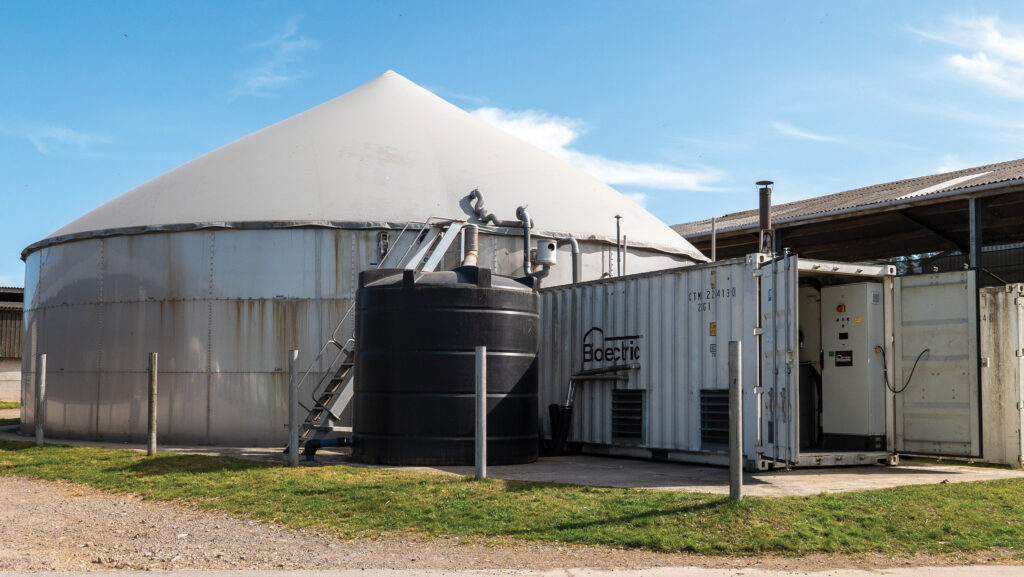 Biolectric combined heat and power unit © Biolectric
 The UK produces about 7TWh (terawatt-hours) of energy from slurry, food waste, manure and crops, each year meeting just 1% of gas demand.
However, the potential biomethane demand and output levels dwarf that figure.
The National Energy System Operator has recommended to the government that UK supplied biomethane should increase to 36TWh by 2035 and 65TWh by 2050.
See also: How arable farms are adapting as public funding disappears
It sees biomethane as essential to achieving an affordable energy transition to low carbon sources.
But a report by bioeconomy consultancy Alder Bioinsights suggests output could potentially reach 120TWh of biomethane produced by 2050 – enough to heat almost half of the UK’s homes.
The UK’s largest gas distribution network operator, Cadent, has confirmed it aims to decarbonise gas in its pipelines by reducing its use of fossil fuels and switching to biomethane.
The company supplies 11m homes and 40,000 businesses and says the switch is good news for UK agriculture, which is expected to supply the majority of feedstocks.
Over the past year the biomethane sector has experienced an unprecedented level of government interest, according to Cadent.
The government is now actively preparing a long-term policy support package for the biomethane sector to meet the country’s decarbonisation targets and support British farmers.
Cadent chief strategy and regulation officer Dr Tony Ballance says: “What we have here is a situation where the stars are aligning for the farming sector – the UK right now being hungry for home-grown, renewable energy, and a farming sector that has all the ingredients to make it happen.
“Whether that is growing crops to feed the anaerobic digesters, or having a biomethane production facility on your land, biomethane is an incredible opportunity.
“It means farmers can develop new income streams, continue to grow food and improve soil health, and help deliver a more cost-effective way of decarbonising the UK’s energy needs.”
Later this year, Cadent will begin offering a new cost structure for biomethane in a bid to make injecting the gas into its network more accessible to small-scale producers.
The company hopes this will accelerate growth in the biomethane sector and should mean new opportunities for farmers to grow feedstocks will increase rapidly in the coming months and years.
Buyers are already keen to build long-term relationships with farmers and set up multi-year offtake contracts, to lock in their input materials in a competitive market.
In the past 12 months, large businesses – such as pharmaceutical company Astrazeneca, and food and drink giant PepsiCo – have decarbonised their UK gas demand by signing contracts with biomethane producers Future Biogas and Engie.
The general gas network is also ready to accommodate biomethane at scale.
Cadent says it wants to work with farmers and developers to ease the process to connect into the network, as well as make it more affordable.
For example, where there is opportunity to “cluster” new farm sites, it wants to consider the options for connection costs to be shared.
“There is an immediate opportunity here for farmers to increase their income streams while continuing to use the land for growing food and crops,” says Tony.
“We want to make it very clear that we are interested in working with all potential developers, no matter the size of the operation,” he says.
So what are the benefits, opportunities and systems available to reduce emissions from biomethane production on farms?
Biomethane benefits
Cost-effective decarbonisation
The Green Gas Taskforce report produced by business consultant Baringa showed that biomethane from sustainable feedstocks – especially when delivered through large-scale anaerobic digestion (AD) plants – could cut the cost of reaching net zero by £150bn-£220bn.
This would make it one of the most cost-effective climate solutions in the UK’s net-zero pathway.
Seamless supply change
One reason for the lower cost is due to biomethane’s chemical structure, which is identical to natural gas.
That means there is no need for costly changes to the existing supply chain systems and domestic equipment.
Energy supply
A downside of solar and wind power is that they are both weather dependent and supplies fluctuate.
Because AD plants run 24 hours a day, the energy supply is constant, providing known amounts of fuel to networks and farm equipment.
Environmental
The potential environmental benefits are enormous – models calculated by the Anaerobic Digesters and Bioresources Association suggest 27m tonnes of carbon dioxide could be removed from the atmosphere each year.
Individual farms can reduce their carbon footprint by 30%. This is achieved through the capture of fugitive methane and carbon removal during the AD process.
Carbon removal occurs when biogas is captured from feedstocks and split it into carbon dioxide and methane, creating refined biomethane.
Because methane is roughly 80 times more potent as a greenhouse gas than carbon dioxide, over the first 20-year period, removing it from slurry before it reaches the atmosphere is key in reducing farming’s carbon footprint.
Valuable by-products
The by-products of biomethane production can also help to cut emissions and offer cost-
effective alternatives to artificial fertiliser and livestock bedding.
Digestate from the AD plant is nutrient rich and the nitrogen content is in a form that is readily taken up by crops.
Using digestate decreases the quantity of fertiliser needed by up to two-thirds. It also reduces the reliance on inorganic fertilisers.
That is crucial in farm carbon footprint calculations because inorganic fertiliser production consumes large amounts of energy, usually in the form of fossil fuels.
Another beneficial by-product is green bedding. The solid material left over from the AD process can be dried, pasteurised to kill off bugs, and converted into bedding.
Carbon dioxide production
When biogas is “upgraded”, the biomethane and carbon dioxide are separated.
While the biomethane gas is used for energy generation, the carbon dioxide fraction can be filtered to food-grade quality, which can be harvested for products like carbonated drinks.
Biomethane systems available
There is a wide range of systems suitable for farm production.
The range covers slurry- , waste- and crop-fed digesters that create heat and electrical energy, along with alternative setups that capture fugitive methane from feedstocks and convert it to fuel to run machinery.
On-farm digesters can provide power for the home and business or – where the infrastructure is available – supply national gas networks.
Farms may also operate as feedstock providers for off-site, large-scale AD plants that then feed biomethane into national gas networks.
Feedstock supply
One route is to supply feedstocks to a separate large-scale digester business such as Future Biogas. It operates 11 plants around the UK, including Lincolnshire, East Anglia and Yorkshire.
Feedstock director Angela Battle explains that the company has large-scale digesters fed on maize, rye, barley and other agricultural feedstocks.
The sites are supplied by a network of about 400 farmers, with each site sourcing feedstock from growers within a 15-mile radius.
The aim is to keep transport use down, to minimise costs and limit the carbon footprint of the whole production process, says Angela.
How it works
Future Biogas plants produce biogas and separate the biomethane from the carbon dioxide, she explains. The biomethane is then fed into the gas network as a direct replacement for natural gas.
The carbon dioxide is currently used for industrial use such as putting bubbles in fizzy drinks, but the company are exploring permanent geological storage, which has the potential to make the entire gas production process carbon negative.
Future Biogas returns the digestate produced to the growers who supply the feedstocks.
This meets the key aim of decarbonising the farming sector by providing low-carbon,
nutrient-rich biofertiliser that improves crop yield and soil health.
The new economic model is based on long-term profitability without government subsidies, says Angela.
For example, Future Biogas’s site at Gonerby Moor provides more than 100 gigawatt-hours of renewable gas annually, which is load balanced through the grid to provide the gas needs of Astrazeneca’s
manufacturing operations.
On-farm AD and CHP unit
On-farm AD plants operated in tandem with a combined heat and power (CHP) unit are usually relatively small-scale units of 11-75kW, designed to run on slurry, manure and food waste.
The range in power outputs makes the system suitable for a wide range in cattle herd sizes – for example, 11kW is suitable for herds as small as 50 milking cows.
Efficiency rates can reach 98% and, unlike wind and solar power, the energy is produced whether it is calm or windy, wet or dry, night and day, says Biolectric’s UK operations director Gary Hague.
How it works
Biolectric’s AD plant and system is modular with installation typically taking about four days. Operation and energy production can begin immediately, explains Gary.
The first step is the slurry intake, which is pumped from the farm’s reception pit into a heated, insulated digester tank.
“The fresher the slurry, the better – to capture as much methane as possible to conserve its energy potential and with the least loss to the environment,” he says.
Inside the digester, temperatures are kept at about 42C. This supports methane-producing bacteria to break down the organic matter into biogas, which is approximately 60% methane and 40% carbon dioxide, says Gary.
Cooled and filtered biogas, then passes into a combustion engine connected to a generator to produce electrical energy.
The generator supplies farm equipment such as robot milkers, lighting and ventilation, while heat produced by the digestion process can be used to heat water, dry crops or heat buildings.
Processed slurry or digestate is pumped into storage and separated into liquid and solid fractions which are important by-products.
The liquid fraction can be used as a nutrient-rich fertiliser that can reduce a farm’s carbon footprint and cut fertiliser bills.
The solid digestate can be dried to create bedding, potentially saving thousands of pounds in bought-in straw, sand or shavings, Gary points out.
The most cost-efficient way to manage a system is to use the power on the farm substituting it for bought-in energy.
But the setup offers the opportunity to operate a hybrid model selling any surplus gas to the grid.
Combined with savings and output, payback times are remarkably short.
Setup costs start at £180,000, rising to £480,000 for the larger systems, however, payback times range from seven years down to as few as three years for a larger-scale system.
Bottled gas production
The Bennamann methane capture system creates automotive grade biomethane. It is ideal as a power source for vehicles and heating on remote, small-to-medium farms.
How it works
The first step in the process is slurry collection from livestock housing, which is pumped into a reception tank. Slurry is then macerated on its way to a storage tank to prevent a crust from forming and to promote the release of biogases.
Bennamann director of public affairs Gilles Mayer says: “A cover that is designed to capture fugitive methane directly from the storage tank has been used previously, but this is undergoing a redesign so is not currently commercially available.”
For now, the system relies on a slurry-fed AD plant to create biomethane. The captured raw gas can be piped through primary and secondary gas filtration systems to draw off hydrogen sulphide and moisture.
Further upgrading takes place when the feedstock passes through a BioCycle unit – a processing unit that is available as a static or mobile unit.
The unit upgrades the methane to a purity of 93-97%. A single BioCycle unit is capable of producing 180,000kg of bottled biomethane a year, says Gilles.
For on-farm use, products can be stored in tanks via pressurisation at 250 bar to create compressed natural gas or by subjecting the gas to extremely low temperatures to create liquefied natural gas (LNG).
Cooling the biomethane to -162C and turning it into LNG reduces the volume to 1/600th of the gas state.
The biomethane produced is a high-grade, clean-burning fuel that is available for a variety of uses, explains Gilles.
Outlay for the system varies widely according to the type of storage and upgrader systems chosen, but payback time can be as little as two to three years.
Bottled biomethane uses
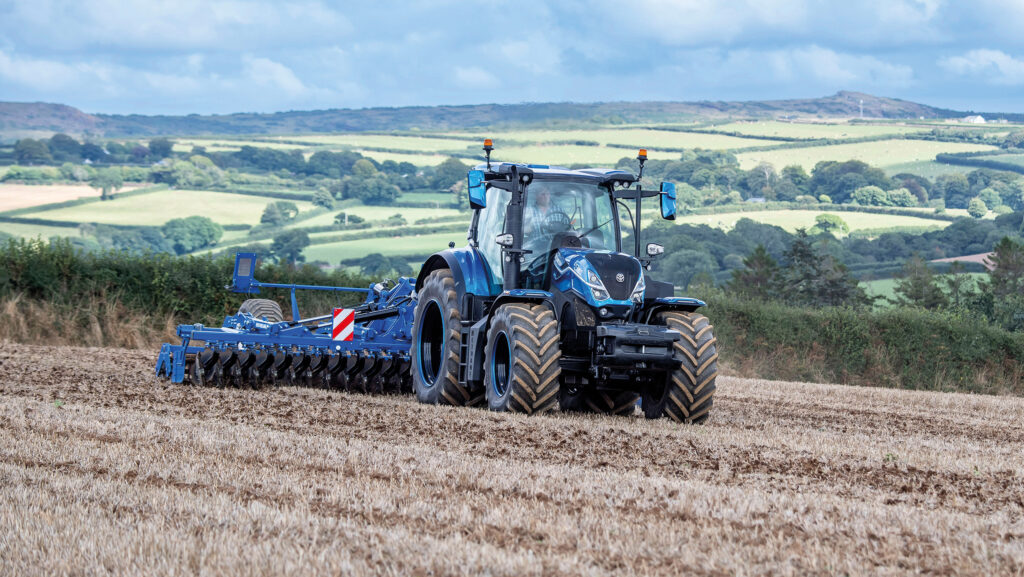
Gas bottled using the Bennamann system can power converted T6 and T7 Case New Holland tractors © New Holland
Biomethane produced by the Bennamann system is used for the following:
- Tractor fuel for the converted Case New Holland 180hp T6 and the 270hp T7
- On-farm energy via the bottled gas for heating or electricity generation through
a combined heat and power unit - Off-grid power and charging through electric vehicle (EV) generators
- Grid injection – any surplus biomethane can be blended into the national
natural gas grid where connections are available
Transition Farmer: Eddie Andrew, Cliffe House Farm, Sheffield
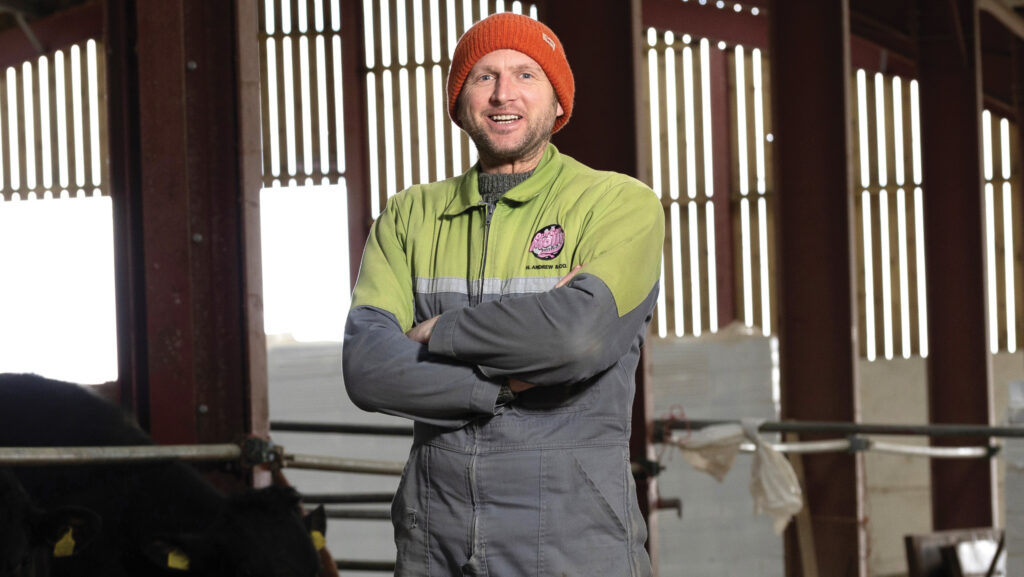
Eddie Andrews © Nathan Stirk
Transition Farmer Eddie Andrew has long been a champion of low-carbon energy and he aims to be fossil-fuel free at Cliffe House Farm in the next five years.
Eddie is strongly in favour of slurry-fed anaerobic digestion (AD) plants and will have a Biolectric system installed this autumn.
Slurry-fed systems have an unlimited, cost-effective supply of low-carbon fuel without having to give up land for food production, says Eddie.
“This helps to protect our business and the country from volatile global fuel prices. It also reduces emissions in both the farming and energy sectors,” he adds.
Because biomethane is a cost-effective energy source, it could also contribute to lower food prices for the long-term.
At Cliffe House Farm, the foundation pad is ready for the 37kW Biolectric system to be installed in September.
“We designed our new building with underground storage that will allow fresh slurry to be scraped into a reception pit and pumped automatically into the AD plant,” Eddie explains.
“The closed system means we will prevent emissions and gain sufficient, constant electrical power to run three robot milkers and cooling plants for the milk.”
The major difficulty with the investment has been affording the £250,000 cost after additional costs incurred during construction of the cow shed swallowed up the budget.
To continue with the project, the farm turned to its dairy-product customer base and the local community to set up a power purchase agreement.
Funds raised by the community will buy the equipment and will then effectively become Cliffe Farm’s power supplier.
“It means we have an energy supplier that we can work closely with, and the community setup will offer us a known price for the energy we consume,” says Eddie.
As well as the electricity production, the farm will produce biomethane for a hydrogen electrolyser to sell bottled gas to Sheffield Council’s bus fleet.
However, an alternative option being considered is to produce biomethane for the national gas network due to the farm’s close proximity to Sheffield.
Whichever the outlet, Eddie is committed to creating green energy from the farm’s slurry.
“Biomethane production is the golden goose that nobody seems to be aware of. We need to stop looking at our slurry storage as waste stores, and start to see them as fuel tanks,” he stresses.
Case study: Feedstock supply
Tom Hawthorne, Flawborough Farms, Nottinghamshire

Farm owner Tom Hawthorne says Flawborough is using its land as a natural asset to work with the private sector.
The farm extends to 300ha, but a key part of the Flawborough Farms’ business is contract farming for 13 other holdings and estates, taking the overall farmed area to about 3,200ha.
“Our mainstay is still winter wheat, which takes up half the farmed area,” says Tom.
About 25% of the rotation is under maize, or whole-crop barley and rye, to produce feedstocks for the Future Biogas contracts. The remainder is down to oilseed rape, beans, spring barley and oats as break crops.
“I don’t have a problem with using the land for non-food crops. Above all, our aim is to be sustainable and that means being financially sound,” says Tom.
Using the land to grow non-food crops is part of Flawborough Farm’s history.
“We are the third generation here. My grandfather used a quarter of the farm to grow crops as feed that fuelled the horses, and my father grew industrial oilseed rape. So non-food crops are not a new thing here,” Tom reflects.
“We are simply using our assets to link up with the private sector and make an income that is free from any government support.”
Contracts with Future Biogas
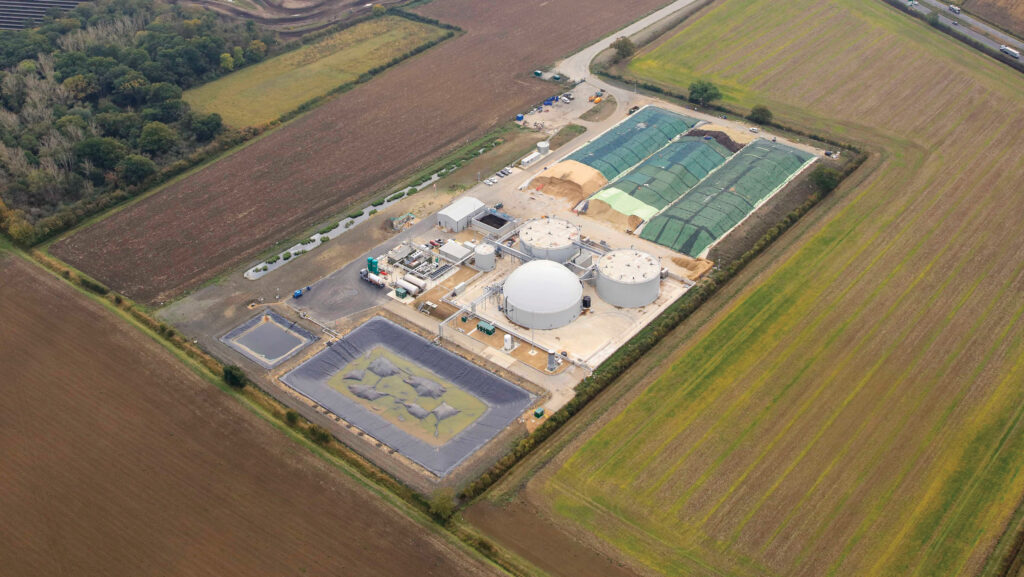
Future Biogas © Jonathan Perugia/Gaia Visua
Agreements are up to 15 years long and based on a cost of production plus margin model. Costs of growing the crop are calculated with figures on fertiliser, seed, agchems and operational inputs totalled up per tonne.
Once the costs are known, Future Biogas adds on a margin figure for an average yield. Payments are made in December, about six weeks after harvest, and there are no rejections, quality queries or storage issues.
“It means we are paid a fair price that isn’t subject to the usual volatility in wheat prices, and that really helps because know exactly what will get in terms of margin,” says Tom.
An additional payment is made if the crop is grown using sustainable techniques such as low tillage and no artificial fertilisers.
This is achievable because the digestate resulting from the AD plant processing is delivered back to Flawborough and applied to the growing crop farm free of charge.
For each tonne of crop, Future Biogas returns 500kg of liquid and 200kg of solid digestate.
Digestate contains nitrogen, phosphorus and potassium, as well as high-value micronutrients that are not present in inorganic fertiliser.
“The whole setup is circular, and because we can cut down on our artificial fertiliser use, it reduces our carbon footprint too,” says Tom.
Explore more / Transition
Follow the experiences of our 16 Transition Farmers and access in-depth supplements, expert webinars, live events and practical content covering the challenges and opportunities facing farm businesses.
Transition is an independent editorial initiative supported by our UK-wide network of partners.
Explore the Transition hub for the latest insights, resources and events.
