

Badenoch signals more nature-focused Tory farm policy
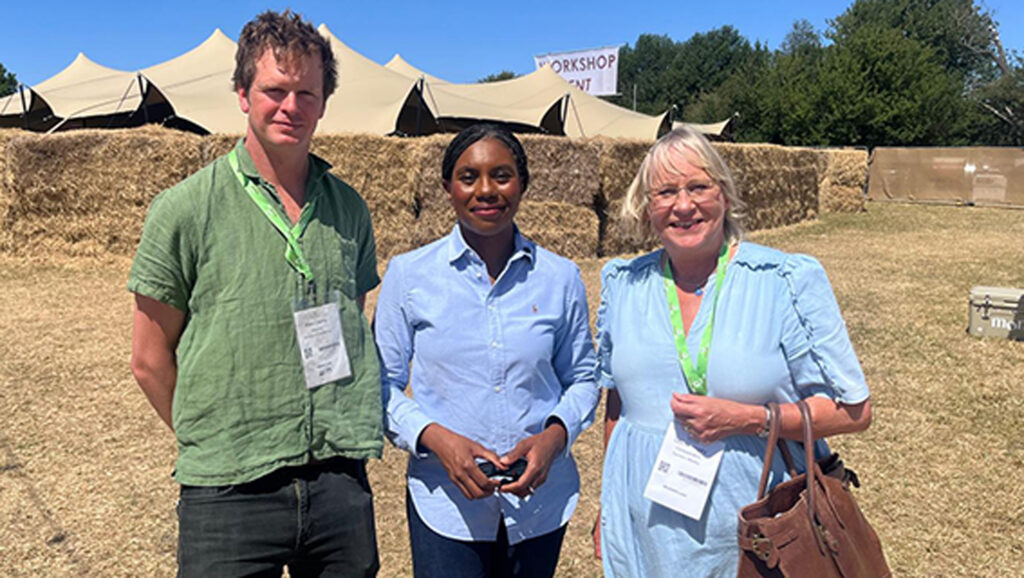 Groundswell event director Alex Cherry, Conservative Party leader Kemi Badenoch and Farmers Weekly Podcast co-host Louise Impey © Louise Impey
 Conservative Party leader Kemi Badenoch has signalled a more nature-focused approach to farming policy after making her first visit to Groundswell, saying future environmental measures should be shaped by farmers rather than officials in Whitehall.
Speaking to Farmers Weekly Podcast co-host Louise Impey at the regenerative farming festival in Hertfordshire on 2 July, Ms Badenoch said farmers should play a much bigger role in developing policy.
Despite the Conservatives’ decision to abandon the party’s commitment to achieving net zero in the UK by 2050, arguing the deadline was unrealistic, she insisted the party remained committed to nature-focused policies.
See also: Farmers Weekly Podcast Ep 310: Farming Roadmap and flaming June
“What I want to see is us using nature, biodiversity, using the experience and understanding of the people who actually work the land – farmers – to develop policy, rather than developing policy in Westminster, in Whitehall, often done by people who don’t actually have experience of the land in the first place,” she said.
“So yes, we do want to see more nature-focused policy within our environmental and rural affairs portfolio.”
Ms Badenoch described her visit to Groundswell as a “learning experience”, spending much of the day touring the site with event director Alex Cherry.
Stability first
While praising regenerative farming, Ms Badenoch said the industry’s biggest priority was policy stability after years of changing government schemes.
“What farmers really need at the moment is stability. We’ve had an awful lot of chop and change, stop and start.”
She stopped short of committing a future Conservative government to retaining existing farm support schemes, saying policy should be developed from “first principles” while recognising the need for certainty.
Ms Badenoch also acknowledged that some post-Brexit agricultural policies introduced by previous Conservative governments had proved unpopular.
“There were many things which we did in government that were a response to Brexit. But people did not necessarily like the way the schemes were handled.”
She said the Conservatives were still developing their future agricultural policy and invited farmers to help shape it.
“We’re not pretending that we know everything, and I’m not here to say that everything we did before was perfect.”
Five-point plan
Ms Badenoch linked farming to the Conservatives’ wider economic agenda, highlighting lower energy costs, lower taxes, less regulation, support for business and improving employment opportunities for young people.
“We spend a lot of time devising schemes, starting things, stopping them. Actually, perhaps if we didn’t create problems for farmers in the first place, we wouldn’t need all these schemes.”
She reiterated the party’s pledge to reverse the government’s inheritance tax reforms affecting family farms and questioned whether Labour would stick to its recently published 25-year Farming Roadmap.
“Farmers are tired of being sent one way and then told that they have to go another,” she said.