

Advice on growing successful maize crops after a wet winter
 © Tim Scrivener
 Challenging wet weather, waterlogged soils and flooded sites mean growers must be flexible and develop a farm-specific strategy to get maize seed in the ground this year.
Conditions are not going to dry up suddenly, particularly with no dry spell forecast well into March, says KWS product manager Andrew Cook.
See also: Benefits of following maize with Westerwolds ryegrass
His advice is not to rush to get maize in, pointing out that premature drilling results in poor germination, uneven emergence and reduced nutrient uptake.
Instead, he recommends being patient and developing a resilient plan that works year on year.
“Wait till soils are right; get the seed-bed in best order – and it will deliver an even crop that will reach the desired yield and harvest quality,” he says.
Catch crops sown after maize
Andrew has seen a “huge” variation in ground conditions across the country, from bare soils to those waterlogged or still under water, in addition to healthy catch crops sown after last autumn’s early maize harvests.
These crops have grown well over winter, capturing unused nutrients.
“Their root structure and green mass have increased water infiltration, and they will continue to suck water out of the soil once it warms up,” he adds.
It may be tempting to silage these crops, but as they are very wet, he advises not trying for big yields.
“Take them at a lower dry matter yield for early maize entry, to get an early maize harvest to protect soils,” he says. Where practical, some farms could get a quick grazing instead.
Field inspection prior to drilling
From mid-March, Andrew says it is important to begin walking fields earmarked for maize to assess conditions, then plan appropriately.
This includes keeping contractors informed about the state of the land and potential drilling dates.
If it turns out to be a compressed maize growing and harvesting season, they need to have the ability to plan their logistics, he explains.
Field inspection should include digging some holes in flooded and waterlogged areas to check for compaction.
Whole fields, or patches within a field, may need subsoiling to get the fine tilth and well-aerated soils required for a good seed-bed.
Without corrective work, the risk is an oxygen-deficient seed-bed leading to poor root formation or premature crop senescence.
“Dig a hole to check before burning diesel. Soils need to be in the right condition, so be flexible with cultivations field to field, and within fields.
“Progressive farmers who have taken a min-till approach may need to plough very wet soils this year to aid drying,” he advises.
Optimum soil temperature
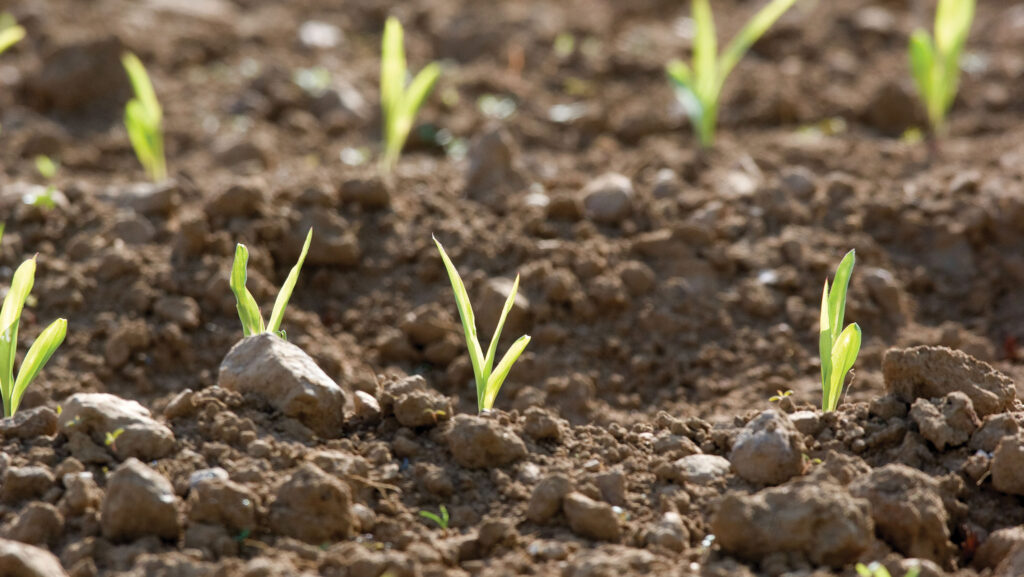
Lower seed rates help in plant stress situations © Tim Scrivener
Wet conditions are also likely to delay the rise in soil temperature critical for maize germination.
Lighter soils need to be at least 8C and rising for a continuous period of three to four days; heavy soils (more easily waterlogged and remaining cold for longer) should reach 12C and be rising.
“Look at your weather forecast and delay drilling if more wet and cold conditions are due,” says Andrew.
If wet weather pushes back sowing date by up to three weeks, he advises easing back on seed rates by between 5,000 and 10,000 seeds/ha.
As the plant will be under stress, a lower seed rate will help increase light interception, he explains, and give the plant more opportunity to “get going”.
Capturing more light eventually produces a higher cob-to-stover ratio and brings harvest forward 10 days.
Herbicide use in catchy weather
Although Andrew recommends pre- and post-emergence herbicides as standard, he thinks their advantages could certainly be realised this year if spraying windows are narrowed by poor weather.
Weed impact on early growth is not always visible, he says, though consequences on yield will be seen later in fewer trailer loads coming off the field.
A relatively cheap pre-emergence spray knocks back the weed burden (depending on soil moisture), thereby helping the post-emergence one to be effective, when the spraying window lacks suitable days.
Sowing depth
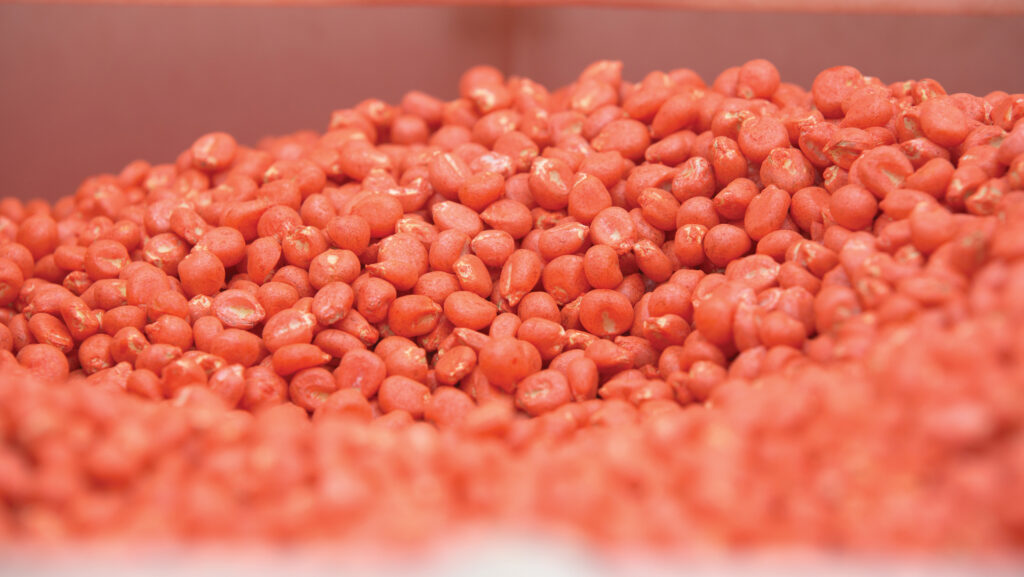
Alter sowing depth of maize seed according to date © Tim Scrivener
Late sowing not only risks a delay in harvest and more chance of lodging – plants will also fail to capture the same amount of heat units, says Andrew.
Maize is the latest spring-sown crop that can be drilled but, by early June, the risk is that seed-beds begin to dry out.
However, a flexible approach to drilling depth, whereby seed is placed close to moisture, depending on date, site, soil type and season, should mitigate problems (contractors need to be on board with this).
“Sowing depth is really important later in the season – we advise drilling seed so that it warms up quicker, crops emerge sooner and it won’t compromise harvest date.
For crops drilled in early to mid-April, sow at 3-5cm; from early to mid-May, sow at 5-7cm; and from mid-May onwards use 7-9cm,” he says.
“Buttress roots also get extra anchors in the soil, which gives them greater lodging resistance and storm protection, and if harvest is delayed by wet weather.”
Maize strategy
Maize should fit into a farm’s system rather than just be seen as a “mega-yielding crop”, says KWS product manager Andrew Cook.
Rather than being tempted to purchase later-maturing varieties in a bid to boost yield, he says a September harvest should be the target for everyone, regardless of farm location.
If conditions dictate, growers may have to roll into early October, he says, but they should still do everything they can to protect soils.
“There is still an opportunity to establish a crop after maize to reduce bare soil over winter,” he says.
Choice of variety
“Choose a variety that is right for your farm in a testing year. We are getting polarised weather patterns, but they are not consistent.
“Plan for a resilient harvest in good time, and go for earlier maturing varieties for your farm. You need a timely harvest, good dry matter yields and high starch content to get animal performance.”
His advice in a situation of ever-changing weather patterns works because maize breeding programmes have significantly increased yields compared with 20 years ago, he says.
“Ultra-early and early varieties yield an extra 3-4t dry matter/ha while maintaining starch content. So, there is more advantage in that they deliver economic yields with harvest security,” he says.