

Advice on supplementing dry cow minerals without a wagon
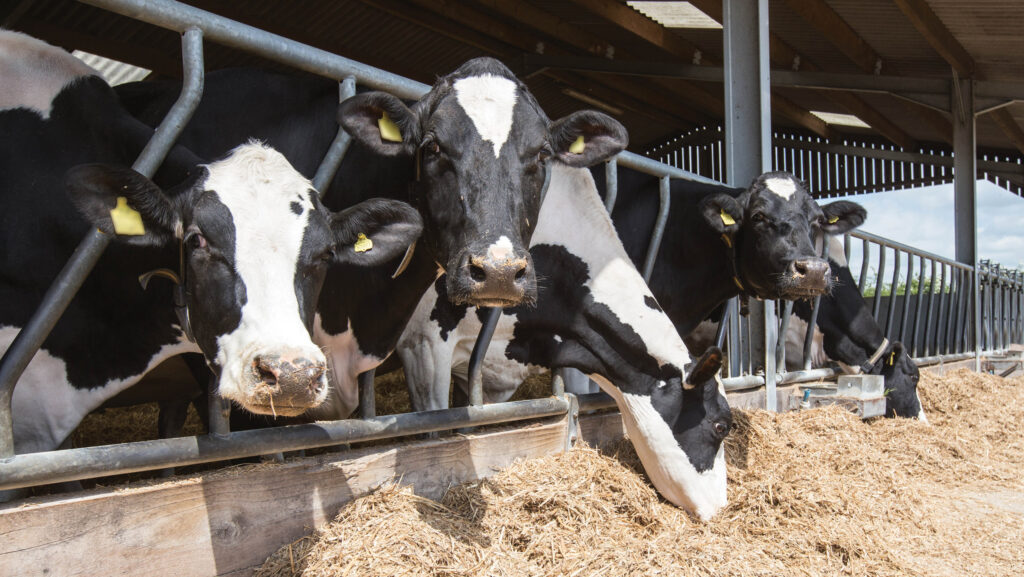 © Tim Scrivener
 Providing cows with magnesium, selenium, iodine and other minerals is vital in the dry period.
Yet it can be a stage in the production cycle that many farmers get wrong and the consequences can be costly.
Some options for delivering these minerals – from top-dressing silage and providing mineral licks, to adding magnesium to drinking water and giving it in bolus form – come with challenges.
See also: Copper in dairy rations: Is too much as bad as too little?
It can be a tricky area to get right, agrees independent ruminant nutritionist Dr Annie Williams of Mineral Advice.
“Mineral status and supplementation is both a science and an art: animals respond differently on different farms in different situations and sometimes we don’t understand why.”
Minerals are important at all stages of production, but none more so than the dry period to set the cow up for her next lactation and to guarantee the health and performance status of her calf.
Annie says mineral balance needs to be correct in the dry period to enable calcium to be mobilised at calving – if it is not, the cow will be at high risk of milk fever at calving and won’t achieve her milk yield potential.
Minerals for calves
Minerals are critically important to the unborn calf, too.
The cow needs to get enough trace elements to enable placental transfer to her calf so it is born with good mineral status, says Annie.
“If it isn’t, that calf will struggle through the pre-weaning phase and possibly beyond it, depending on what happened in that pregnancy and [the reasons] why the cow didn’t get enough minerals and trace elements.”
Rapid genetic progress has added to the challenge of mineral supplementation, she adds.
“We are seeing more dairy animals born with very high genetic potential, but there is little data available on their mineral needs; it can be a big problem.”
Farmers shouldn’t wait until they have a deficiency issue before seeking advice on supplementation.
Firefighting after dry cows have been blood tested and it has been established that their mineral status is low is not ideal.
Although there are remedies that can be used, it is potentially too late.
However, one of the biggest challenges with mineral supplementation is that many are unpalatable, especially magnesium – which is the reason why a cow will reject feed or drinking water.
Cows will sort through silage top-dressed with magnesium or refuse to visit the water trough where it has been added, but that shouldn’t be a surprise, says Annie.
“Magnesium tastes really bad. If you are adding it with other minerals to a total mixed ration, cows won’t notice 150g in 30kg of feed.
“But when they are dusted on top of silage, they will.”
She suggests there are ways to prevent this and other routes to supplementation, too.
Magnesium in drinking water
In a dairy system that cannot add minerals to the diet, adding magnesium to drinking water is Annie’s “go-to”.
It is a misapprehension to believe it is not possible to get enough into dry cows using this route.
If it is done correctly, principally by ensuring that troughs containing it are the only water source available to cows, it can be very effective.
“If there are two troughs but only one with magnesium in, cows will almost certainly drink only from the one without – it needs to be in both,” says Annie.
Dry cow rolls
Dry cow rolls can be one of the more expensive options for supplementation, but they work because cows love them.
“Rolls are formulated precisely to have the right amount of magnesium and other trace elements in them and they are super palatable, so there is never an issue with getting the cows to eat them.”
Top-dressing silage
When silage is offered in a feed passage, it can be top-dressed with minerals, although if this system is used, application needs to be more frequent than once a day.
Add a big amount once a day and the first cows to feed will eat the feed around the minerals, resulting in different levels of consumption, depending on the cow’s status in the herd.
The more that intakes can be evened out the better.
Annie advises top-dressing twice a day, even when fresh silage is put out once daily.
Mineral licks and blocks
Mineral licks contain high levels of molasses and for that reason some cows love them; others are less interested, which makes blanket supplementation patchy.
Inability to control intakes and cost are two reasons why licks do not sit at the top of Annie’s list of preferred mineral options for dry cows.
“Social dynamics in a herd can mean some cows don’t get a look in at the licks because they are bullied away.
“And intakes between individual animals can be quite wide ranging, which is less than ideal,” she explains.
There is also a risk of over-supplying elements to the greedy cows, some of which are dangerous at high levels, principally copper.
“Copper is a big problem in the UK dairy industry, we are oversupplying it, and you can’t control how much each animal is getting from a lick,” she adds.
Magnesium and trace element boluses
Administering a magnesium bolus can be difficult and labour intensive.
However, they are effective at providing the cow with some magnesium daily through the risk period.
The efficacy of boluses relies on the timing of administration.
“They are a good option if you get in there early enough, but it is no good bolusing a couple of weeks before calving,” says Annie.
“The bolus needs to be administered at drying off so that it starts releasing trace elements from that point onwards.”
Boluses are not a licensed or registered product and, despite manufacturer claims, some are less effective than others.
Before deciding which to use, always ask for the manufacturer’s data that proves the bolus raises, or maintains, mineral status.
If the bolus does what the manufacturer claims, that data will be provided.
“If they are not forthcoming it means they don’t have the data, therefore I wouldn’t use that bolus,” says Annie.
“If the claim is that the bolus lasts six months, and the data supplied by the manufacturer demonstrates efficacy for only 12 weeks, to me it suggests there is no data to prove that it really does work for six months.”
Injectable trace elements
If an injectable needs to be given as a rapid means of administering trace elements to a dry cow, Annie says the feeding system needs to be reviewed.
When deficiency is severe, it will be evident in the calf when it is born.
“When this happens, a farmer needs to question what has gone wrong, and what didn’t transfer during pregnancy because they shouldn’t be in a position where they are attempting to salvage the situation with an injectable,’’ says Annie.
“Try to establish how that situation has occurred and how it can be prevented in future.”