

Top quality forage minimises feed costs in autumn-block herd
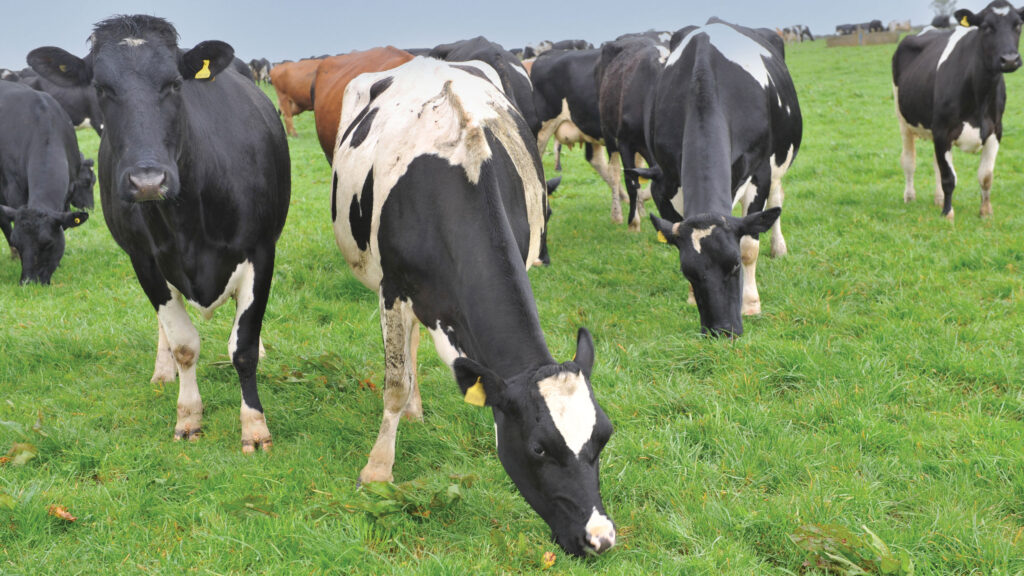 The herd at Penygraig Farm © Debbie James
 Stocking the milking platform at 5.5 livestock units a hectare is challenging.
But with good grass management and making quality silage at 12MJ of metabolisable energy/kg dry matter and 16% crude protein, more than half of Gwyndaf Thomas’s milk production is from forage.
Gwyndaf runs 300 autumn-calving cows at Penygraig near Meidrim, Carmarthenshire, with one full-time worker, one part-timer, and additional help from his children, Carwyn, Aled, Elan, and Lynwen.
The herd produces an annual average milk yield of 6,800 litres with 3,800 of those litres produced from forage.
He achieves this through capturing high protein and energy values in grass silage, feeding home-grown maize silage, and strategic grazing.
See also: How to replace concentrates and get more milk from forage
Farm facts: Penygraig, Carmarthenshire
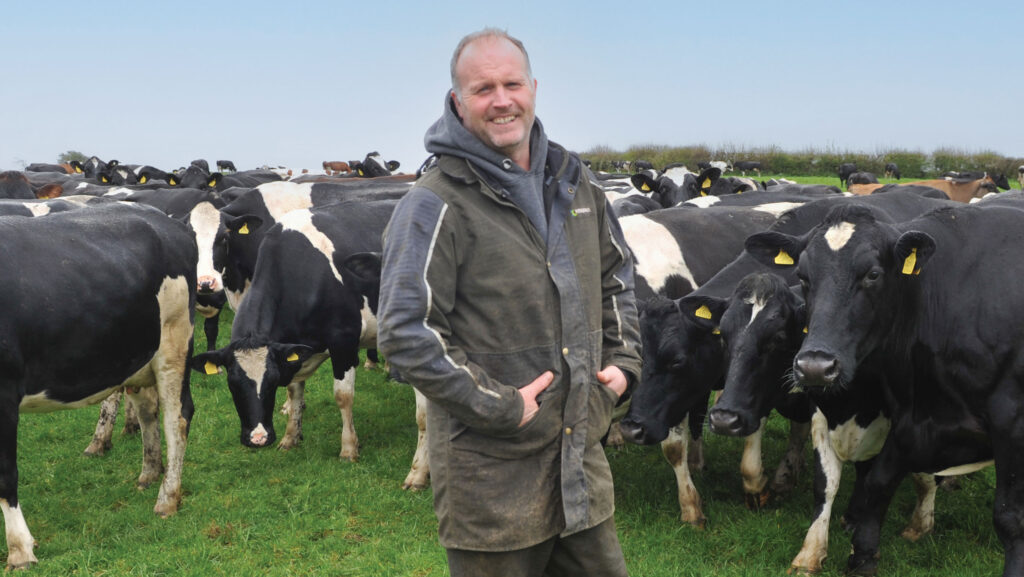
Gwyndaf Thomas © Debbie James
- Farming 81ha plus 93ha run-off block
- 300 cows
- Mostly British Friesian genetics
- 120 replacement heifers
- Calving in 12 week block from 1 August
- Beef calves sold at Whitland or Carmarthen mart a one month old
- Milk sold to Dairy Partners
Penygraig has 81ha, but only 55ha are productive and they form the grazing platform; the remainder comprises rough grazing and woodland. Every blade of grass at the farm is dedicated to grazing.
Gwyndaf also owns 93ha of land less than two miles away, where he takes five cuts of silage and maize, and also runs his 120 heifer replacements.
This year, first cut was taken on 8 April – early even by Gwyndaf’s target as his first cut is usually in the first week of May. This was largely down to need, he points out.
“We needed to empty the slurry store, so the silage had to be cut to be able to spread onto that ground. But we had a good wedge of grass and we took a chance while the weather was favourable.’’
Targeting top quality
He aims to produce silage at 12MJ of metabolisable energy and 15-16% crude protein – and this year’s first cut was at 28% dry matter (DM).
These values are “critical’’ for autumn calving, Gwyndaf suggests.
“We are going against nature by expecting cows to milk well in the autumn – making quality silage is key for the job. Quality forage minimises our cost of production.
“We got caught out by the weather three years ago and made bad silage – that hurt financially,” he explains.
“Feeding cows poor-quality silage is a bit like putting food in front of children which they don’t like: you end up wasting the food and rummaging through the fridge for something else, and that costs.”
Multiple cuts are taken from young leys with silage fields reseeded every three or four years using short-term, high-yielding Italian ryegrass varieties.
This is where maize works well in the rotation, says Gwyndaf.
“We grew 14ha last year and put that ground back to Italian ryegrass; we will do that on another 14ha this year.
“By the time we work around the block, that ground will be reseeded again after four years – meaning we have young leys that grow quickly.’’
Contractors are used for silage making, grass is wilted for 24 hours, and sprayed with an additive. A big emphasis is placed on consolidating the clamp.
“Rolling the pit well is critical; you can’t cut corners there,’’ he insists.
The clamp is covered with oxygen barrier plastic film and a double layer of plastic silage sheet.
The winter ration – consisting of 30kg grass silage, 15kg maize silage and a 4kg blend (made up of 30% wheat, 20% wheat feed and 50% maize distillers), plus up to 4kg of a 16% high-energy cake is fed in the parlour.
“On price, on pound-for-pound basis, the blend worked out cheaper last winter than feeding more cake in the parlour,’’ says Gwyndaf.
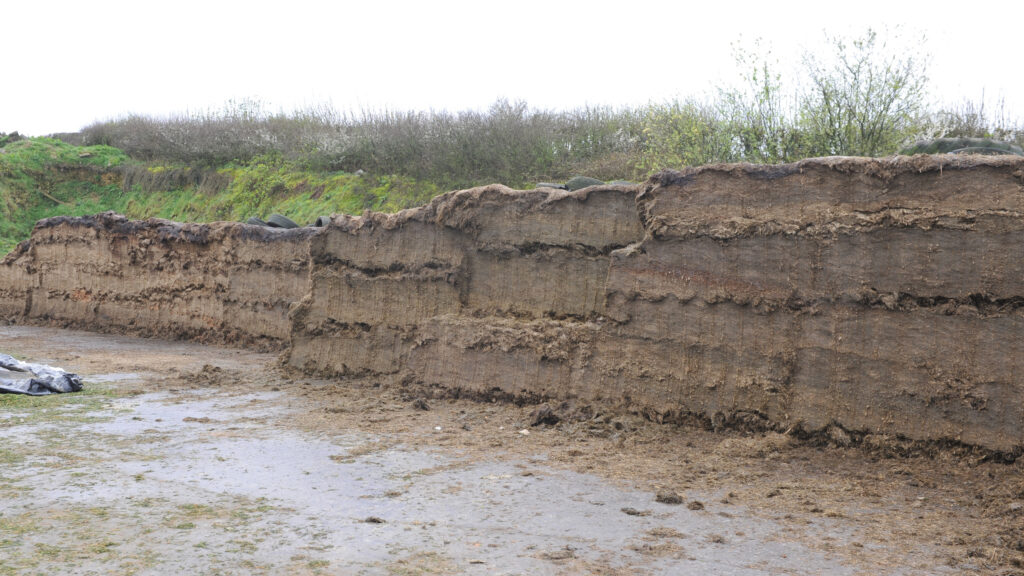
The goal is to make 12 ME quality silage for winter rations © Debbie James
Strategic nitrogen applications
A further 20ha of land are rented to grow winter oats to either feed as wholecrop or combine. Fertiliser is applied “little and often’’.
“Everything used to get a big dose in the spring, but this year it was 125kg/ha (57kg N/ha) of protected urea in early March, and a slow-release fertiliser of nitrogen, sodium and sulphur is applied over the grazing platform at 100kg/ha (28kg N/ha) every four weeks from mid-April.’’
Silage land gets a dressing of slurry after each harvest, followed by a nitrogen and potash fertiliser on land not earmarked for maize.
On the maize and oat ground, other than fertiliser going down the spout with the seed, a foliar feed is used.
Cows graze by day from mid-March, supplemented with a ration of silage and blend at half the winter rate when housed at night until at grass full time from 10 April.
“With a high stocking density on the grazing platform you could argue why not turn out full time earlier, but I know full well that if I did that by the time the herd had gone round the platform once I would need to house again,’’ says Gwyndaf.
“They have been out as early as mid-February, though – it all depends on weather and ground conditions.’’
He admits it is not easy to manage turnout in spring with his high stocking rate, and says it relies on ground conditions as well as a good network of tracks “so that cows don’t walk over where they have already grazed – that is key”.
He adds: “There is a lot of on-off grazing in the spring where we turn out straight after milking, keep an eye on cows and bring them back in again at lunchtime.”
Heifers clean-up grazing platform
Cows are housed from 1 August once they have calved, then the platform is grazed by bulling heifers.
“They have a quick run round the paddocks before they come in for the winter as a management tool to nip off the grass.
“It helps to graze down to residuals, otherwise you get into that sticky position where you are turning out cows onto grass that is already too strong,” Gwyndaf explains.
The result is a big enough wedge of grass that builds up over winter to allow opening covers of at least 2,800kg DM/ha.
Calving is in a 12-week block and mating starts at the end of October – five weeks of insemination with British Friesian sexed semen.
Insemination then switches to Belgian Blue genetics with Hereford and Limousin stock bulls used as sweepers.
The calving period used to start at the end of August, but is now four weeks earlier because of the high stocking rate and successive dry summers. “When the grass goes dry, so do the cows,’’ Gwyndaf admits.
He wants as many cows as possible to calve outside, and having that earlier start date while the weather is still favourable helps achieve that goal. Reliance on autumn grass is therefore minimal, he adds.
“Once cows calve, they are on a winter ration. We would rather house earlier and turn out earlier in the spring because in theory they should be back in calf by then and be more tolerant to being challenged.’’