

Poultry housing order extended beyond critical marketing date
 © Branex/Adobe Stock
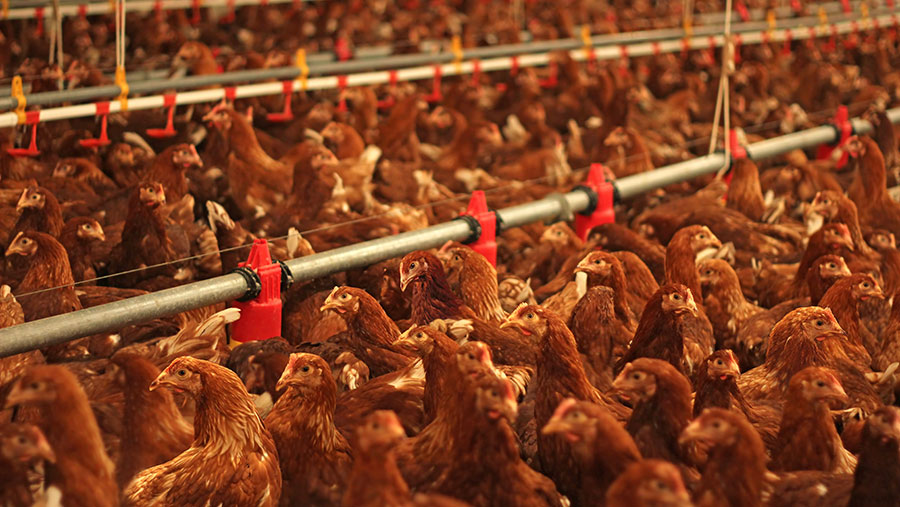
 Free-range egg producers must continue to house flocks beyond 21 March to protect them against avian influenza, Defra has announced.
Cases of the disease are still mounting and passed the 100 mark for the winter last week, making it the worst UK outbreak on record.
On 21 March, it will be 16 weeks since the housing order was introduced last November, the British Free Range Egg Producers Association (Bfrepa) said.
Under marketing laws, that means a temporary derogation, allowing eggs produced from housed birds to be branded as free-range, will expire. From that date, egg producers must instead market produce as barn eggs.
See also: 3 poultry diseases to look out for in 2022
Labelling
A labelling and marketing protocol, devised by the British Egg Industry Council and the British Retail Consortium, has been approved by Defra.
- Consumer information explaining the relabelling will be provided at the point of sale and via social media and web-based communication
- Egg stamping with the number “2” indicating “from barn systems” will take place at packing centres, rather than on individual farms
- Free-range egg packs can continue to be used, but the words “barn eggs” must be shown on pack, either via direct print or sticker.
The move for packers to stamp Lion eggs was approved to prevent additional costs for individual farm, which would otherwise have to invest in changes to marking systems.
Direct sellers
The change is more onerous for direct sellers, explained Bfrepa chief executive Robert Gooch, as they too will be required to label eggs as barn and use the number “2” on product.
Mr Gooch urged these producers to ensure label guns can incorporate the word “barn” or consult label suppliers immediately.
He also raised concerns for flocks if the housing order continues into the warmer weather.
“With cases continuing, we are nowhere close to having the housing order lifted,” he said. “As temperatures are likely to start warming up, producers face an increased risk of red mite infestations in sheds,” Mr Gooch said.
“Also, with the longer day lengths, birds will want to go out and range, adding potential behavioural stress.”