

Why egg producer includes humic acid in layer rations
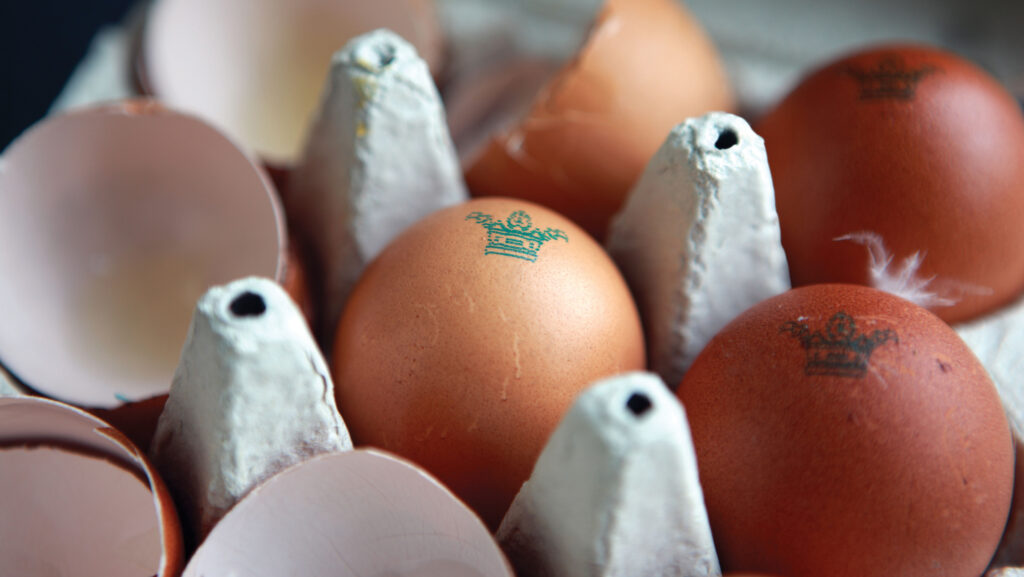 © Lynne Sutherland/Alamy Stock Photo
 The latest cycle of hens at Glanalders in Radnorshire produced 14 eggs a bird more than the breed average, worth an additional revenue of £37,300 across the flock of Burford Browns.
For egg producer George Wozencraft, capturing an extra margin of £2 a bird is an important milestone: rewind seven years, and he was dealing with a continual cycle of infectious bronchitis (IB) and its financial consequences.
See also: How bokashi is helping a poultry farm’s nutrient management
Farm facts
Glanalders, Nantmel, Radnorshire
- 400 acres farmed
- 250 Mule ewes
- 600 improved Welsh ewes
- 30 Belgian Blue suckler cows
- Lamb sold liveweight at Builth Wells mart
- Beef calves sold as weanlings at Knighton and Hereford marts
During every outbreak, treating the flock with antibiotics provided only brief respite as the highly contagious respiratory virus would strike again within weeks.
The result would be mortalities and a big dip in egg production – and ultimately business income and profit too.
“IB was a continual issue for us with repeated cycles of challenge, antibiotics treatment, recovery and then another drop in production,” recalls third-generation farmer George.
“When I look at our egg production graph from that period, it shows huge peaks and troughs, and from that I can pinpoint exactly when we were getting those IB challenges.”
Alternative health strategies
IB would leave the birds susceptible to secondary infection. With antibiotics use and veterinary costs at a much higher level than he was comfortable with, he researched alternative strategies that could bolster flock health.
For him, the solution was to have humic acid included in both his bespoke rearer and layer rations formulated at the feed mill.
Humic acids are naturally occurring compounds and are increasingly being recognised as a nutritional tool to support bird performance.
Peer-reviewed research published in the past two years report improvements in egg numbers, egg mass and shell thickness when humic acids are included in layer diets, and better feed efficiency. At Glanalders, they stabilised bird health.
“Since using humic acid, those IB-related dips that used to show clearly on the production graphs are no longer evident on our farm,” says George.
“I’m not making a scientific claim, but from my experience that change has made a big difference to stability in the flock – we get a nice continuous flow of eggs.”
The farm diversified into egg production in 2011. The business also produces suckler beef and lamb from a flock of Improved Welsh and Welsh Mule ewes – but when George joined his grandfather, Abraham, and father, Malcolm, on the farm, an additional source of income was needed.
Investment in poultry
They started with a 16,000-bird flat deck system, producing eggs for Stonegate from Clarence Court hens, but in 2025 converted the existing shed to multi-tier.
Committing capital to upgrading infrastructure at a time when egg prices were strong was an investment for the future, says George.
“If I didn’t do it then, I would have to do it in five or six years, by which time the egg business might not be going so well.
“I would also be older and less inclined to want to borrow that money, or indeed have the drive to do it,” he adds.
The shed was upgraded after it was depopulated in June 2025, and the current flock was installed in the new facilities in December.
Strong start
“We use humic acid in the rearer diet too, to give the bird’s gut a good start health-wise,” says George.
“Rearing has been very good, with birds coming into lay in strong condition, and we have had very low mortality.
“The transfer from rearing to laying is a stressful period, particularly with vaccinations, and I feel humic acid gives the birds a strong start for very little outlay.”
The last four flocks have been Burford Browns, a switch he made to supply Waitrose.
Unlike the standard hybrid previously kept, he says it is a more challenging bird, as genetic improvement has been slower, but the breed captures a higher price for a premium egg.
What is no longer evident though is the IB challenge that previously plagued Glanalders, a major positive for the bottom line of the business.
While George accepts that there may be other contributory factors, he believes humic acid plays a major part in supporting health and production.
“I’ve noticed drier litter and manure, fewer dirty eggs, and a more pleasant shed environment from less odour, and ventilation is easier to manage,” he says.
Cost benefit
Adding humic acid to the premix costs the business £0.27 a bird over the full laying cycle, or about £0.07/dozen eggs laid.
Although a direct cost, George says there is a cost benefit from not only achieving better and consistent production but from having fewer mortalities and lower vet and med expenditure.
“It is a very small cost in the context of the benefits seen. Having fewer health dips overall gives me the confidence that keeping birds in better underlying condition makes them more resilient to challenges.”
Feed conversion efficiency is very good too, he has observed. “It stands to reason that if the gut is healthy, it is better able to convert the feed, and you get a more efficient bird.
“Previously, feed intake tended to rise after antibiotic treatments and then fall away again; now, intake is much more consistent.
“I try to be proactive with bird health, and the extra intestinal support has paid off, particularly when year-on-year consistency and feed efficiency are important to the business.”
Egg production up 5% in humic acid trials
A 16-week controlled feeding study published in a peer-reviewed journal Veterinarija ir Zootechnika in 2024 saw Hy-Line W-80 laying hens at 38 weeks fed either a standard diet or the same diet supplemented with humic acid.
Compared with the control group, egg production in the hens receiving humic acid was 5% higher and egg mass a hen day, 61.30g, about 8% higher than the 56.76g recorded in the control.
Shell thickness also improved approximately 2-3%, and late-period shell thickness by around 5%.
Sam Bowler of Natural Farma, which supplies humic acid to the industry, says that in practical terms stronger shells are typically associated with fewer cracked and downgraded eggs, especially later in lay.
Feed conversion
“Because feed is the single largest cost input in egg production, it is particularly relevant that the study also reported improved feed conversion in supplemented birds, alongside the gains in egg numbers, egg mass and shell quality,” he says.
The study also reported lower faecal counts of E coli in supplemented birds – E.coli is widely recognised as a common contributor to gut upsets and performance dips in poultry, he adds.
“Alongside lower faecal E coli counts, the study also reported reduced levels of other gram-negative bacteria.
“This indicates less background gut pressure, which may help birds use nutrients more efficiently and perform more consistently.”
In broader poultry research, humic substances have also been associated with improved nutrient utilisation and reduced nitrogen losses, which can contribute to lower ammonia pressure and a more favourable house environment.