Bolt-on kit adds compost teas and micronutrients during drilling
 © James Andrews
 Since moving to his North Yorkshire arable farm two-and-a-half years ago, Matt Emmett has been on a quest to breathe new life into its light-bodied soils.
Prior to his arrival, the land had been ploughed and combination drilled, with all straw removed and little in the way of muck put back; a policy that had left it lower in organic matter and biodiversity than he would have liked.
“So I decided to do everything I could to kick-start soil biology, making use of some of the techniques I’d learned on my previous farm in Buckinghamshire,” he says.
See also: Herts firm invests in monster 15t, 18m Horsch Avatar drill
He also enlisted the help of Edaphos agronomist Richard Bolden, and local regenerative farming adviser Mark Palmer, to usher in his new regime.
This included a switch to no-till drilling, liberal use of the combine’s straw chopper, planting of companion and cover crops, and a muck-for-straw deal with a neighbour.

Matt Emmett and Mark Palmer © James Andrews
Plus, he carried over his decade-long policy of banishing insecticides and seed dressings, while keeping fungicide applications to a minimum.
In tandem came efforts to boost soil biological and fungal activity, with the brewing of compost teas in a Johnson-Su bioreactor.
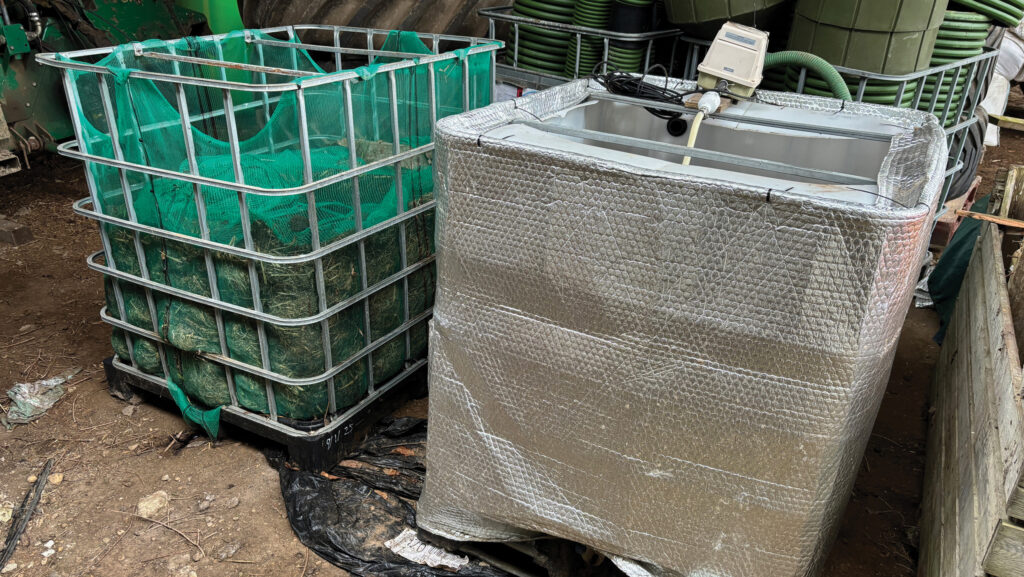
A Johnson-Su bioreactor (left) and brewing vessel (right) are used to prepare products © James Andrews
Though pleasingly cost effective to create, the challenge was finding an efficient way of getting this liquid into the ground at a budget befitting his 90ha arable area.
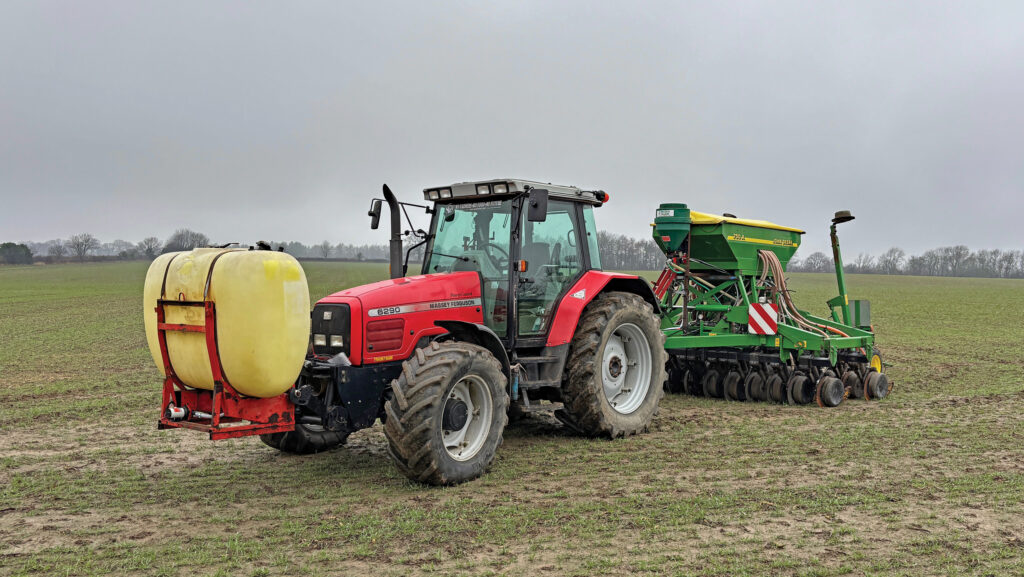
Matt’s plan was to place it in the seed furrow during drilling with his John Deere 750A – imported second-hand from Spain in 2015 – for which he needed some sort of applicator.
However, with costs for suitable systems running to more than £15,000, a rethink was required.
Danish designed manifold
This is where Mark stepped in: through his Systems4Food business he had begun importing a manifold designed by Danish farmer Ib Borup Pedersen – see “Systems4Nutrition application system”.
It is able to take liquid from a bulk tank and distribute it evenly across a series of outlets – 24 in the case of Matt’s setup.
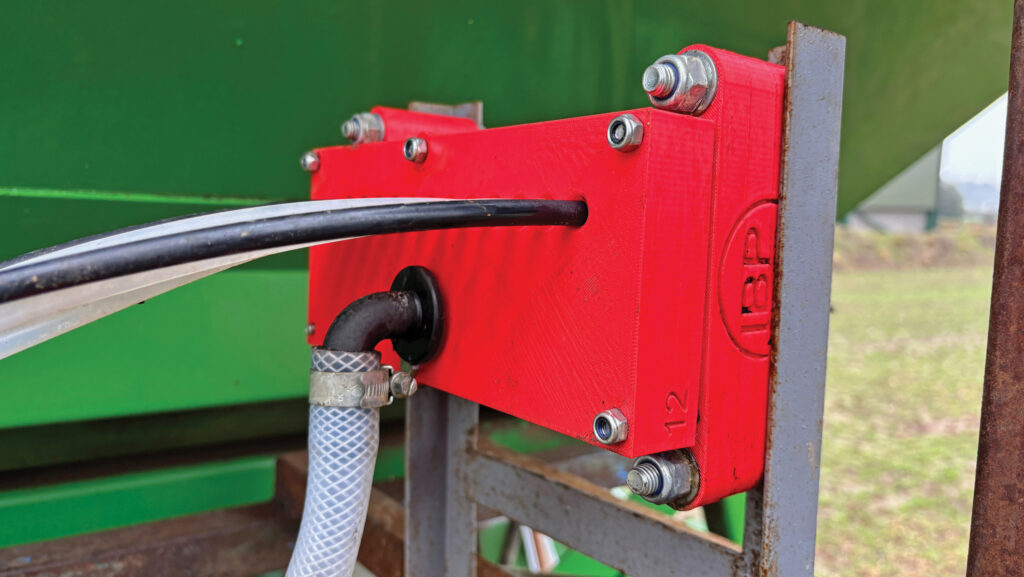
Pedersen manifold evenly distributes liquid through 24 outlets © James Andrews
“I’d tried rigging up a drill in the past using a series of splitters on pipes, but the liquid always takes the path of least resistance, so it was hopeless,” says Mark.
Pedersen’s manifold solves this thanks to its bank of shaped channels and airways that maintain a constant low pressure across all outlets.
The lack of force is important, as rough handling can harm sensitive micro-organisms such as nematodes and archea suspended in compost teas.
Systems4Nutrition application system
The success of the applicator fitted on Matt Emmett’s drill has prompted Mark Palmer to put a self-fit kit together, called Systems4Nutrition, that similarly minded farmers can buy.
Prices vary slightly according to drill type and the number of coulters but, as a guide, a setup to suit a 3m machine will come in at about £2,500.
For this, buyers get the Pedersen manifold, a pump, pipework and a control box. That just leaves them to source a suitable tank.
Installation can be easily completed in a day, with a couple of hours required in the field for calibration and testing.
Those that would prefer to build a system themselves also have the option of buying the manifold as a standalone product.
Another service offered by Mark’s Systems4Food business, where he works alongside Dr Tara O’Neill, is detailed soil and sap testing to accurately determine micronutrient levels of the crop.
A recent investment to help in this process is a Senseen Nutriscope, which allows instant in-field testing of crop tissues to be carried out.
Completing the system
But in order to create a complete application system, they needed a tank, a pump, some form of controller and a set of pipes to deliver the product to the coulters.
The storage vessel was easy to solve, with an old 800-litre Hardi sprayer tank proving ideal for mounting on the front linkage of Matt’s drilling tractor – a 140hp Massey Ferguson 6290.
Though this was originally teamed with a diaphragm pump, the output was higher than needed and, at any rate, the tractor lacked a front pto to run it. Instead, they fitted a small self-priming 12V water pump with a flow of up to 18.9-litres/min.
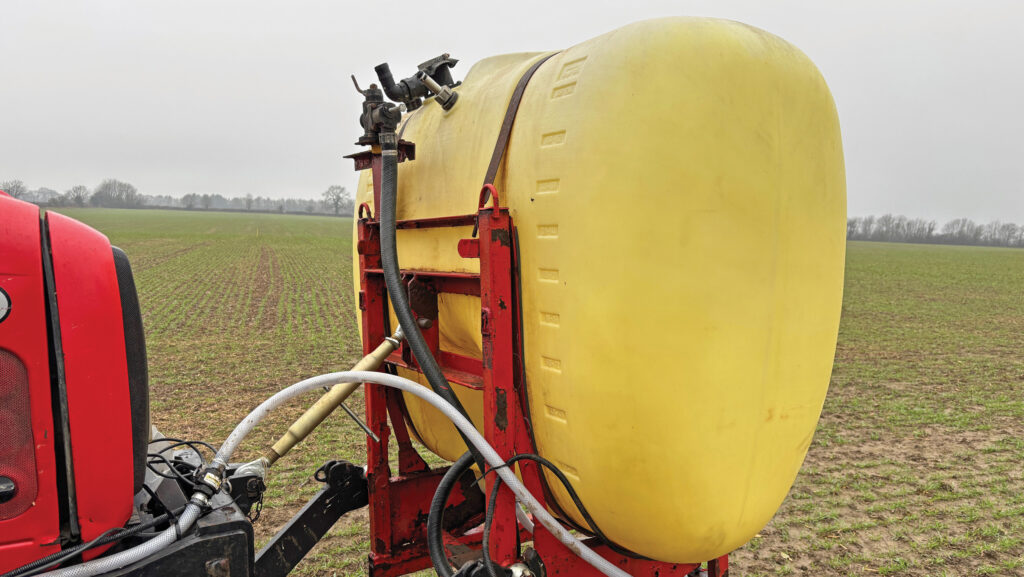
Hardi front tank © James Andrews
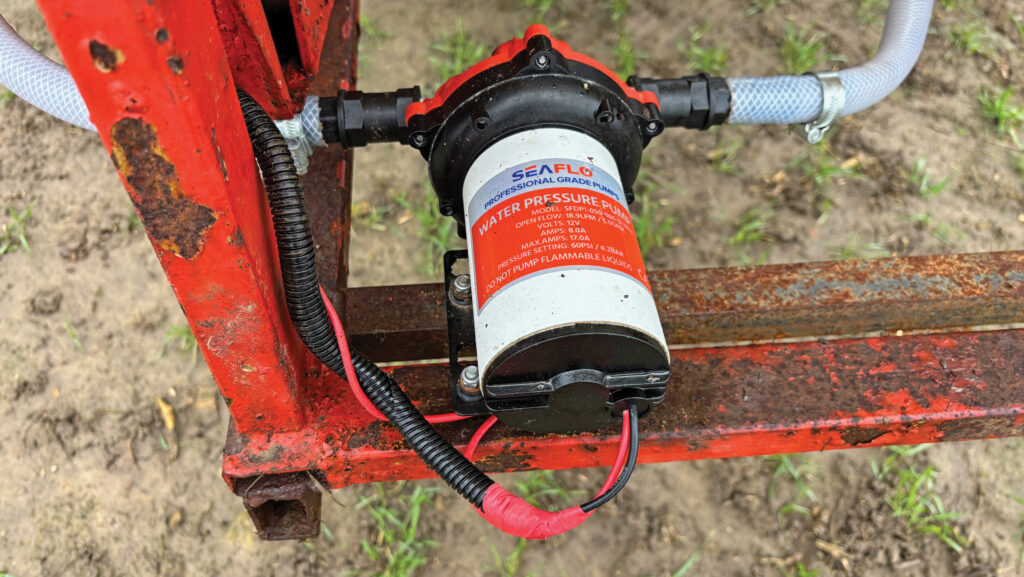
The small self-priming 12V water pump delivers the brew to the manifold © James Andrews
This pushes liquid to the manifold – mounted on the front of the drill hopper – through a regular hosepipe, before it’s spilt into narrow-gauge tubes with 6mm internal diameters. Each of these runs to the tip of a coulter so that products are applied right next to the seed.
To avoid any blockages that could result from the low pumping pressure, they positioned the manifold as high as possible, making sure that there was no sagging in the pipes.
Finally, they needed some form of rate controller, which they decided to make themselves. This has a dial for adjusting pump speed, with a digital display to show the setting.
There’s no pressure gauge as yet, but one will be fitted so that Matt can check it’s working as it should.
They also avoided fitting any fine filters. “We’ve got a coarse one to stop any big particles getting through, but if you strain it too much you prevent a lot of the beneficial biology from getting into the ground,” says Mark.
Compost tea production
The system was used to apply the first batch of compost tea last autumn using material that had been maturing in a Johnson-Su bioreactor for about 12 months.
Sticking to the tried-and-tested design, Matt constructed his out of an IBC frame lined with a breathable membrane. Lengths of drainage pipe, peppered with holes, were then placed inside on their ends to make sure there was good air flow throughout.
Inside went a mix of manure, hay, grass clippings and woody material, with some worms added later to speed up the decomposition process.
To make the tea, he removed a bucket of the compost, placed it in a muslin bag and steeped it in water to extract the nutrients and micro-organisms.
This liquid was then placed in the front tank and applied at a rate of 3ml/m in each of the 24 rows.
On-farm trials
Together with agronomist Richard, they set out a series of trials in winter wheat crops drilled last autumn to see how effective the treatments are at boosting soil biology.
These have included applications of straight compost tea, as well as mixes including humic acid and fish hydrolysate.
In addition, Matt has put on some brewed bacterial mixes which have been multiplied by blending with molasses and water in another IBC, plus ready-to-use products such as Avia’s Bioplus T.
“I’m looking forward to seeing what sort of impact these have had on crop health, as well as yield results at harvest,” he says.
As mentioned earlier, cover and companion crops are another key part of Matt’s plan.
Examples of the latter include wheat sown with beans, spring barley with linseed, and oilseed rape in a four-way mix including berseem clover, buckwheat and vetch.
“I’ve also got some living clover mulches that are now in their second year and are still looking good – it all makes farming interesting again.”