

Organic farm ditches its plough to improve weed control
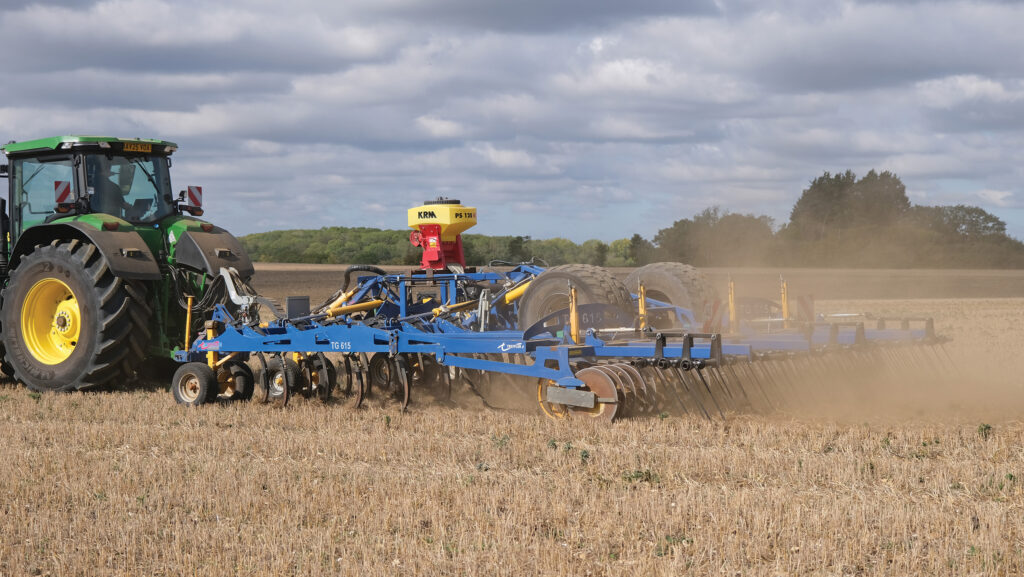 Treffler TG615 cultivator © James Andrews
Almost a decade after starting the conversion to organic production, Trucketts Hall Farm in Suffolk has begun overhauling its crop establishment system.
Marianne and Luke Ashmore, who run the 350ha farm near Boxted in partnership with Marianne’s parents, are slowly reducing their reliance on the plough in favour of non-inversion tools.
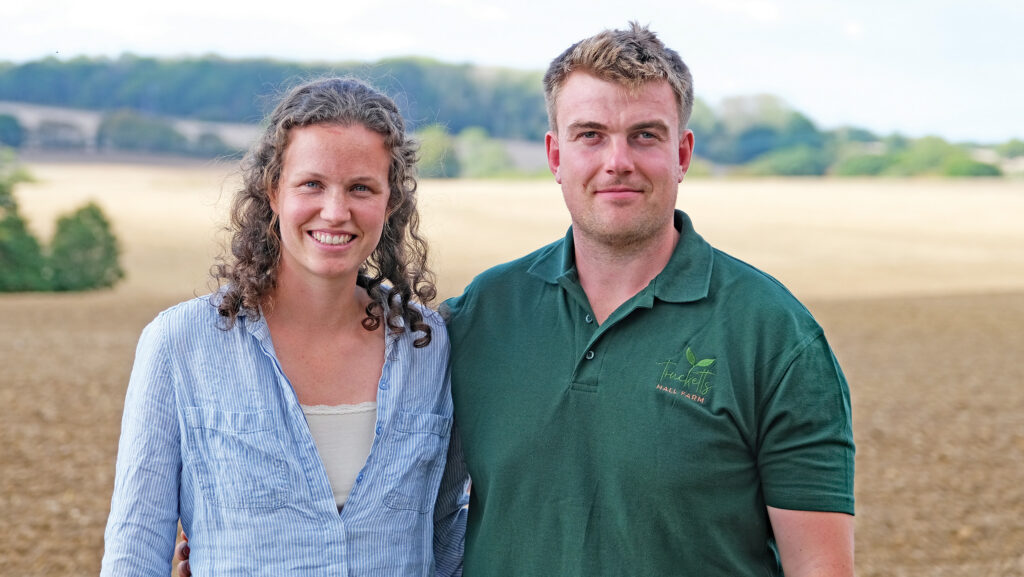
Marianne and Luke Ashmore © James Andrews
By cutting furrows every few years rather than annually, they hope to improve soil health and conserve moisture, all while maintaining their 4t/ha cereal yield target and keeping weeds at sustainable levels.
A selection of implements has been drafted in to help with their endeavour: a 3m Ryetec Riot, a Treffler TG615 tine cultivator, and a Weaving GD direct disc drill.
See also: Gloucestershire farmer builds £2k weed-crushing combine add-on
To find out which combinations work best, they’ve spent the past few years assessing different establishment setups.
This was formalised late last year when they joined an Adopt (Accelerating Development of Practices and Technologies) project to trial low-disturbance cultivation and alternative seeding methods (see Adopt project box).
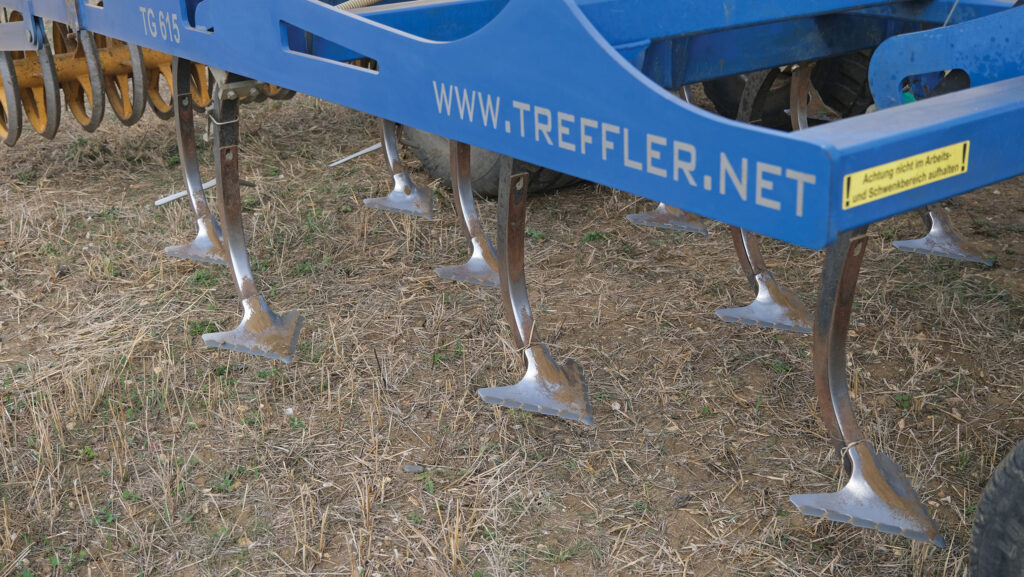
Treffler TG615 cultivator sweep tines © James Andrews
Shallow cultivation
The 6m Treffler TG615 tine cultivator is a core part of the system, undertaking multiple cultivation, seeding and weeding roles. Armed with a series of tungsten carbide-tipped A-shaped “sweep” tines, it can move soil across the full working width at depths as shallow as 2cm.
Furrow closers then push the soil back into place, leaving a flat, even surface, before a dual packer roller consolidates the ground. Finally, a three-row tine harrow evenly spreads weeds over the top so that they dry out and don’t re-establish.
In one of the farm’s trial setups, the Treffler is being used to clean up stubbles before the crop is established using the Weaving GD. Cereals are drilled at a depth of 50mm, which allows the Treffler to run through again before seedlings start to emerge.
“We wait until the seeds chit and then cultivate at 20mm to take out any early-germinating weeds,” says Luke. “The Treffler’s depth control is so accurate that we don’t have to worry about it interfering with the crop.”
This approach has worked well, with no discernible yield penalty compared with the farm’s traditional plough-based system. Most fields have seen a decrease in weed populations too, as seeds are kept at the surface and not mixed through the soil profile.
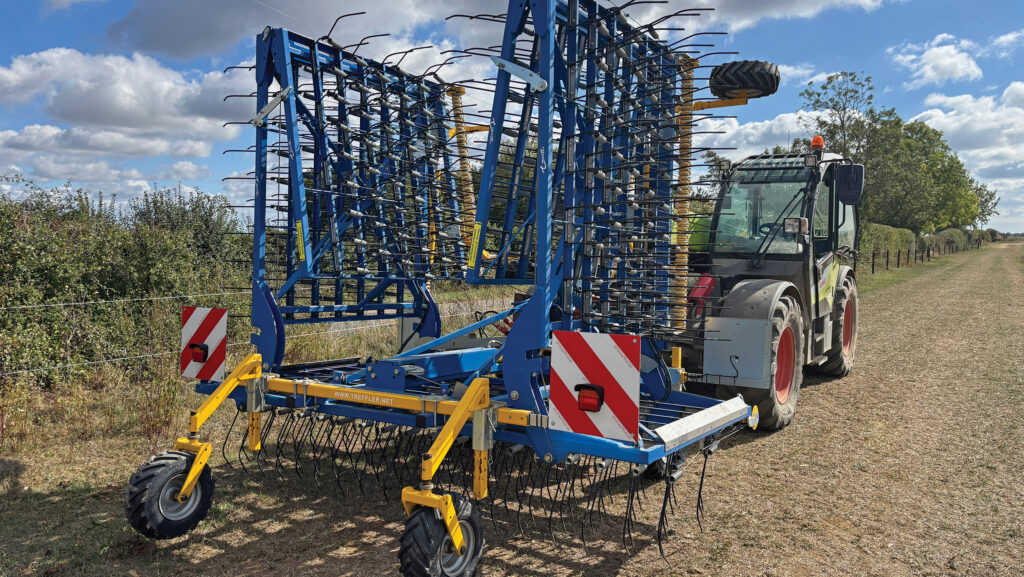
Treffler TS920 © James Andrews
Dealing with weeds
The main tool for tackling weeds that rear their heads post-emergence is a 9.2m Treffler TS 920 harrow. Unlike inter-row hoeing tools, this drags tines through the crop, which means timing is crucial.
Go too early and there’s a risk of damaging plants, but wait too long and the weeds become too well rooted to be flicked out.
“We’re not that sold on the idea of band sowing and inter-row hoeing, as there’s too much bare soil for weeds to get established. Instead, we’re aiming to get an even covering of seed across the entire field so that there’s less space for them to grow,” says Luke.
As the Weaving GD drills at 166mm spacings, rather than the traditional 125mm, there is a bit more uncropped ground than they would like.
To combat this, Luke and Marianne are considering broadcasting a portion of the seed, which would then be harrowed in by the TG615 during its pre-emergence pass.
Current thoughts are that 70% will go in with the GD and 30% with the spinner. They’re also thinking about adding a Weaving Sabre tine drill to their fleet, which will allow them to keep seeding when conditions aren’t ideal for the disc drill.
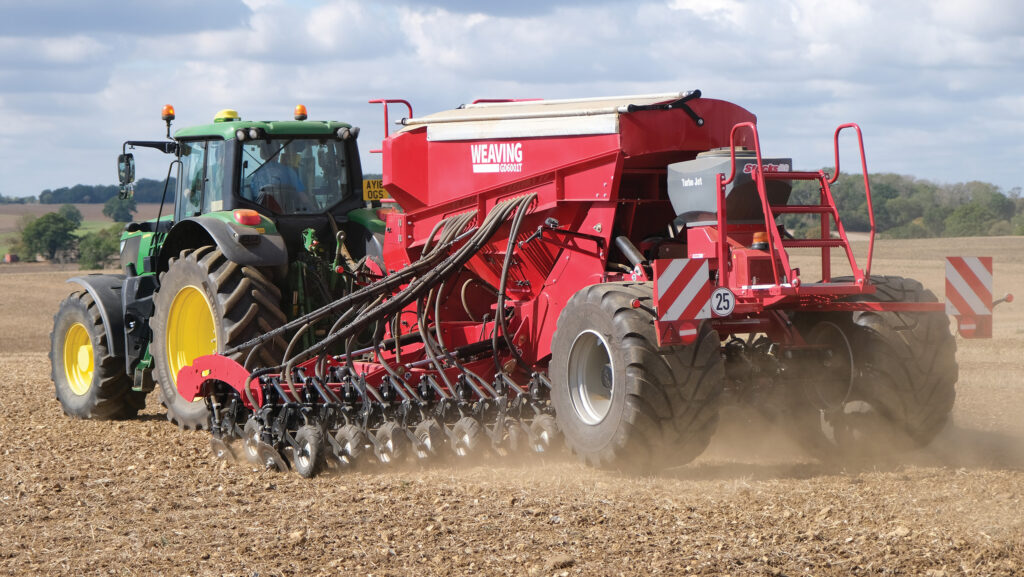
6m Weaving GD © James Andrews
Broadcast establishment trial
Another regime they’ve been testing is shallow cultivating with the Treffler before broadcasting all the seed using a fertiliser spreader and harrowing it in. It’s an ultra-low-cost technique that, in theory, provides an even distribution of plants across the entire field.
However, results have been mixed. They have had some good yields when doing this in the autumn, but spring has been less successful.
This season, the lack of moisture resulted in a complete crop failure, so they’ve concluded that it’s only really suitable for autumn establishment. Even then, it’s more likely that it will be used to fill in gaps after the drill has planted most of the seed.
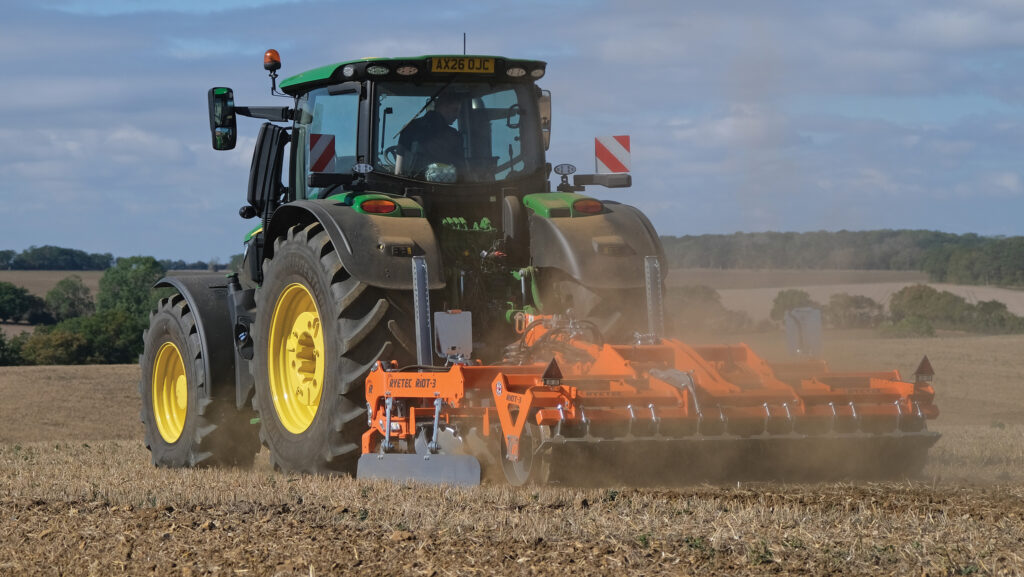
Deeper cultivation
When soils need more aggressive treatment, the 3m Ryetec Riot steps in. This was launched at the 2026 Lamma event and arrived on the farm this spring.
It’s a versatile tool, with leading discs that slice through trash, six JJ Metcalfe NG low-disturbance legs, two rows of discs and a ridged packer roller at the rear. All elements are hydraulically adjustable, and both the legs and discs can be engaged or disengaged as required.
“We’re hoping to use it in the autumn to open ground up so that we can do lighter cultivation in the spring,” says Luke.
However, the fact that it can be configured in so many different ways means that it will likely play several different roles. “It’s hard to have any set plans, as the weather, soil conditions and weed levels vary so much from year to year, but the selection of kit we’ve got means we can adapt.”
Plough still has a role
The plough will likely remain in the rotation, as it is still the preferred tool for incorporating fertility-building leys after their three-to-five-year tenure.
After this, they plan to sow winter wheat with beans, winter oats with beans, spring barley with peas, finishing with rye or spelt. Their initial experiments with companion-cropping have worked well, so a grain cleaner has been ordered to make it easier to separate them post-harvest.
There’s also stock on the farm, with a 60-head Hereford suckler herd grazing the fertility-building leys. Luke and Marianne are adding value by selling beef boxes direct to consumers, as well as eggs from their free-range chickens.
“The cattle are a real asset to the farm and, over time, we’d like to increase the herd size and reduce the arable area a little,” says Luke. The farm will also reach a significant milestone in 2027, when the final portion of its land is due to be granted organic status.
About the Adopt project
In autumn 2025, Luke and Marianne joined an Adopt project, along with Kiln Farm (also organic) and Scotts Farm, which farms conventionally.
The trial runs for two years and will evaluate how well crops perform when planted with low-disturbance tools. The aim is to improve soil biological health in the organic systems and reduce the reliance on chemical inputs on the conventional farm, all while maintaining yields.
All three operations have been trialling the same two establishment regimes alongside their regular setups. Both approaches start with shallow cultivation using the Treffler TG615, but while one drills seed using the Weaving GD, the other simply broadcasts it using a fertiliser spreader.
So far, the former has produced the most promising results, with yields matching those achieved using each farm’s standard technique. Broadcasting has been far more variable, with some good results, but Trucketts Hall Farm suffering complete crop failure this spring due to a lack of moisture.