

Fly-tippers face losing driving licences under new powers
 © Warwickshire Police Operational Patrol Unit
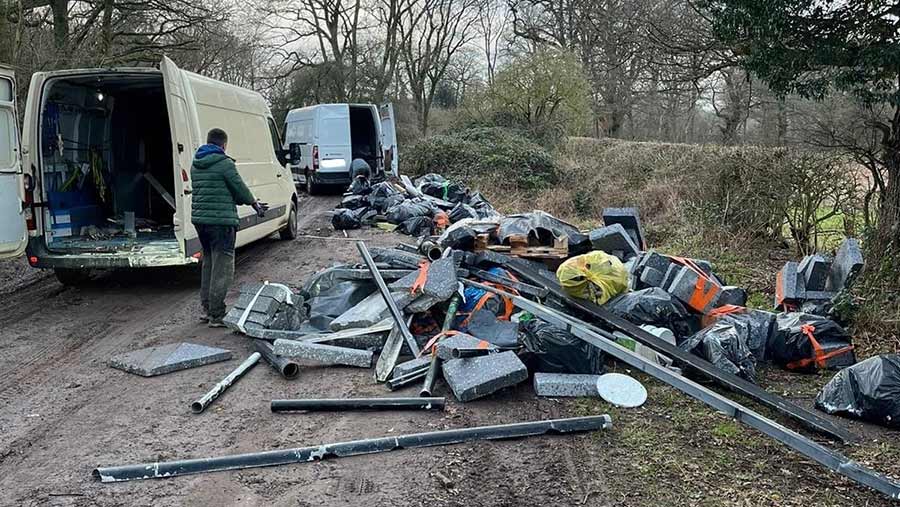
 Fly-tippers face losing their driving licences under tough new court powers designed to curb illegal dumping across England’s towns and the countryside – measures that farmers say cannot come soon enough.
Under the new rules, offenders can receive up to nine penalty points for a single incident, meaning repeat offences could quickly lead to disqualification.
The move targets the vehicles used in most fly-tipping cases, particularly vans, and forms a central part of the government’s waste crime action plan.
See also: Fly‑tipping law change to protect farmers blocked
Defra secretary Emma Reynolds said the crackdown would “hit offenders where it hurts”.
She added: “Fly-tipping is a disgrace that blights our communities, harms our environment and damages our economy.
“Courts will soon be able to strip repeat fly-tippers of their driving licences, helping to clean up our streets and countryside.
“Our message is simple: if you dump waste illegally, you will face the consequences.”
For farmers, who experience much of the crime away from public view, the announcement is a significant step forward.
Industry groups have repeatedly warned that official statistics – 1.26m incidents in England in the 2024-25 financial year – fail to capture the true scale, with large volumes of waste dumped on private land.
The Country Land and Business Association (CLA) has highlighted that nearly three-quarters of farmers are affected, with clean-up costs often exceeding £1,000 per incident.
Beyond the financial hit, dumped materials can contaminate soil, threaten livestock and block access to fields.
Lucy Charman, the CLA’s national rural crime lead, said:
“Fly-tipping is a serious organised crime and it’s time it was treated as such. Penalty points on offenders’ driving licences can work as a deterrent, but the courts must use these powers.
“We need better intelligence sharing and closer joint working between the police, Environment Agency and local authorities. Until then, rural communities will continue paying the price for a crime they didn’t commit.”
‘Real deterrent’
Dr Anna Scott of Keep Britain Tidy also welcomed the measures, saying: “Fly-tipping is far from a victimless crime. Adding points to driving licences will provide a real deterrent.”
With powers also expanded to seize vehicles and force offenders to fund clean-ups, rural communities hope the reforms will finally stem what many describe as an escalating “fields of waste” crisis.
Waste crime policy is largely devolved, and enforcement and penalties for fly-tipping differ across Scotland, Wales and Northern Ireland.