Care farming gains momentum
Third-generation farmer Tim Waygood has always known that he would make his living from the land.
Church Farm, a 175-acre farm in Ardeley, Hertfordshire, is the same farm that his grandparents and parents ran – and on which he grew up.
What Mr Waygood didn’t know then is that two years ago he would introduce a new way of working, combining a traditional, mixed and sustainable system that works with the local community.
Previously a pig and arable farm, when Mr Waygood took over in 2008 he decided there needed to be a change.
“I wanted to diversify and to start selling more locally,” said Mr Waygood. “I wanted to look at economies of scope rather than of scale – and to re-engage with the local community in a way that would make the farm more sustainable.”
As well as introducing cattle, sheep, geese, chickens and ducks to the mix, Mr Waygood introduced organic gardens and orchards. He also started running education programmes and set up a care farming programme called Rural Care.
Care farming uses farming practices to provide opportunities for structured care – therapy, education and rehabilitation – to some of society’s most vulnerable people.
While it’s not yet widely recognised in the UK, its effectiveness has been proved in The Netherlands and elsewhere in Europe, where a network of over 2000 care farms has flourished over the last decade.
Care farming is gathering momentum in the UK, too, with around 150 farms such as Church Farm providing care for around 6000 adults and young people each week. The National Care Farming Initiative (NCFI) offers support to UK care farmers, and its lobbying and awareness-raising is contributing to make it a big part of mainstream care provision.
It was through a partnership with social worker Ann de Bock and with the help of a loan from Triodos Bank that Mr Waygood set up the Rural Care Centre. Its focus is to provide training and work experience for disadvantaged people, particularly those with learning difficulties and mental health issues.
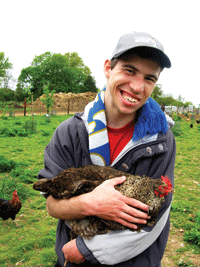
Rather than being ostracised from society, the seven “co-workers” are well integrated into working life at Church Farm. They get fresh air, exercise and have a structure to their day. Be it cleaning the chickens out and collecting their eggs for sale in the village or fruit and vegetable harvesting and farm maintenance, their jobs are meaningful and serve a purpose on the farm.
Mr Waygood is clear about the benefits of care farming. “Our co-workers are involved in something real. Their therapy is purposeful activities that make a real difference to the local community as opposed to workshops or therapy divorced from the real world. This gives them massive self-esteem and the feeling of having a place in society.”
One such example is Dave, a 35-year-old co-worker who has been at Church Farm for more than a year.
With a mental age of around 12, it would be hard for Dave to find any kind of employment outside of the village where he lives. Yet his work at Church Farm is greatly appreciated.
“Dave is fit and strong – an excellent pair of hands to have around the farm,” says Mr Waygood. “He’s been given a new lease of life since working here and the fact that he’s incredibly valued as well has significantly boosted his self-confidence.”
The income that Mr Waygood gets for care farming – between £15,000 and £30,000 per annum – comes from social services. For this reason, he suggests that only those people who have the basic facilities already available should consider setting up a care farm. “It’s doesn’t generate thousands so it wouldn’t make any sense to set up a farm specifically with the idea of offering social care. With other enterprises running, it certainly makes a contribution to the overheads.
“If someone is interested to know more about a care farm,” says Mr Waygood, “I sometimes suggest that they come and work on Church Farm for a few months, so they can experience it for themselves. It is impossible to describe the enormous impact that the farm has in one conversation.”
SETTING UP A CARE FARM: Advice from Tim Waygood
• Create a partnership with someone who has a background in social care. “You could do it yourself, but it would take ten years to amass the knowledge of someone who has been working in the social care sector. It is a partnership that makes it work.”
• Think hard about the funding side and look at it from a commercial point of view – will you break even if you’re setting up from scratch?
FINDING FUNDING FOR YOUR CARE FARM
One of the main challenges is securing finance. Triodos is a socially-responsible bank that only finances projects that make a positive difference to society and the environment. They are working closely with the NCFI. Go to www.triodos.co.uk