

Droughts and floods: Double challenge for farmers everywhere
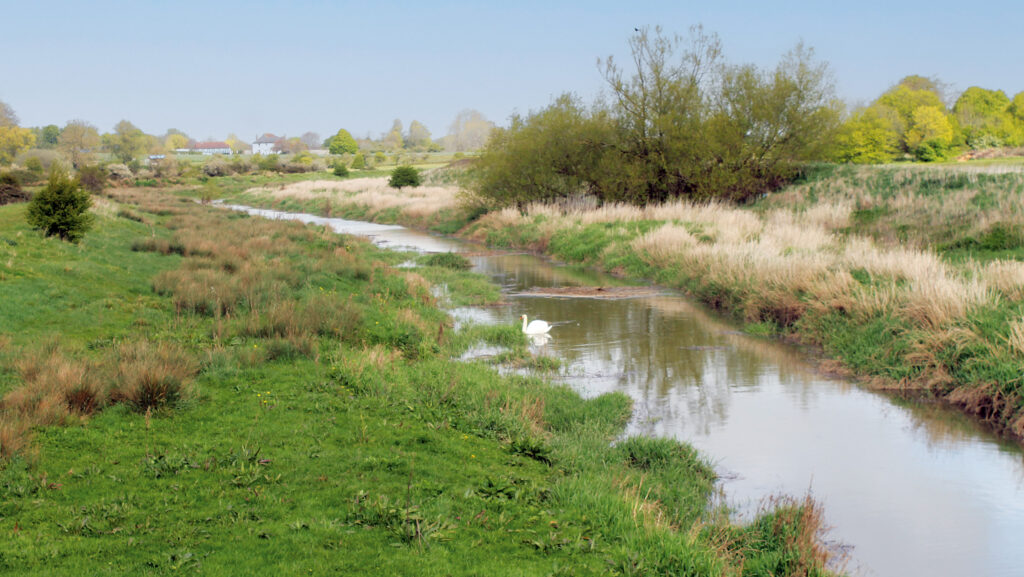 Cuckmere River © MAG/Philip Clarke
 Water management is a mounting challenge for farmers everywhere, with climate change ensuring many have experience of both “too much” and “too little”, sometimes in the same season.
Nowhere are the conflicting pressures epitomised better than in the Cuckmere River catchment in East Sussex – a destination for thousands of geography field trips.
Here, farmers are having to deal with both drought and flooding on a semi-regular basis.
See also: Are farmers really to blame for water pollution?
Conserving water and ensuring its quality is a particular priority for third-generation mixed farmer Duncan Ellis.
Mr Ellis not only has a flock of sheep and a suckler beef herd to maintain, but also runs a successful brewery operation.
Around 70% of drinking water in the area comes from groundwater rather than river supplies.
To assist with purity, Mr Ellis has been keen to embrace low-input, regenerative farming across the 1,200ha of owned and rented land he manages from Church Farm, Litlington.
And with livestock often located some distance from the farmstead, he is also mindful of the dangers of leaks in the mains supply lines.
“We have a maze of underground pipes that we cannot see, so leaks in pipes and troughs could go undetected for a long time,” he says.
“I have been very reliant on my team to do manual checks, which is time consuming and costly.”
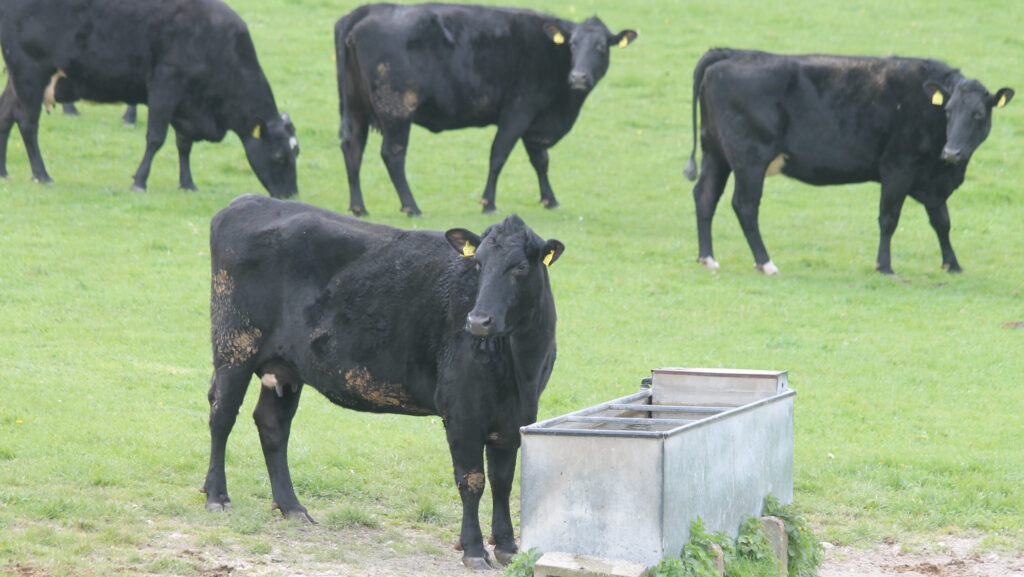
Duncan Ellis’ cattle drinking from a trough © MAG/Philip Clarke
New metering system
That is why when local water company South East Water approached the business with a proposal to trial a new metering system that can provide real-time data on water supply in multiple locations, Mr Ellis jumped at it.
Powered by solar photovoltaic (PV) panels, seven of these new meters – a Spherag system marketed by Wroot Water in the UK – are located at various points across the farm.
Each one transmits water flow data over a 2G connection, which Mr Ellis can access via an app on his phone or laptop in the farm office, allowing him to monitor and review water consumption remotely.
“The system was very easy to install,” he says.
“Because we were trialling it, we chose some pretty challenging locations on the farm for the meters, with no power and poor signals. We had to make it ‘farmer proof’.”
And it has worked well, with the continuous data transmission building up a baseline picture of what water consumption should look like, enabling Mr Ellis to then spot when anything appears out of the ordinary.
For example, the system picked up a surge in water consumption next to a rental cottage on the farm, which continued overnight.
Subsequent investigation identified a valve leak in the garden, which was quickly repaired.
Tom Brassington, principal agricultural consultant with Adas and a key instigator of the project at Church Farm, says:
“On two other occasions, the technology allowed us to identify a burst pipe very soon after it happened, so the water loss was minimal.”
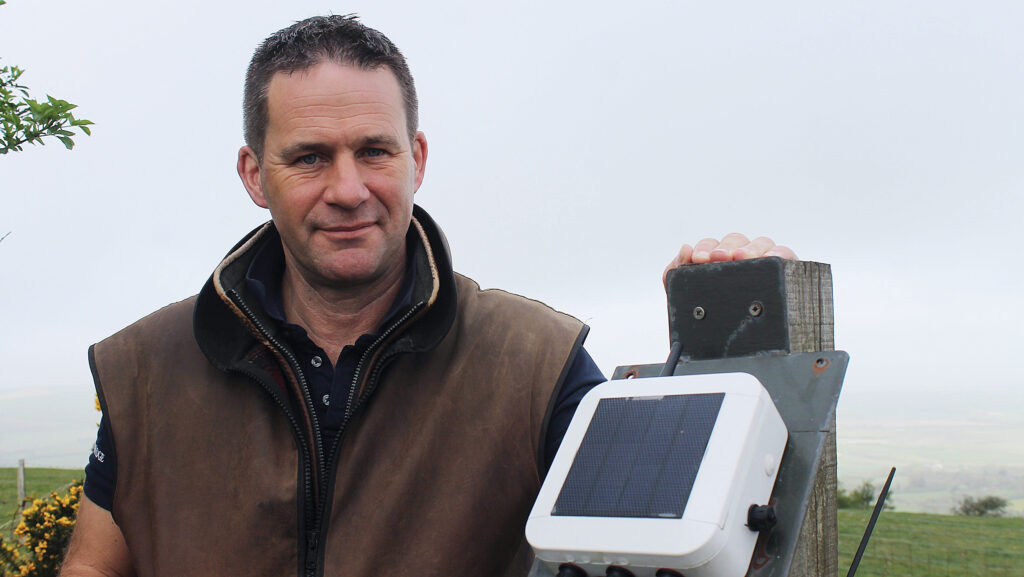
Duncan Ellis with the metering system © MAG/Philip Clarke
Teething issues
“There were some minor teething issue,” he recalls.
“For example, one of the solar-powered meters was installed in a low, shaded position on a roadside verge and didn’t have sufficient power to send a signal, so we replaced it with a higher-output PV cell.
“We also installed protective casing around cables to protect them from rodent damage, and fenced off units to prevent livestock from bumping into them.”
South East Water is so pleased with the outcome that it now wants to extend it to other farmers in its area, to conserve water resources in the face of climate change and housing pressure.
“Agricultural businesses have been identified as a key group where water use can be high, and monitoring is challenging,” says Steve Howe, operational catchment lead for South East Water.
“We feel it’s important to address this and, thanks to Duncan, we now know remote monitoring using specialised meters can work in a farm setting.”
Flooding – another threat to catchment farmers
Another farmer in the Cuckmere catchment with a keen eye on water levels is Richard Brown, who owns the 170ha Clapham Farm in Litlington, and rents a further 350ha from the National Trust.
As well as low-input crop production, he runs more than 1,000 breeding ewes, a herd of about 130 spring-calving suckler cows, plus 50 Boer goats.
Mr Brown is a stickler for measuring rainfall, which he says is the major determinant of the farm’s performance in any given year.
“2020 was the worst year in my farming life. We had so little rain there was no grass, the straw was half its usual length and we got about half the normal grain yield,” he recalls.
Silt
But the area of the farm adjacent to the Cuckmere River is highly prone to flooding as well.
Currently, water levels in the catchment overall is the responsibility of the Water Level Management Board (WLMB), which includes a number of farmers and councillors – local people with local expertise.
But the river itself remains the responsibility of the Environment Agency (EA).
And Mr Brown is critical of the way water flow and flood control have been allowed to deteriorate over many years.
A particular problem is that silt has built up, especially near the village of Alfriston, just upstream of the farm’s lowland grazing.
“The bank on the east side of the river has been eroded – mostly by walkers – and in 2023-24 it overtopped 20 times from October to March,” he says.
Channel restoration
After years of negotiation, the EA finally gave the WLMB permission to do the channel restoration – at its own cost.
“Even then, we were only allowed to remove the silt from half of the channel, and were told we could only do it in February, because of concerns about disturbing ground-nesting birds, migrating eels, harvest mice, or water voles at other times of year,” says Mr Brown.
“If we’d been able to start in January, it would have been OK.
“But in February 2024 we got 210mm of rain and the site was under water for six weeks.”
Channel restoration could not actually start until the autumn, by which time it was too late to dry the silt to repair the banks with.
They had to be repaired with brought-in clay at an additional cost of about £30,000.
Mr Brown says the whole operation cost “a mind boggling” £200,000 for just a 300m stretch.
Transferring responsibility
“The immediate problem has at last been solved, but we do need to do more and further progress has been slow,” he says.
“We want the Cuckmere River to be ‘de-mained’ – meaning that maintenance would become the responsibility of the WLMB.
“Transferring those legal rights and responsibilities to the WLMB would be better, as we are locally motivated and would do a better job – doing essential maintenance in anticipation of things happening, rather than just responding to them once there is a crisis.”
Mr Brown agrees that local farmers’ relationship with the EA is better than it used to be. “But we’d still like to cut out the bureaucracy that slows everything down,” he says.
“Natural England and the Environment Agency need to compromise on some of the regulations, such as ground-nesting birds and eel migration, and allow us to do the maintenance at the right time of year.
“It’s right that these species are protected, but sometimes that can go too far, causing even greater cost to the environment and the taxpayer.”
On a more positive note, Mr Brown points to the “more attentive” efforts of the EA in recent years to clearing the build-up of shingle at the mouth of the river at Cuckmere Haven, preventing “tide lock”.
“When that happens, the water backs up, forcing overtopping of the banks, causing damage to both the wildlife and farming operations.”
South East Water drives for quality and quantity
South East Water says it is “ahead of the game” in working with farmers to contain the supply of water across the region and improve its quality.
Over the past five years, the company has collaborated with farmers and landowners across more than 15,000ha, offering capital grants for planting cover crops, reducing soil run-off and reducing fertiliser and pesticide infiltration.
With rainwater running 20% below average for much of last year, the company is also offering grants of up to £15,000 towards rainwater harvesting equipment, as well as water efficiency audits, advice packages, and leakage reduction incentives.
More recently, in March, the Seven Sisters National Nature Reserve (NNR) was launched, with South East Water one of the partner organisations.
“It is the first super NNR declared for groundwater protection, using nature-based solutions and regenerative agriculture practices to improve the quality and quantity of water in the chalk aquifer,” said a spokesman.
The aim is to bring local farmers and landowners on board “to improve climate change resilience for both farmers and the environment”.