

Analysis: SFI returns in 2026, but doubts linger
 © Tim Scrivener
 After months of uncertainty, Defra has confirmed that England’s Sustainable Farming Incentive (SFI) will reopen in 2026, in a bid to rebuild confidence after the scheme’s abrupt closure last March.
Announcing the decision at the recent Oxford Farming Conference, Defra secretary Emma Reynolds acknowledged the damage caused by halting the scheme, admitting that “mistakes were made” and pledging there would be “no more sudden unexpected closures”.
See also: Defra sets out two-window SFI return in 2026
She promised a “simpler, fairer and more stable” SFI, with its core design fixed “for the rest of this parliament”.
As Defra’s flagship Environmental Land Management (ELM) scheme, the SFI has become a vital income stream for many farms, supporting cashflow while paying for public goods such as improved soil health, habitat creation and biodiversity.
Its closure to new applicants last March, after the scheme’s annual budget was fully allocated, left tens of thousands of businesses unable to apply and raised serious questions about trust and long-term stability.
While the latest announcement signals a reset, farmers, advisers and environmental groups say the success of the relaunch will depend on the detail.
Two windows, one reset
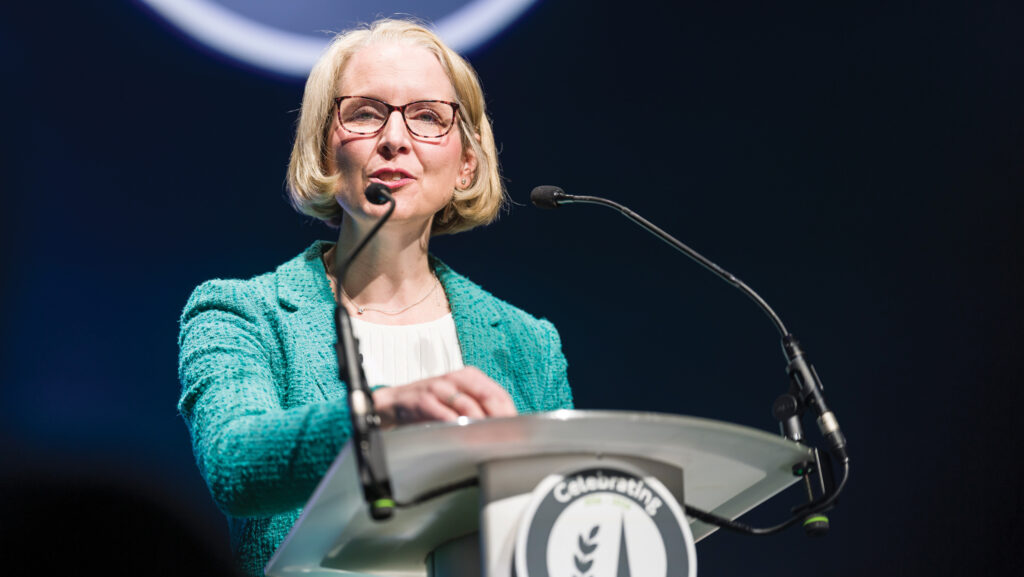
Emma Reynolds addresses the Oxford Farming Conference © OFC
The relaunched SFI will open through two application windows in 2026. The first, from June, will be restricted to smaller farms and those without existing ELM agreements.
A second, wider window will open from September for all farms.
Ms Reynolds said Defra was still working on how to define a small farm, but that it would be based on land area (hectarage) rather than turnover.
“The proxy has generally been 50ha, but we will come back and engage with the sector on that,” she said.
Martin Lines, chief executive of the Nature Friendly Farming Network, said the next two months were critical for shaping that definition.
However, he warned that key uncertainties remained.
“We don’t know the overall budget for the June window, or how much money will be available per farm,” he said, noting that Defra was actively considering imposing an agreement value cap on the amount individual businesses can claim.
Mr Lines urged Defra to focus on what constitutes a resilient business, including the income needed to provide a living wage and long-term financial sustainability.
He also warned of a “real risk” that strong demand in June could significantly reduce the amount of funding available in September.
Simpler, more capped
Defra argues that the SFI has become over-complicated. Ms Reynolds said 90% of current spending went on fewer than 40 of the 102 available actions.
The proposed reforms include reducing and bundling actions, limiting how much land can enter certain options – particularly those that remove land from production – and reviewing payment rates where uptake has been high.
Defra says fairness is the second major pillar of reform. Its figures show that about 25% of funding currently goes to just 4% of farms.
Ms Reynolds says that concentration cannot continue if the government is to meet its Environmental Improvement Plan target of doubling the number of farms delivering for wildlife by December 2030.
Planning risk
Advisers warn that without early clarity on actions and payment rates, farmers will struggle to plan rotations and make cropping decisions.
Rob Gazely, a farming consultant and partner at Ceres Rural based in Essex, said:
“The cropping year effectively starts in April, with cropping plans being produced and fertiliser bought forward. Does Defra recognise timing as being a critically important factor?”
Further key questions remain, including which actions will have adjusted rates and whether changes will apply to boundary measures such as buffer strips and grassy corners, or broadacre options such as legume fallows, low-input cereals and overwinter stubbles.
It is also unclear whether this will be a one-off reset or the start of regular rate changes, as occurred under Countryside Stewardship.
Chloe Timberlake, an environment adviser at Ceres Rural based in Oxfordshire, warned that reducing payment rates for some actions risked incentivising corner-cutting, including the use of cheaper, lower-quality seed mixes, reduced fertilisation of wild bird food plots, and failure to top up or re-establish wildflower margins once they decline.
“This could see public money spent on substandard public goods, while headline statistics still show ‘delivery’,” she said.
Budget pressure and ambition
The NFU accepts the farming budget is finite, but cautions against diluting the SFI’s ambition.
Its deputy president, David Exwood, said the scheme must remain accessible to all food-producing businesses if it is to deliver the public goods it was designed for.
If caps are introduced, the NFU supports a per-hectare approach rather than an overall agreement ceiling. Lower-value agreements may no longer be worth the administrative effort for participating farms.
Lower-value agreements may no longer be worth the administrative effort for participating farms.
The NFU also warned of mounting urgency, with 27,800 agri-environment agreements due to expire by the end of 2026-27.
With that deadline approaching, Mr Exwood said clear SFI budgets for both windows were essential to maintain environmental delivery and give farmers the confidence to plan and invest.
Environmental organisations, meanwhile, warn that spreading funding more thinly must not undermine outcomes.
Alice Groom, head of sustainable land policy at the RSPB, said agri-environment schemes could recover nature, “but only if well-designed and paired with nature-positive advice”.
She also highlighted a looming green scheme cliff edge: by 2028, all Higher Level Stewardship and many legacy agreements will expire, potentially leaving more than 1.5m hectares of land without support.
“We urgently need a transition plan for these early adopters so they can build on the gains already made for nature and climate,” she said.
Application windows and delivery
Defra has pledged that application windows will not close without warning and that budgets will be published in advance.
Farmers want reassurance on how this will work in practice, including whether real-time uptake data will be available and what thresholds might trigger early scheme closure.
There are also concerns about timing. Short application windows in June and September coincide with some of the busiest periods in the farming calendar, while delayed agreement start dates could push delivery of some actions back by a full cropping year.
“If agreements from the September window don’t start until late autumn, some actions will be unable to be delivered until the 2027-28 cropping cycle, delaying the environmental outcomes Defra wants to see,” Mr Gazely said.
His preference is for Defra to reintroduce a rolling application window to allow farmers and consultants more time to plan and submit applications.
Stability promised, detail awaited
As of October 2025, committed annual SFI spending stood at £848m across about 35,500 businesses.
Defra says full details of payment rates for the reformed 2026 SFI will be released before the June application window opens.
Ms Reynolds pledged clearer guidance, defined budgets for each window, and regular updates on uptake. “You’ve told me you need clarity, stability and predictability,” she said.
For farmers, the direction of travel is clearer. Whether the 2026 reopening delivers a scheme that is genuinely simpler, fairer and robust enough to support both food production and long-term land management now depends on the detail still to come.
Government launches rural investment drive
The government has unveiled a trio of major farming and rural policy announcements, signalling a renewed focus on collaboration and long-term investment in England’s protected landscapes.
Speaking at the Oxford Farming Conference, Defra secretary Emma Reynolds announced a new £30m Farmer Collaboration Fund, to be delivered over three years.
The fund will support existing and new farmer groups to share knowledge, work with experts, and unlock opportunities that are difficult to achieve alone.
“The Batters review [the Farming Profitability Review, led by Baroness Minette Batters and published on 18 December 2025] highlights that collaboration between farmers and indeed with experts will be key to closing the productivity gap and improving farm profitability,” Ms Reynolds said.
The second announcement sets out a long-term transformation of England’s uplands, beginning with pilot partnerships in Dartmoor, followed by Cumbria.
Defra will work with social entrepreneur Dr Hilary Cottam and local communities to develop a new, place-based approach that pools public, private and third-sector resources.
Ms Reynolds said Dr Cottam and Defra would start a long-term partnership with communities, aiming to “lay the foundations for new income streams and creating the skills and networks that let communities lead their own transformation”.
The Foundation for Common Land welcomed the initiative. Julia Aglionby, its executive director, said the uplands “are better managed when we put people and their relationships at the heart of decision-making, where we build capacity among communities to address knotty problems”.
The third announcement extends the Farming in Protected Landscapes (FiPL) programme for a further three years, with £30m of funding nationally in 2026-27.
John Marland, who farms in Sussex and chairs the FiPL panel for the High Weald landscape, said:
“These grants have already funded more than 150 excellent projects across the High Weald and I’m very pleased this work can continue.”
Explore more / Transition
During the series we follow our group of 16 Transition Farmers through the challenges and opportunities as they seek to improve their farm businesses.
Transition is an independent editorial initiative supported by our UK-wide network of partners, who have made it possible to bring you this series.
Visit the Transition content hub to find out more.
