

Farmers’ High Court battle begins over IHT reforms
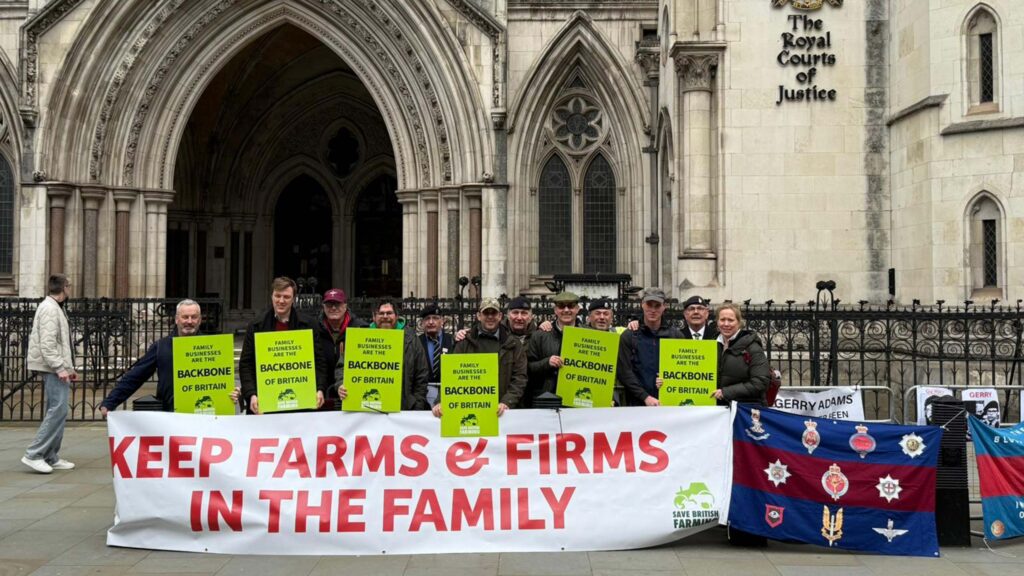 Save British Farming supporters outside court © Save British Farming
 A legal challenge to farm inheritance tax reforms began today (17 March) in the High Court, with farmers and business owners arguing the government acted unlawfully by failing to properly consult on sweeping changes.
The two-day judicial review at the Royal Courts of Justice in London will examine whether chancellor Rachel Reeves should have conducted a full public consultation before altering agricultural property relief and business property relief (APR and BPR).
The legal challenge is being brought by Cambridgeshire farmer Tom Martin, his father George Martin, and the campaign group Farmers and Businesses for Fair Tax Relief. The claim is supported by law firm Collyer Bristow on behalf of Alvarez & Marsal.
See also: High Court date set for APR legal challenge
Farmers and supporters from the Save British Farming lobby group gathered outside the court today, displaying a large banner reading “Keep Farms and Firms in the Family” and holding placards declaring, “Family Businesses are the Backbone of Britain”.
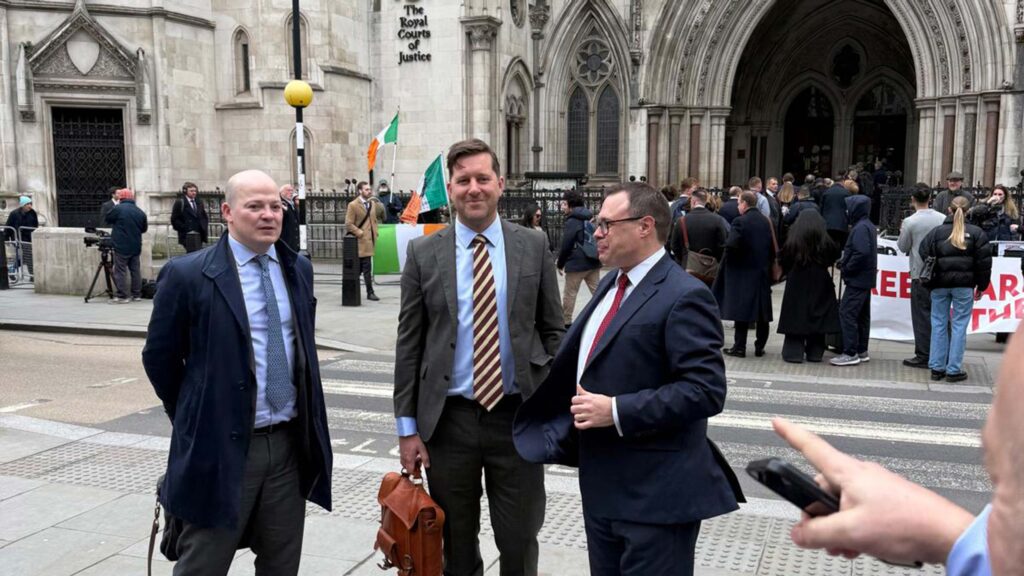
Tom Martin (centre) and lawyers © Save British Farming
Posting on Facebook ahead of the hearing, Tom Martin said: “I should be on the farm today planting barley or spreading fertiliser, but instead we’re at the High Court asking the court to declare that the chancellor’s decision not to consult properly on inheritance tax changes was unlawful.”
The claimants argue that the government promised to consult on major tax changes under its long-standing Tax Consultation Framework, in place since 2011, which commits ministers to “carry out at least one formal, written, public consultation in areas of significant reform”.
They say the farm inheritance tax (IHT) changes clearly qualify as significant, yet only a narrow technical consultation on trusts was carried out, leaving affected families without a meaningful opportunity to influence the reforms.
In summary, the claimants argue:
- The government had a clear policy committing to consultation on such changes
- Consultation never properly happened, denying people a voice in decisions affecting their livelihoods
- The reforms significantly affect how farms and businesses are passed down through generations.
Under current proposals, due to take effect from 6 April 2026, inheritance tax will provide 100% relief on the first £2.5m of agricultural and business assets and 50% thereafter.
However, married couples and civil partners will qualify for £5m tax relief plus standard allowances, with any tax payable over 10 interest-free years.
Farming families ‘in limbo’
Lawyers representing the claimants say the lack of consultation has left farming families in limbo.
Alexander Marcham, managing director at Alvarez & Marsal Tax, said: “Many of the farms and businesses affected have been built over generations. When tax changes this significant are implemented without giving those affected a chance to be heard, planning for the future becomes much harder.
“Families are left making decisions about succession, investment, and their businesses without clarity or a fair chance to participate in policy development.”
The government disputes the case, arguing that judicial intervention risks encroaching on parliamentary territory.
The claimants reject this, insisting that the decision not to consult occurred before any parliamentary process began and is therefore open to legal challenge.
Reserved judgment ‘likely’
Judgment is likely to be reserved at the end of the hearing and issued in writing, probably within three months. The outcome could have far-reaching consequences for how future tax policy is shaped.
The UK government said it did not comment on ongoing legal cases.