

Scottish elections: Swinney vows fast action on food cap
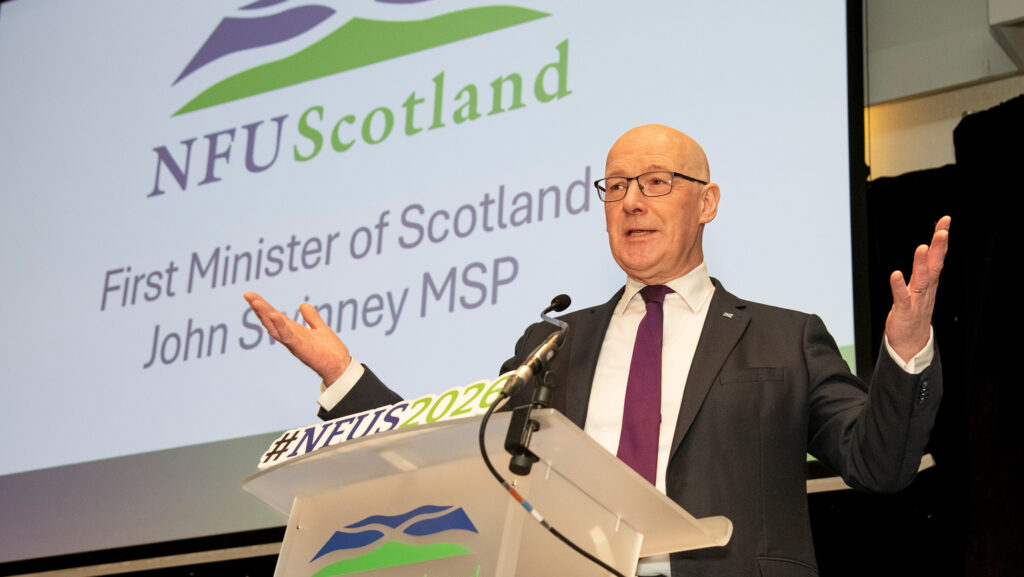 John Swinney © NFU Scotland
 John Swinney has reiterated his commitment to introducing legislation for a supermarket food price cap within the first 100 days of a new SNP government, despite growing concerns from the farming and food sectors over how the policy would work in practice.
Speaking to BBC Scotland as early Holyrood election results pointed towards another SNP-led administration, the first minister said the party would begin the legislative process for the policy immediately if returned to power.
“We’ll be taking the legislative steps to take that forward within the first 100 days, just like I promised that we would do,” Mr Swinney said.
See also: Analysis: Tight Holyrood race raises stakes for Scottish farming
“That will be one of the central commitments, because what I promised the people of Scotland was that I would act, and I’d act decisively to help them in their time of need, in meeting the challenges of the cost of living.”
The SNP’s proposal would allow ministers to cap the prices of a basket of staple supermarket food items to tackle household cost pressures in Scotland.
Supply chain concerns
However, the idea has already prompted concerns across the agricultural supply chain, with questions over whether retailers could ultimately pass costs back to farmers and processors already operating on tight margins.
The policy also raises questions over how any Scottish-only cap would operate alongside the UK Internal Market Act and wider UK competition rules.
One of the few international examples frequently cited by critics is Hungary’s attempt to cap prices on around 30 staple food products, which faced significant legal and market challenges.
As Scotland moved towards what appears likely to be another SNP-led administration, rural organisations warned the next parliament would face mounting pressure over farming, food production and land use policy.
Early election projections suggest the SNP remains comfortably the largest party, although still potentially short of the 65 seats needed for an outright majority, increasing the prospect of renewed co-operation with the pro-independence Scottish Greens.
Scottish Labour has also underperformed expectations, intensifying questions over whether Sir Keir Starmer’s government at Westminster has failed to translate broader UK Labour support into gains north of the border.
SNP secures Shetland
One of the election’s most striking rural results came in Shetland, where SNP candidate Hannah Goodlad secured a surprise victory with what broadcasters described as a roughly 10% swing away from the Liberal Democrats – a rare breakthrough for the party in one of Scotland’s traditional Lib Dem strongholds.
Agriculture minister Jim Fairlie also retained Perthshire South for the SNP with 14,707 votes, ahead of the Conservatives on 9,646, Reform UK on 5,128, the Liberal Democrats on 4,329 and Labour on 2,599.
However, the Scottish Liberal Democrats secured one of the election’s most emphatic victories in Orkney, with returning MSP Liam McArthur winning 70% of the vote – the largest vote share recorded in the history of the Scottish Parliament.
Early polling suggests Reform UK has emerged as one of the election’s biggest disruptors, appearing to draw significant support from traditional Scottish Conservative voters and contributing to a disappointing performance for the Conservatives across parts of rural and suburban Scotland.
SLE reaction
Eleanor Kay, senior policy adviser on agriculture and climate change at Scottish Land & Estates (SLE), said the next parliament would be “a busy time for farming and rural policy”.
“From food price caps and funding pledges to the usual commitments to cut red tape and let farmers farm, the voice of rural Scotland can have a real bearing on what the parliament will deliver,” she said.
The result of the 2026 Scottish Parliament election is expected by early evening, around 6-7pm on Friday 8 May, once the last constituency and regional declarations come in.