

How an AI agent helped a farmer beat the SFI deadline
 © Adobe Stock
When Staffordshire arable farmer Clive Bailye sat down in a London café on 22 September, he had one thing left to do on an application worth hundreds of thousands of pounds to his business – check it and press submit.
The paperwork was filled in. The field details were there. Even a discrepancy in one parcel had been spotted.
The “person” responsible was Giles, an AI farming agent being developed by a small start-up.
See also: Alasdair Boden: AI will never replace a farmer’s gut feeling
“I’m blown away by it,” says Mr Bailye. “I’ve seen plenty of new technology in my farming career, but this is the first that, straight out of the blocks, has added real, tangible value to my bottom line.”
Two or three weeks before Window 2 of the 2026 Sustainable Farming Incentive (SFI26) opened, he used Giles to plan which options suited his cropping and productive land.
Then he realised he would be in London the day the window opened. “I told Giles my problem,” he says.
“The system monitored the government website and, when the window opened at 10am, began filling in the application. By about 10.30am, I received a message saying it was ready to review.”
Mr Bailye checked and cleared the application on his phone.
“At 11.09am it was all in,” he says. The funding pot was exhausted at 3.48pm.
“If I had chosen to leave it until I got home from London, I would have missed out on a significant amount of money.”
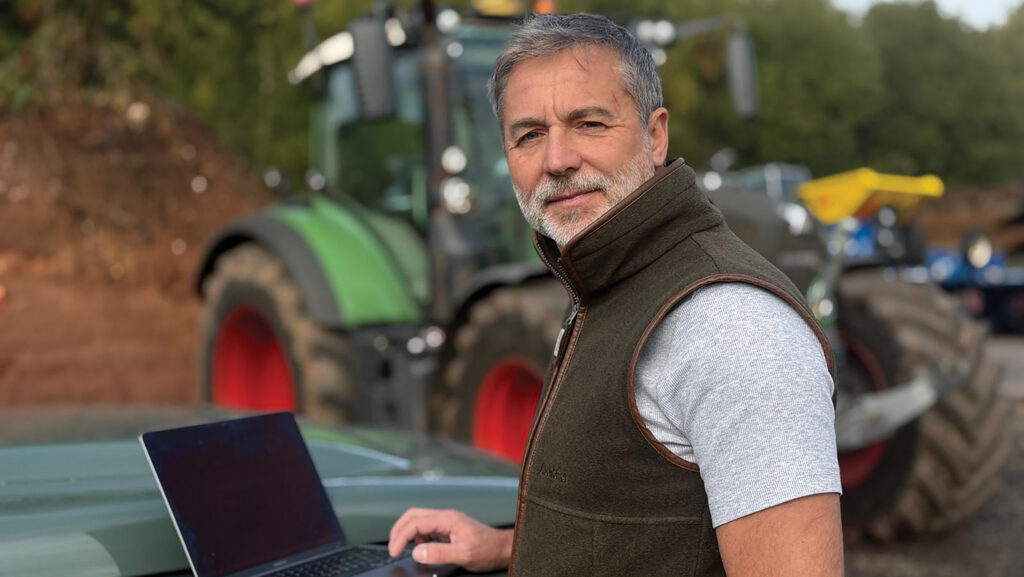
Clive Bailye
Proactive advice
Mr Bailye describes Giles as a “super consultant”, bringing together the roles of agronomist, administrator, accountant and commercial adviser.
It has analysed more than 20 years of yield maps and soil-testing data from his farm, TWB Farms, near Lichfield, Staffordshire.
It also suggested growing spelt wheat and found a microbrewery four miles away looking for growers.
When he needed 10,000 litres of red diesel, it found suppliers, sent enquiries by email and came back with offers.
“It’s not just reactive. It’s proactive. That’s what I like about it,” he says.
Next up is Red Tractor. A long-time critic of the scheme’s red tape, Mr Bailye believes Giles could automate much of the audit process, paving the way for more credible field-to-fork assurance and potential premiums for farmers.
How Giles works
According to David, a developer building the system, the idea came from Mr Bailye.
“The reason farmers aren’t doing this is they don’t have the time to learn how to set it all up. I’m just the implementer.”
Rather than relying on a single AI model, Giles selects the most cost-effective and efficient tool for each task from a growing range of large language models (LLMs), including Claude, ChatGPT, Gemini, Grok and Jev.
It is designed to build a private “farm memory” from records such as field maps, yield data and machinery details, and by asking the farmer questions.
Farmer stays in charge
As AI moves from advice to action, David insists farmers remain in charge.
A second AI system provides an additional check on its work, although final verification and decisions remain with the user.
Each farm’s information is kept separate and will never be sold or shared commercially with buyers or suppliers.
Asked whether tools such as Giles will cost farm jobs, David says: “AI isn’t going to take your job. But people using AI are likely to take the jobs from people who are not.”
The adviser’s view
Simon Haley © Simon Haley
Simon Haley, an independent rural business adviser at SRH Agribusiness and a member of the Central Association for Agricultural Valuers’ (CAAV) AI working group, says tools such as Giles are “genuinely exciting and potentially valuable”.
However, he warns that their adoption will require farmers to take data governance and privacy more seriously.
Asked whether AI will take over the traditional role of the farm business consultant, he says: “AI will take on a growing share of the administrative work advisers have traditionally done, and the profession should not pretend otherwise. But that is not the same as replacing good advice.
“The value of an adviser is increasingly in knowing what matters, challenging the evidence, understanding the individual farm and its people, joining different issues together and being accountable for the recommendation.”
But he adds: “Advisers need to adapt, but good professional judgement becomes more important, not less.
“It is still the adviser sat in the farm kitchen, with the communication skills to build and nurture relationships, and deliver effective and considered advice, that will matter most.”
Who is behind it, and what next?
Giles is being taken to market by a newly formed limited company, Agigence.
It has received initial grant funding from Defra’s Adopt innovation fund, which will pay for the AI running costs so trial farmers can use Giles for free from November through most of 2027.
Agigence is looking for more farmers to pilot the tool at agigence.com.
Early in 2027, a public beta is planned for low hundreds of UK farmers, starting with arable, as a web app with iOS and Android versions.
Pricing has yet to be set, but if commercialised, Giles is likely to be offered through a free tier alongside paid monthly subscriptions.
Mr Bailye accepts Giles is not ready for general use and that sharing farm data raises concerns.
But seeing it identify and correct errors during testing has given him confidence.
“It allows farmers to farm rather than spend their lives filling in forms,” he says.
AI and Giles explained
What is AI?
Artificial intelligence is software trained on vast amounts of text and data to recognise patterns and produce useful answers.
Tools like Claude and ChatGPT are large language models (LLMs).
They can read documents and maps, write, calculate and, increasingly, carry out tasks online.
How does Giles work?
Giles sits on top of an LLM and adds farming knowledge, such as how to complete SFI and grant applications, and builds a private “farm memory” from your records.
What do I tell it?
Start with your farm, then add your SFI agreement reference number, so it can pull in field data. Or just ask general questions.
What can it do?
Research, calculate, draft applications and gather supplier prices. Built tools include seed rate and crop margin calculators.
Who decides?
You do. Giles asks for approval before acting and drafts for you to check.
Is my data safe?
Each farm’s information is kept separate and not sold or shared.
The farmer remains in control and chooses how much or little, he/she is prepared to share.
The more they share, the more Giles can help them, but that choice is theirs.
Which AI does it use?
For each task, Giles picks the AI and model best suited to that particular job, choosing between Claude, ChatGPT, Gemini and others, and the most efficient one that will do it well, to keep costs down. As new models arrive, its choice grows.
Farmer hands wheat fungicide plan to AI
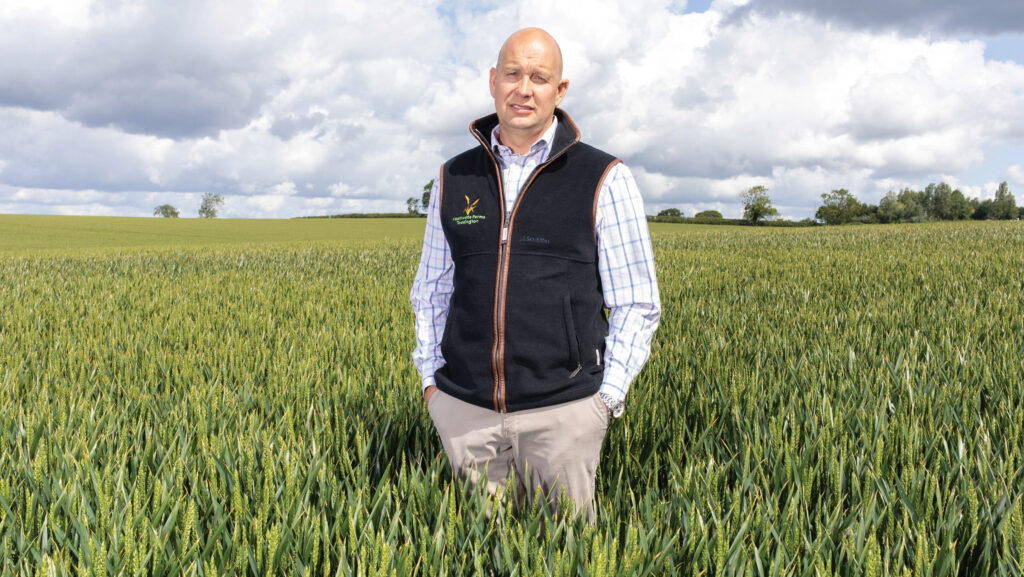
Andrew Robinson © Tim Scrivener
A farmer who asked artificial intelligence (AI) to devise a fungicide programme for his winter wheat, says he plans to repeat the experiment this season.
Andrew Robinson, farms director at Heathcote Farms, in Toddington, Bedfordshire, had the idea in the middle of the night.
“It started off as almost a bit of fun,” he says.
But the more information he fed into Microsoft Copilot, such as seed rate, drilling date, soil type, the more reasonable its answers looked.
“I wanted to see what AI could do compared to what we could do – and I didn’t actually disagree with it.”
Mr Robinson says the AI recommendations differed from his own, suggesting a heavier T1 spray and lighter T2 – the reverse of the farm standard.
The half-hectare trial plot looked cleaner than the farm’s standard spray programme.
But it was also dearer, costing £167/ha against £136/ha for the farm’s own. It wasn’t infallible either, working from the wrong weather forecast until it was corrected.
But Mr Robinson says the experiment was useful because it recommended a fungicide programme he hadn’t considered.
“It’s just about learning,” he says. “We’re all about learning and we plan to repeat it this season.”
The trial features in a new Farmers Weekly Farm Insight podcast – available to listen to on Apple Podcasts and Spotify – in which host Johann Tasker asks: “Can AI replace your agronomist?”
Explore more / Transition
Follow the experiences of our 16 Transition Farmers and access in-depth supplements, expert webinars, live events and practical content covering the challenges and opportunities facing farm businesses.
Transition is an independent editorial initiative supported by our UK-wide network of partners.
Explore the Transition hub for the latest insights, resources and events.
