

Opinion: Muck will become more valuable as the climate changes
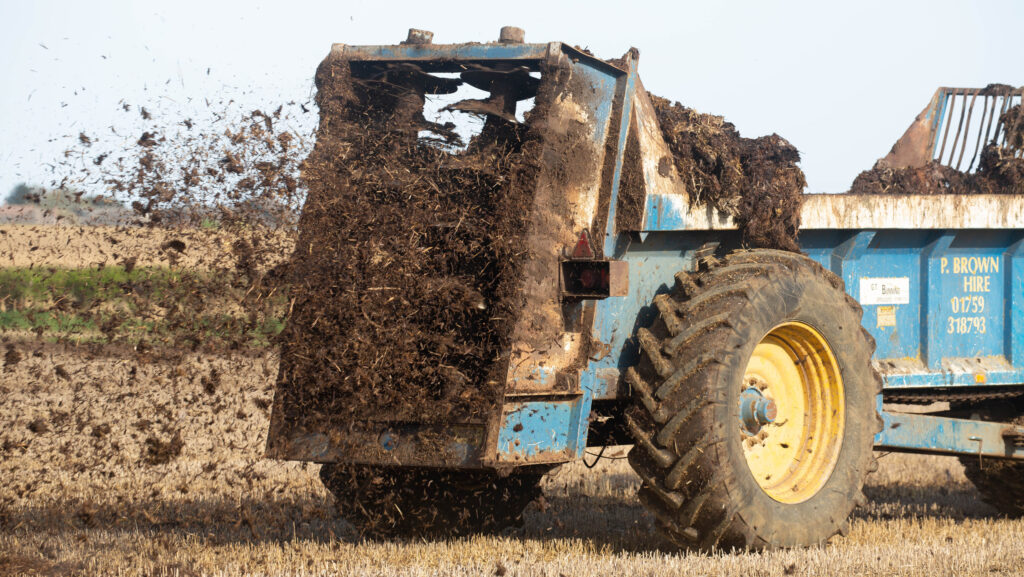 © Tim Scrivener
 A pattern of wet winters followed by dry springs seems to be emerging – the wet winters leading to poorly rooted crops and the following dry springs leaving crops unable to access the moisture and nutrients they require.
We need to be working towards a cropping system that is more resilient to these extremes.
Lots of small things can help, but it has become increasingly clear in the past few years how valuable manure applications are in improving a crop’s ability to withstand these prolonged weather events.
See also: Opinion – new SFI means more risk and more cost for farmers
About the author

Last year on our farm, one of our blocks of wheat particularly struggled. It had been continuous cereals for four years, but it hadn’t obviously suffered from take-all.
The wheat looked fine through the early spring, but died off much too early and yielded very poorly.
In contrast, on a farm that we contract for (with a similar soil type), their second and third wheats yielded very well.
This is despite being drilled in such poor conditions that we didn’t dare apply the full pre-emergence herbicide array as too much seed was visible.
The only reason I can think of for such a stark difference is the amount of manure applied on that farm – either the nutrients were more readily available near the surface or the organic matter was more able to hold onto the moisture.
There will be farmers in parts of the country heavily populated with livestock who can’t find enough land to get rid of their muck.
But in the East, where livestock numbers continue to decline, it must be increasingly common to have land that never receives any.
As the climate changes and crops suffer stress more often, these farms need to look carefully at where they can get more muck.
It can seem expensive either when bought outright or when valued equivalent to the straw it replaces.
The easiest way to improve average yields is to make the poorest parts of the farm better, and this is where muck will help
But muck usually works out to be much better value for money than the alternative when the nutrient content is fully considered.
Logistically, hauling, storing and spreading manure also takes a lot more work.
The regulatory burden also has to be considered.
Defra is tightening up the rules around manure spreading, and for a while last year was considering banning autumn applications.
This could have been a real disaster for arable and livestock farmers as spring applications, in many cases, don’t fit the cropping cycle.
Fortunately, when the updated guidance on the Farming Rules for Water were released this was not the case.
But there is now a requirement for justifying “crop need”, documented in a nutrient management plan.
Environment Agency inspections are becoming much more frequent.
We had our first inspection recently and it is true they spend a large amount of time checking all things relating to muck and it would be very easy to slip-up.
Despite the cost, logistics and extra paperwork, any farm that does not currently apply manures would greatly benefit from introducing it.
The easiest way to improve average yields is to make the poorest parts of the farm better, and this is where muck will help.
If the nutrients, organic matter and the extra life that it brings can make the poorer parts good, gross margins as a whole can be greatly improved.