

Swinney pledges safeguards for farmers over food price cap
 © Adobe Stock
 First minister John Swinney has sought to reassure Scotland’s farming industry that SNP plans to cap the price of essential food items will not come at the expense of producers.
The pledge came as the Scottish government prepares to deliver one of its key first 100-day commitments, publishing draft legislation requiring large supermarkets to cap the cost of staple products, such as bread, milk and eggs.
Under the proposal, retailers would be required to offer at least one version of selected essential items at a capped price as part of efforts to tackle the cost-of-living crisis in Scotland.
See also: Scottish elections: Swinney vows fast action on food cap
However, a similar proposal was previously ruled out by the UK government after attracting strong opposition from retailers and industry groups, who warned it could distort markets and ultimately harm suppliers.
Speaking at the QMS breakfast meeting at the Royal Highland Show in Ingliston, near Edinburgh on Thursday 18 June, Mr Swinney insisted the Scottish Government remained committed to the policy, but acknowledged concerns within the agricultural sector.
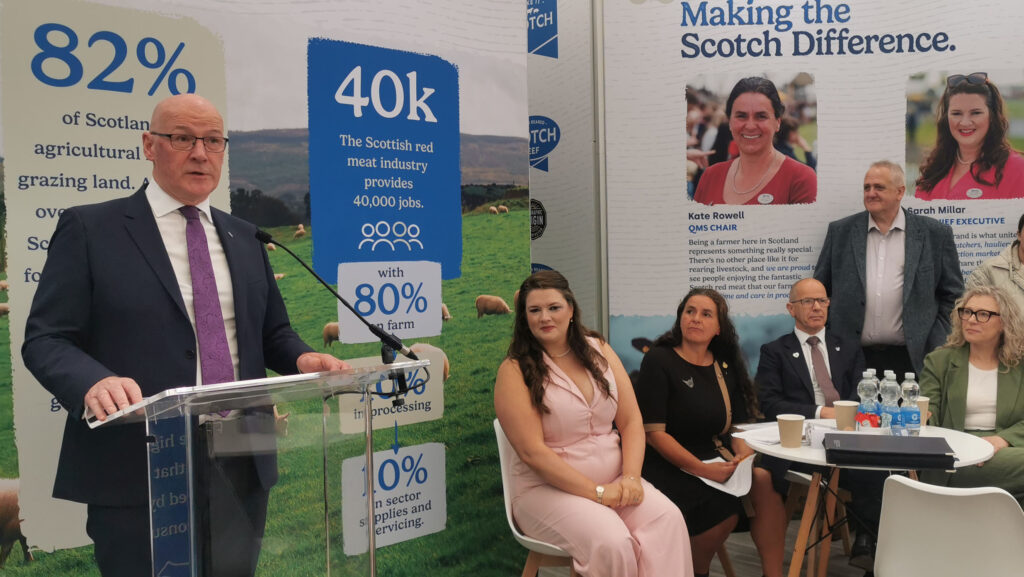
First minister John Swinney addresses the QMS Breakfast meeting © MAG/Philip Case
“I believe the cap is needed to ensure that as the cost-of-living pressures persist, essential food items, and I stress essential food items, remain affordable to members of the public,” he said.
“It’s needed because no one should have to choose between feeding their family and meeting other basic needs.”
Pledge to farmers
However, he stressed the policy would not be allowed to undermine Scotland’s food producers.
“We also know that achieving our aim requires very careful consideration and handling. That cannot come at the expense of farmers, growers and producers who produce these items for us all.”
Mr Swinney said ministers would work closely with the industry on the policy’s implementation.
His comments were later reinforced by agriculture minister Jim Fairlie, who said protecting producers would be central to the scheme.
“My job will be to make sure that this does not land on the doorstep of the primary producer,” he said.
“I will be absolutely vigorous in my defence to make sure that that doesn’t happen.”
NFUS concerns
Responding to the comments, NFU Scotland vice-president Duncan Macalister said farmers remained concerned about how the plans would work in practice.
“If we have a food price cap and it’s squeezed back by the processors to the primary producer, we’re not going to be here. We can’t keep getting squeezed,” he said.
“The consumer may get a bit of short-term gain, but there’ll be long-term pain because we won’t be there to produce their milk, their eggs or their beef.”
Asked how producers would be protected, he added: “I don’t know. That’s a very good question. If they can find a way of doing it, bring it on, let’s talk about it. But it cannot come at the expense of primary producers.”
The proposal could also face legal and political challenges, with SNP ministers arguing that changes to the UK Internal Market Act may be required to prevent the legislation being blocked.