

How low-input spring malting barley wins for Dorset farm
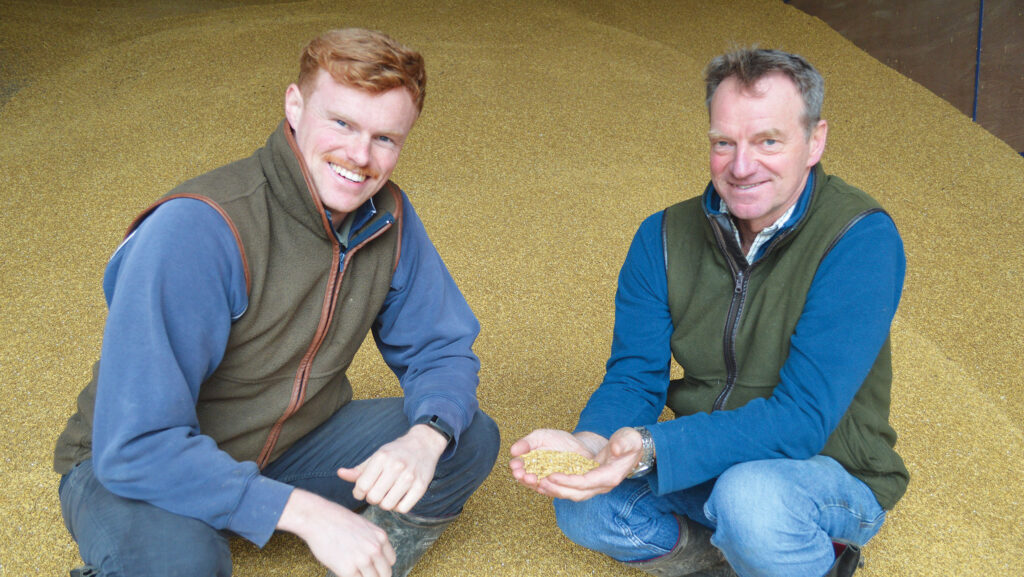 Ben (left) and David Chick © David Jones
 Dorset spring malting barley growers David and Ben Chick are continuing to grow the crop, despite collapsing malting premiums, as it performs consistently with low inputs and has won them a key trophy.
In a year of poor malting barley performance in eastern England and Scotland, the father and son’s 2025 yield was down, but still produced a very respectable 7.5t/ha at a grain nitrogen content of 1.75%.
See also: New barley set to be key dual-purpose variety across UK
A bold, bright grain sample of the variety Laureate helped them win the best malting barley crop with local grain merchant Robin Appel, despite a bone dry spring and summer with only 30mm of rain from drilling to harvest.
With sheep grazing cover crops ahead of spring barley, nitrogen rates are pared back to 120kg/ha and soil organic matter has been rising over recent years making the spring-sown crop a very resilient option on their free-draining chalky loam soils.
“Spring barley is a consistent performer and not an expensive crop for us to grow as long as we keep costs under control,” says David, who farms with son Ben.
On the edge of a vast livestock market in the South West, all barley and wheat straw is baled to gain from good straw prices, but every field gets organic matter in terms of compost or manure every three years to keep soil organic matter high.
“It’s a crop that suits the area, we have a variety that is robust and we are on the edge of the West Country for a good straw market,” adds David.
Challenging season
But last season was not without its challenges due to the dry weather, and despite good grain quality, half of the farm’s spring barley from a 120ha crop went as feed as there was simply too much barley chasing a shrinking malting market.
Spring barley yields usually average 8.5t/ha on the family’s Manor Farm at Sixpenny Handley in north-east Dorset, between Blandford Forum and Salisbury, and turn in a grain nitrogen of 1.6-1.7%.
But in 2025 yields were down at 7.5t/ha, within a range of 7-9t/ha, while nitrogen averaged 1.75%.
“These were the most stressed spring crops I’ve ever seen, and we saw many small ears on the barley, so we were pleasantly surprised at the harvest results, which we put down to the resilience of our soils,” says Ben.
Soil organic matter is at a high level of 6.5% on their light free-draining chalky soils, testament to the farm’s cover crop, sheep grazing and compost/manure spreading regime.
“We have been looking after the soil and building organic matter over the years, which is helping our resilience,” says David.
The 400ha arable farm grows winter wheat, spring and winter barley with break crops of oilseed rape and peas. Both spring crops – barley and peas – follow a cover crop or stubble turnips.
These winter forage crops are direct drilled following a cereal crop, and then a local grazier run his sheep across the ground from November to mid-February, and the cover crops can be chest-high by the time the sheep enter the field.
Cover crop
Ben recently completed his dissertation at Harper Adams University on cover crops, so he is keen to find the best mixture of six to eight species to improve soil health.
The mix often includes fodder radish, linseed, phacelia, linseed, oats and forage rape, and the land is grazed by up to 1,000 sheep.
The key question is how much available nitrogen the cover crops and grazing sheep will give the spring crop. David and Ben err on the side of caution and calculate they can cut nitrogen by about 15kg/ha for the following spring barley crop.
The charge to the sheep grazier brings in enough to cover half the seed cost of the Laureate spring barley at £50/ha, plus all the benefits to soil health and fertility.
When the sheep have departed, the cover crops are allowed to green up and then sprayed off with a low dose of glyphosate to kill off what remains of the heavily-grazed crop.
The ground is then cultivated down to 60-70mm with a Kockerling tine and packer-roller machine.
This cultivation takes out any possible soil capping from the sheep grazing and aerates the soil to prime any available nitrogen in the soil.
Polysulphate, to supply potash and sulphur, has already been applied to the cover crop.
The spring barley is drilled with a 6m disc Sky Easydrill, which is flexible enough to drill after minimum cultivation for the spring barley but can still direct drill oilseed rape, cover crops and winter wheat after peas.
“We are using the drill to direct drill, but not for spring barley after sheep as we believe the soils need some aeration,” says Ben.
Seed rates for the Laureate have been edged up in recent years to 400 seeds/sq m from 350 seeds sq/m to allow for the effects of dry spring weather, and the ideal time for drilling is seen as the first week in March, and is then followed by rolling if there is no risk of soil capping.
“Establishment is everything, and if we get it right we are 70% towards getting a good crop,” says Ben.
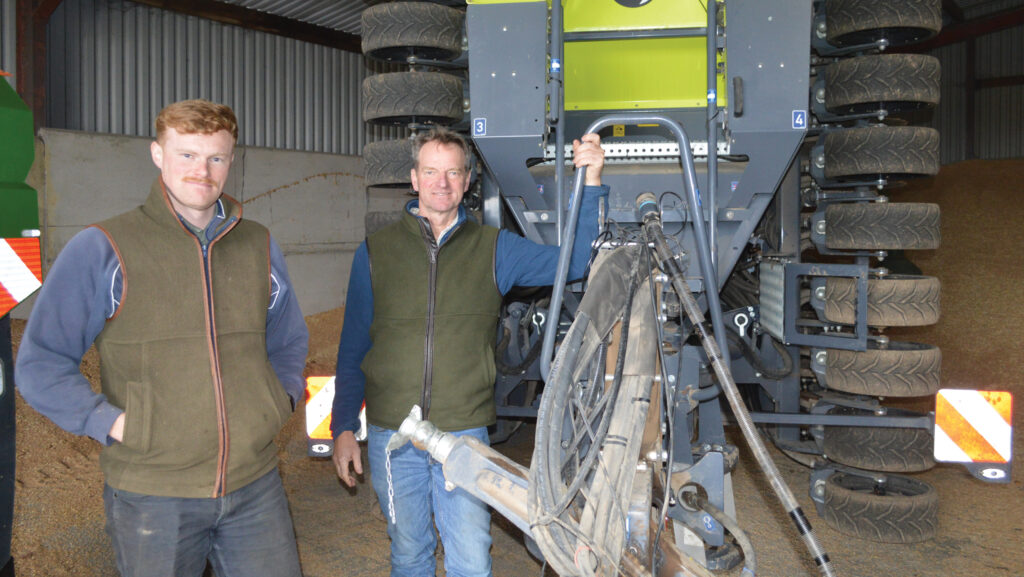
Ben (left) and David Chick with their Sky Easydrill © David Jones
Fertiliser strategy
Nitrogen rates and timings are held back a touch as the cover crop, sheep grazing and light cultivation is deemed to give some available nitrogen to the seed-bed, and so no nitrogen is applied at drilling.
The strategy is to apply 60kg/ha of solid ammonium nitrate when the tramlines are just visible and then another 60kg/ha at the two-to-three leaf stage in early April.
They will be looking to reduce rates down to 100kg/ha with a fertiliser tax looms, but this is tempered this spring by the fact there may be little residual nitrogen in the soil after such a wet winter.
Last season’s spring and summer were so dry, there was little disease in the crop, and fungicide use was limited to a reduce rate of the azole tebuconazole at the end of April.
In a more typical year, this would have been followed up in late May by an azole-strobilurin mix of prothioconazole and azoxystrobin.
Herbicide use is limited to a wild oats product, such as Foxtrot (fenoxaprop-p-ethyl), followed by a broad-leaved weed treatment later.
The result was a Laureate crop cut earlier than usual in mid-July with a yield of 7.5t/ha, specific weight of 66kg/hl, grain nitrogen of 1.75% and low screenings with 97% retention over a 2.5mm sieve, and a bright and bold sample of grain.
This season the spring barley crop will rise to 140ha for rotation reasons, while David and Ben see the crop as key to maintaining the long-term rotation essential for the sustainability of the farm.
Winning crop
© David Jones
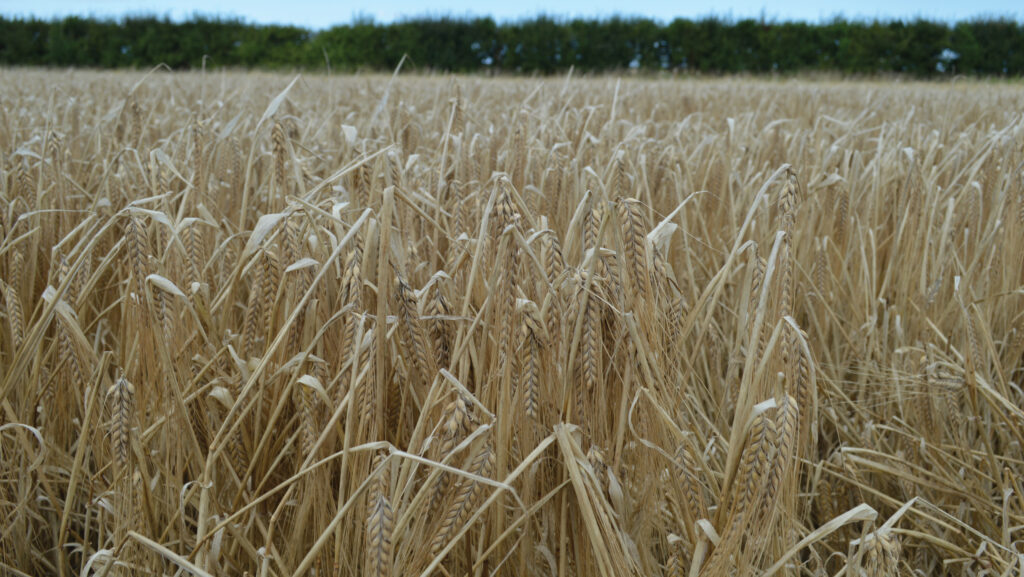
David and Ben Chick’s success in winning the Robin Appel Malting Barley Cup came from producing a grain sample meeting the wide range of characteristics demanded by the maltsters.
Jonathan Arnold, trading director at the grain merchant, says the group looks at the overall impression of barleys such as grain size, skinning, level of awns, lack of fusarium, moisture and a bright and bold grain sample.
With more than 200 samples to judge, it was the all-round quality of the barley from the Chick’s farm that won with a bold grain sample giving a specific weight of 66kg/hl and low screenings, while the nitrogen was relatively low at 1.75%.
Despite the good-quality crop, malting barley premiums have shrunk to about £10-£15/t over feed, down from £80-£100/t a few years ago due to lower demand from the brewers and distillers, and the lack of a strong export market.
The UK spring barley area is expected to be down 15% this year to a 15-year low, and with no early spring barley sowings due to the very wet weather, traders are forecasting a smaller spring barley harvest this summer.
This has helped the malting premium for harvest 2026 edge ahead to £20-£30/t in East Anglia.
