

Advice on effective late blight control in potatoes
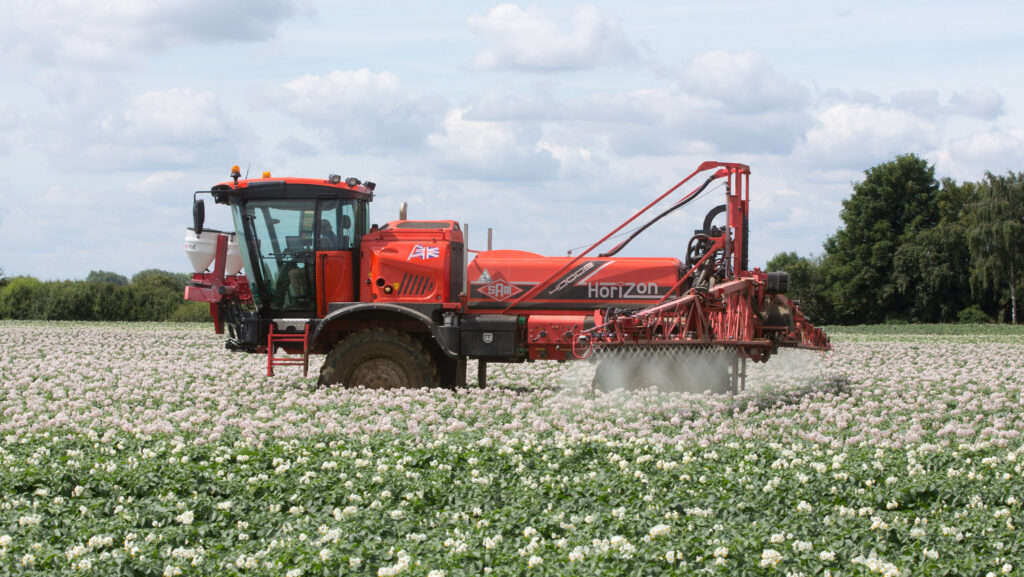 © Tim Scrivener
 Alternating fungicides to protect chemistry is key to maintaining effective late blight control in potatoes.
Resistance management is a central component of any potato blight programme as aggressive and resistant strains of Phytophthora infestans emerge across the UK and Europe.
Hutchinsons potato agronomist Morven Nimmo, says that last year’s late blight pressure was relatively low due to the widespread dry weather conditions, but warns the situation could change rapidly.
“As soon as humidity increases and temperatures are favourable, blight can develop rapidly,” she says.
See also: Why genetics must be central to late blight management
Top tips for managing blight
- Start with a robust prevention strategy
Begin fungicide programmes before infection risk becomes high. Protectant sprays applied ahead of conducive weather remain the most effective defence against late blight. - Mix and alternate modes of action
Avoid repeated use of the same active ingredients. Use mixtures and alternate fungicide groups throughout the programme to reduce selection pressure. - Protect high-risk chemistry
Products containing actives such as oxathiapiprolin or mandipropamid should always be used with appropriate partners to help maintain their efficacy against evolving blight strains. - Maintain appropriate spray intervals
Do not stretch spray intervals beyond recommended timings, particularly during periods of high risk. Even the strongest products can lose effectiveness if intervals are too long. - Monitor local blight populations
Use services such as the Fight Against Blight monitoring programme and consider submitting samples as a blight scout. Knowing which strains are present locally helps inform product choice. - Control volunteer potatoes
Volunteer potatoes can act as reservoirs for blight inoculum. Managing volunteers throughout the rotation helps reduce disease pressure across the wider landscape. - Adapt product choice to crop growth stage
Some fungicides perform best during rapid canopy growth, while others are better suited later in the season as crops begin to senesce. - Watch for early blight pressure
Alternaria is becoming more prevalent in UK potato crops. Monitor crops carefully and adjust fungicide programmes where necessary, particularly in stressed crops. - Maintain crop nutrition and plant health
Nutritional stress can increase vulnerability to disease. With the loss of mancozeb, ensure micronutrient requirements such as manganese and zinc are addressed through crop nutrition programmes. - Take a flexible, risk-based approach
Blight pressure can change rapidly depending on weather conditions. Use forecasting, field monitoring and local intelligence to adjust programmes accordingly.
Understanding blight strains
Late blight populations are made up of different strains, which determines how aggressive the strain is and how it responds to chemistry.
“Repeated use of the same product or mode of action is risky,” explains Morven. Mutation and selection pressure allow certain strains to become dominant over time.
Two strains currently of particular concern are EU_43_A2 and EU_46_A1. EU_46_A1 has demonstrated resistance to OSBPI fungicides, including oxathiapiprolin, while EU_43_A2 shows resistance to both OSBPI and CAA chemistry, such as mandipropamid.
“There is also the risk of cross-resistance,” Morven warns. “So the industry must focus on mixing and alternating fungicides to avoid encouraging resistant populations.”
Data from the Fight Against Blight monitoring programme, run by the James Hutton Institute, recorded 81 outbreaks during the 2025 growing season. In a typical year, up to 300 outbreaks may be reported.
A further 47 outbreaks were identified from September onwards, largely driven by mild autumn conditions that allowed volunteer potatoes to persist and become infected.
“Growers can support the monitoring programme by submitting samples and becoming blight scouts.
“That information helps identify which strains are present locally and supports better decision-making around spray strategies.”
Why it’s best to avoid extended spray intervals
Michael Rodger of Richard Austin Agriculture, who conducts fungicide trials for Hutchinsons, evaluated a range of fungicides currently available in Great Britain.
Oxathiapiprolin plus amisulbrom ranked among the most effective treatments. Other products such as ametoctradin with potassium phosphonates and fluopicolide also provided strong levels of control.
“Some fungicides are particularly well suited to the early part of the season because their systemic activity helps protect rapidly growing foliage,” explains Michael.
However, as the crop begins to senesce, performance may decline, meaning product choice should evolve as the season progresses.
Products with lower rankings in trials can still play a valuable role in programmes but are best used as part of mixtures to reduce resistance pressure.
Lessons from previous resistance
The history of blight management demonstrates how fungicide use can shape pathogen populations. The well-known EU_13_A2 strain, often referred to as Blue 13, illustrates this point clearly.
First detected in Europe in the early 2000s, EU_13_A2 was aggressive and resistant to metalaxyl. Within a few years it became the dominant blight strain across Great Britain.
However, as growers reduced reliance on metalaxyl, the strain gradually declined. By 2025 it represented just two percent of reported outbreaks.
Monitoring data from 2025 suggests that EU_46_A1 accounted for about 23% of samples. However, Morven cautions that this figure may be inflated because many detections came from research trials rather than commercial crops.
Another strain, EU_43_A1, was detected in an infected volunteer potato in Suffolk during autumn 2025. Its ability to spread widely across regions has raised further concerns.
Evidence suggests these strains may have arrived in Britain via weather systems moving across Europe. Their emergence has also been linked to spray programmes in some countries where the same fungicides were applied repeatedly in blocks.
Mixing and alternating fungicides
“In Denmark, growers moved away from repeated applications of the same chemistry and began alternating modes of action while using appropriate partner products,” says Morven.
Products such as oxathiapiprolin-based fungicides and mandipropamid were mixed with other actives to ensure that if one ingredient was less effective against a particular strain, the partner-product maintained control.
For UK growers, the same principle applies. Blight programmes should incorporate mixtures of complementary actives and alternate between different modes of action.
Correct timing is also critical. Some fungicides have relatively short activity windows and must be applied at the appropriate stage to maintain protection.
Early blight also a growing concern
In addition to late blight, growers should also remain alert to the increasing importance of early blight caused by Alternaria species.
Alternaria solani is the more common and aggressive pathogen, but A alternata can be more difficult to control once established in the crop.
The disease reduces green leaf area and accelerates canopy senescence, shortening the bulking period and reducing yield potential.
Changing weather patterns, increasing crop stress and the loss of mancozeb may all contribute to higher levels of early blight in future seasons.
“Nutritionally or physiologically stressed crops are often more susceptible. Maintaining crop health is an important part of managing the disease,” says Michael Rodger of Richard Austin Agriculture.
Ultimately, both experts stress that flexible, risk-based strategies are essential.
