Fungicide application advice as wheat disease pressure remains high
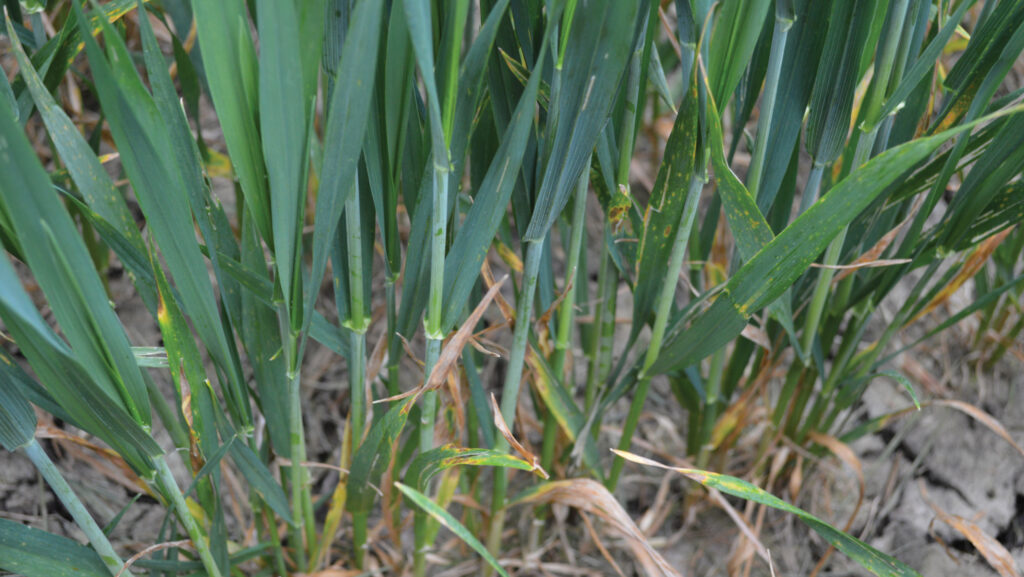 Septoria in the bottom of the wheat crops at the Oxfordshire trial site © David Jones
 Disease pressure is high in winter wheat crops despite a dry April, and growers are being urged to protect the flag leaf at the critical T2 spray timing, especially as many crops have a good yield potential.
Septoria is present on the lower leaves of many wheat crops encouraged by early drilling and the wet winter months, while yellow rust is active especially in newly susceptible winter wheat varieties.
Aoife O’Driscoll, senior specialist in plant pathology at crop consultant Niab, says winter wheat crops are not clean down to the floor because of the heavy disease pressure, so growers need to focus on the critical top leaves.
See also: Arable Insights farmers’ differing tactics for wheat disease
“It’s all about protecting and preserving the flag leaf – there is nothing growers can do now about the base of crops,” she says.
Aoife advises wheat growers to focus on fungicides for the T2 flag leaf spray applied in late May, which are strong on septoria and active on rusts, such as an SDHI or Inatreq in combination with an azole.
Looking at Bayer’s Crop Doctor site in south Oxfordshire, she points out that septoria was visible in a number of wheat varieties after rain in mid-March, while yellow rust “exploded” in the last week of April.
Septoria was being seen at the leaf four stage in late April, – it is likely to rub up against newer leaves and with any rain in May, the disease could move quickly up the crop canopy and hit yield.
Fungicide T1 applications made in late April are focused on protecting leaf three and will probably also protect the tip of leaf two, but the rain in mid-March at the Oxfordshire site will have encouraged septoria to cycle and spread.
Yellow rust was also present at the site and, although controlled by previous fungicides and the dry weather, there was scarring on the winter wheat leaves which indicates some disease damage had already been done.
The foliar disease was especially noticeable in fungicide-untreated plots of the variety Champion.
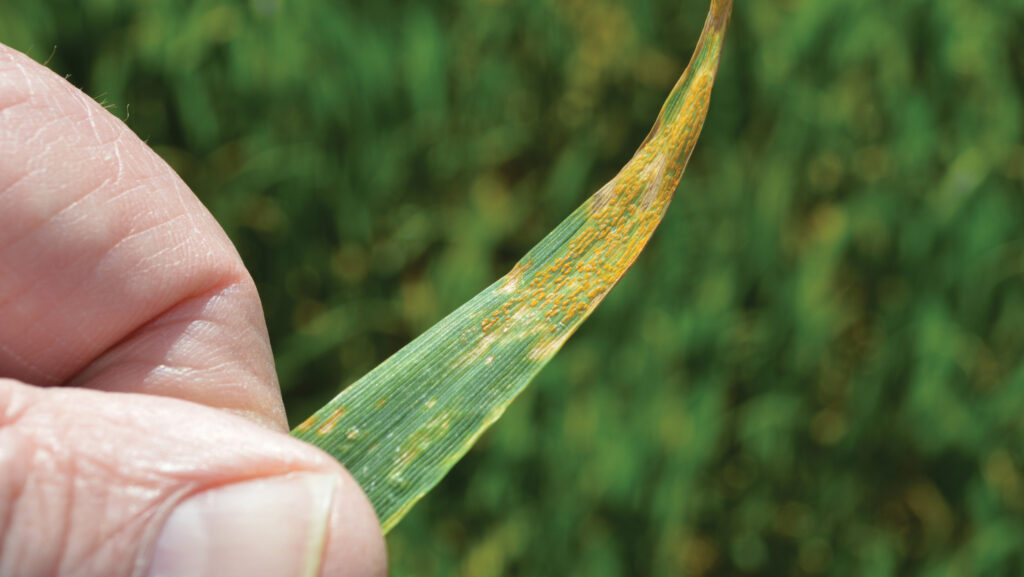
Champion with yellow rust © David Jones
This is one of the winter wheat varieties – along with Dawsum, Beowulf and others – containing the Yr15 gene that has been overcome by the mutation of a yellow rust race, and so these varieties have become more susceptible to the disease.
Brown rust was spotted in the susceptible milling wheat variety Crusoe on the site.
The disease has not developed as quickly as it did in the 2024 season, so an epidemic of that year’s proportions is not expected, although rust control later this season is still important.
Key wheat fungicide actives
- Amistar – strobilurin azoxystrobin
- Ascra – SDHIs bixafen and fluopyram, plus azole prothioconazole
- Comet – strobilurin pyraclostrobin
- Jessico Fusion – Picolinamide fenpicoxamid (Inatreq), plus SDHI isoflucypram (Iblon)
- Miravis Plus and Era – SDHI pydiflumetofen (Adepidyn), in a twin pack with azole prothioconazole (Era)
- Plaxium – SDHIs isoflucypram (Iblon) and fluopyram, plus azole prothioconazole
- Revystar – SDHI fluxapyroxad (Xemium) plus azole mefentrifluconazole (Revysol)
- Univoq – Picolinamide fenpicoxamid (Inatreq) plus azole prothioconazole
Oxford site
The trial site at Glebe Farm in Hinton Waldrist, south-west of Oxford, was drilled relatively late on 14 October to give time to control grassweeds in the silty loam soil.
The farm is close to the River Thames and has a history of rust infections.
Ben Giles, commercial technical manager in central England for Bayer, spotted septoria at the site in the third week of February.
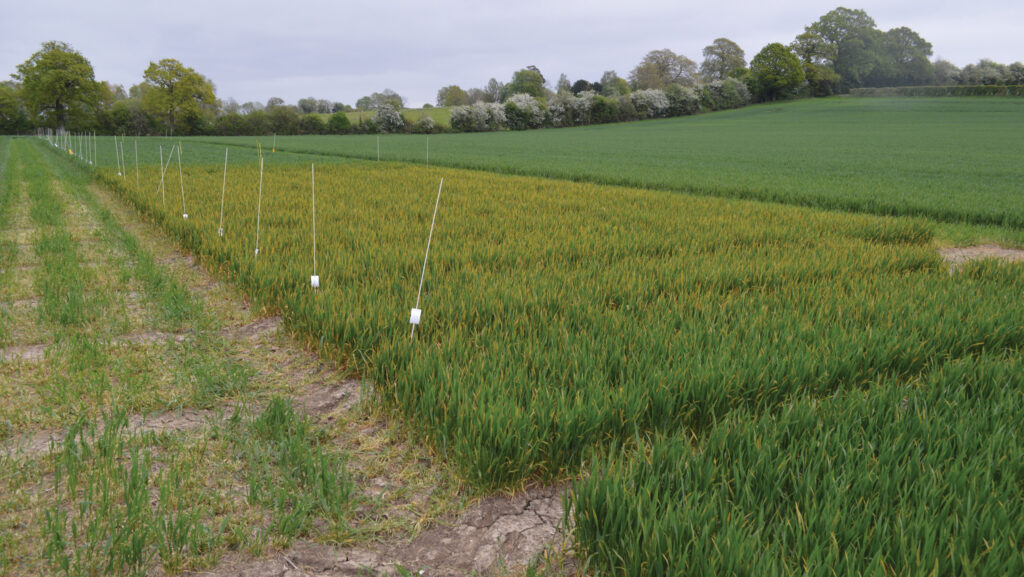
Fungicide-untreated Champion, showing how yellow rust has affected this susceptible winter wheat variety © David Jones
Yellow rust also appeared in the same month, and was especially noticeable on fungicide-untreated plots of the variety Champion.
The site had 15mm of rain on 11-12 March, which is likely to have encouraged the spread of septoria, and since then only 6mm to the end of April.
The field plots had a T0 of the azole tebuconazole on 29 March to protect against yellow rust, and T1s on 24 April included a range of different fungicide treatments.
“The wheat looks good, but there is a lot of disease inoculum in the crop and it will need a robust T2 due to its good potential yield,” says Ben.
Yellow rust was very visible across the site, as it tends to favour cool and damp weather, while septoria spread is a danger as it likes the current warmer conditions, as well as thriving in wet weather.
The later-developing brown rust favours hot and moist weather, which may come later in the season.
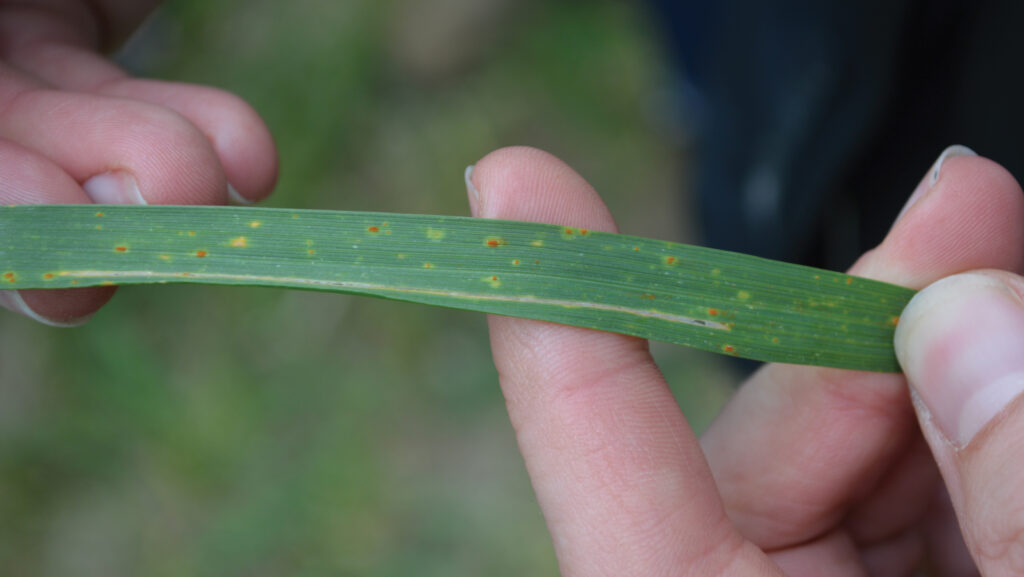
Brown rust on Crusoe © David Jones
T2 choices
Experts caution on cutting back too heavily at the T2 stage, with many well-established wheat crops having good yield potential despite the dry spring.
They emphasise that growers need to keep the flag leaf and as much of leaf two as clean as possible, as disease damage is already being seen on leaves three and four.
They say T2 treatments may tend towards septoria-specific products such as Miravis and Univoq or Jessico Fusion.
But if disease pressure is not so high, then more broad-spectrum products such as Revystar, Ascra or Iblon-based mixes like Plaxium could be used.
Some fungicide products such as Miravis, Univoq or Iblon-based ones can only be used once in a growing season.
The first two may need some rust actives added if rust is a real threat, with tebuconazole or the strobilurin azoxystrobin added if yellow rust is the key risk, or the strobilurin pyraclostrobin added if brown rust is the bigger threat.
The final choice of T2s will depend on the rainfall in May, what fungicide products were used for T1s, and the yield potential of individual wheat crops, say the experts.
T1.5 spray
Agronomist Paul Gruber, who covers Oxfordshire for advisory group ProCam, says there is a genuine threat from yellow rust to leaf twos in wheat crops.
The current cool weather could extend the gap between T1 and T2 sprays to four weeks or even more, so growers may benefit from a T1.5 spray of tebuconazole to keep yellow rust under control.
He has used Vimoy (Iblon) plus Cello on many winter wheat crops in areas with good yield potential at T1, and has tried to delay the spray as long as possible to cover the tip of leaf two.
Cello contains prothioconazole and also tebuconazole to boost rust control and spiroxamine for enhanced mildew and rust control.
“The yield potential is high in many crops, but we know that yellow rust will keep going and septoria spread will happen if it rains,” he says.
Agrovista technical manager Mark Hemmant points out that the current warm days and cool nights have produced overnight dews, which are encouraging septoria and yellow rust.
With so many early-drilled crops, there is a lot of septoria around.
Although there may be some scope to cut back on T2s on lighter soils where yield potential has been lost, this is not the case for the many crops with good yield prospects, he says.
“With many early-sown crops showing potential, the T2 should be robust on septoria and give good rust protection. Disease pressure is higher than last year, so to cut back on T2s can be risky,” he adds.
Farmers Weekly visited the Crop Doctor site in south Oxfordshire in late April.