The machines, technology and software Arable Insights farmers find invaluable
 © Richard Bramley
 Every farmer has a favourite piece of kit or technology on the farm. What is making a difference on the Arable Insights farmer panel’s farms?
See also: Arable Insights farmers’ differing tactics for wheat disease
North
Richard Bramley, Manor Farm, Yorkshire
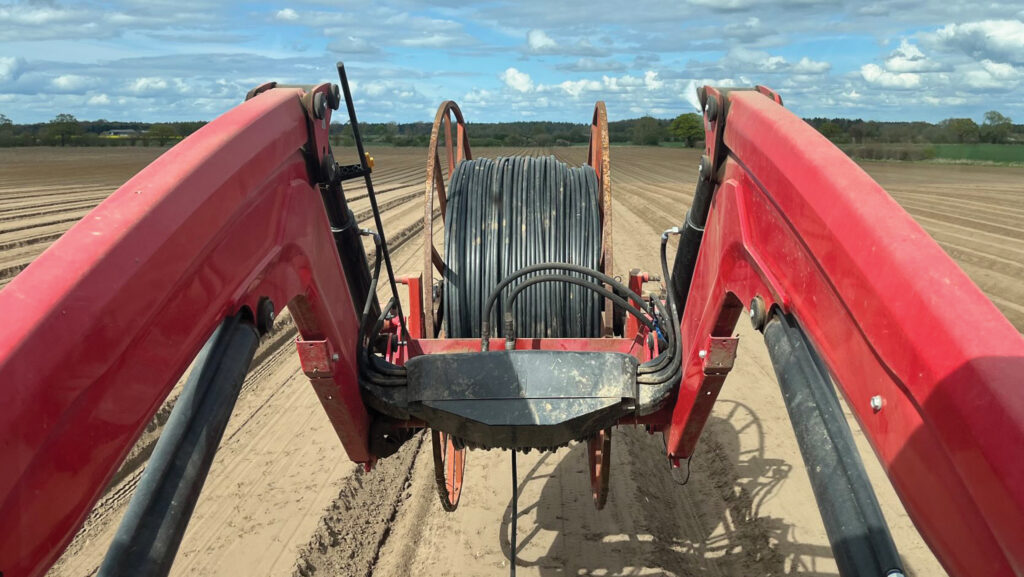
Engineering solution for collecting and laying irrigation
Engineering technology – far from new – is an important component for helping to make sure water is used efficiently on potatoes at Manor Farm, near Selby.
Having invested in reusable hard trickle hose nearly 30 years ago, Richard Bramley quickly discovered that a hired-in machine to lay and collect the hose post-harvest wasn’t particularly user-friendly.
That led to discussions with a local engineer and the development of a piece of kit that lays the hose from a cassette on a frame on the front of the tractor while potatoes are planted and then can collect it after harvest with the same equipment using a different rear-mounted frame.
“It has a hydraulic motor that acts as a brake.”
Further modification to the planter, working with another local engineer, saw the system developed to allow Richard to cut the hose at the end of the row, so he only needs to get out of the tractor once to fix the hose on the next run with a weight before pulling out the next length.
“It’s made potato planting much less onerous and transformed using a form of irrigation where the gain was lost from the practicality of actually using it.”
Water is sourced from two boreholes, which feed a series of sub-mains valves to which the hose is connected, he explains.
“We operate these individual blocks on a sequence in order to deliver what the plant needs each day.
“We don’t put on a week’s supply. We put on an amount of water every day, if it needs it.
“If it rains, we don’t turn it on. It’s an insurance against dry years, in particular.”
Water requirements are informed by irrigation scheduling management provided by Mark Stalham Potato Consultancy using satellite data, soil types, rainfall, ground cover, variety and so on, Richard says.
“In theory it’s more efficient and doesn’t require much management, once it is set up at the beginning of the season.
“It doesn’t interfere with blight management, and while it slows down planting, I think it allows us to do a better job of growing potatoes.”
East Anglia
James Porter, Porters Farm (Walpole), Suffolk

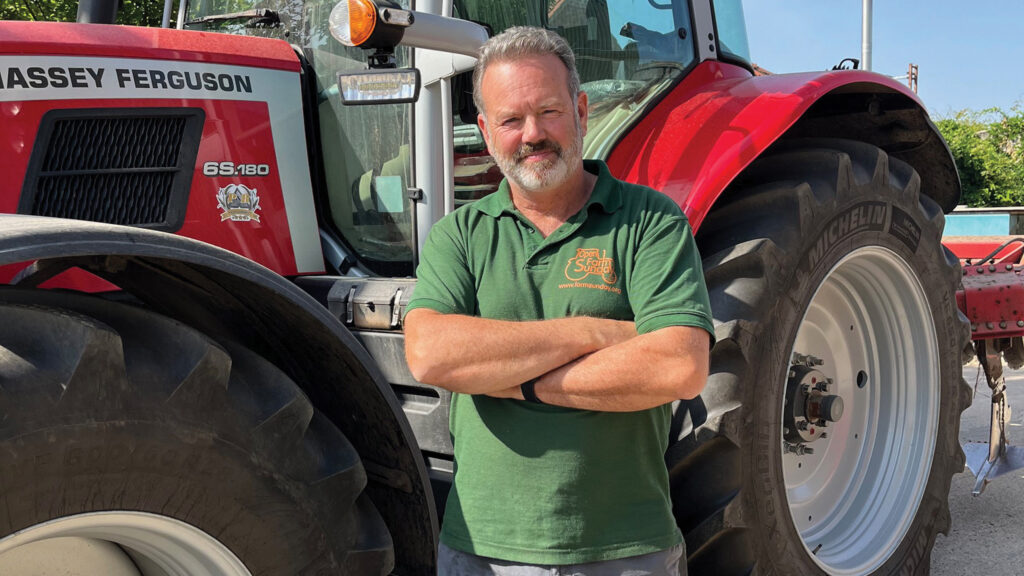
James Porter © James Porter
Gatekeeper farm software
A piece of software that has been around for ages helps make management operations simpler and more precise at Porters Farm (Walpole) in Suffolk, linking to GPS technology on machinery.
“Gatekeeper is a bit clunky and could be improved, but I like it,” James Porter says.
“There’s no other programme that I’ve seen available currently that can do what it does.”
A key initial task was capturing accurate field boundaries by driving around field edges in a GPS-enabled utility vehicle.
Once uploaded into Gatekeeper, James’ wife – a wizard on the programme, James says, spent a lot of time drawing in stewardship plus cross-compliance areas to create precise field boundaries.
“Practically, having this in place is a godsend,” James says. “Once you have it, it just makes a lot of things so easy.”
In particular, it’s the key enabler for precision farming from using it to generate maps for machinery guidance to tracking where work has been done and for planning variable rate applications.
“Variable rate seeding, which we’ve been using for at least 10 years, has been the biggest step forward on the farm.”
But it’s not just precision farming Gatekeeper unlocks – stock management is another challenge it simplifies across the business, which includes land managed under contract farming agreements.
“All our sprays, for example, come into one store. When they are used Gatekeeper pinpoints exactly where it has been used.
“When we send out quarterly charges, we have a Gatekeeper report that works out exactly what chemical has come from where, and how much each farm has used and owes us.”
Using its gross margin analysis across the rotation helped pinpoint areas that were underperforming in arable cropping and were more suited to stewardship areas, while it makes Red Tractor compliance straightforward.
At some point James knows he’s likely to need to either switch into the new farm management software, Gatekeeper manufacturer Telus is developing, or find a new option, but he’s in no hurry.
“None of them seem to be quite there yet,” he says.
Scotland
David Aglen, Inverarity Farms, Angus

David Aglen © David Aglen
Mobile phones
While David Aglen has a bit of a love-hate relationship with mobile phones, given that it makes you contactable at all hours instead of some set times of day, he recognises the positive impact that being able to access the internet has had on running his business.
“It allows us to access far more information from around the world in a far shorter time frame than we might otherwise be able to,” he says.
“You don’t have to wait for some research scientist to present something to you at a conference, you can just find it for yourself.”
An example is researching how to control disease in crops without using fungicides – something he’s been keen to accomplish for several years.
Early searches not only told him that it could be possible but provided examples of using foliar feeds linked to keeping plants healthy making them less prone to infections.
“There’s a lot of knowledge out there.
“When you find lots of stuff that tells you it can work and this is how you do it and how to improve it, it gives you confidence to go and find more people to speak to and learn more.”
The logical next step could be using artificial intelligence.
David has dabbled a little and was impressed at Google Lens’ ability to correctly identify wheat diseases from photos, while noting friends had found artificial intelligence tools relatively useful for suggesting competent fungicide programmes.
But he’s still cautious. “I haven’t got to grips with it,” he admits.
“I don’t trust it because it just takes all the information from anything on the internet and doesn’t know what is actually correct.”
South
Andy Meecham, St Giles Farm, Dorset
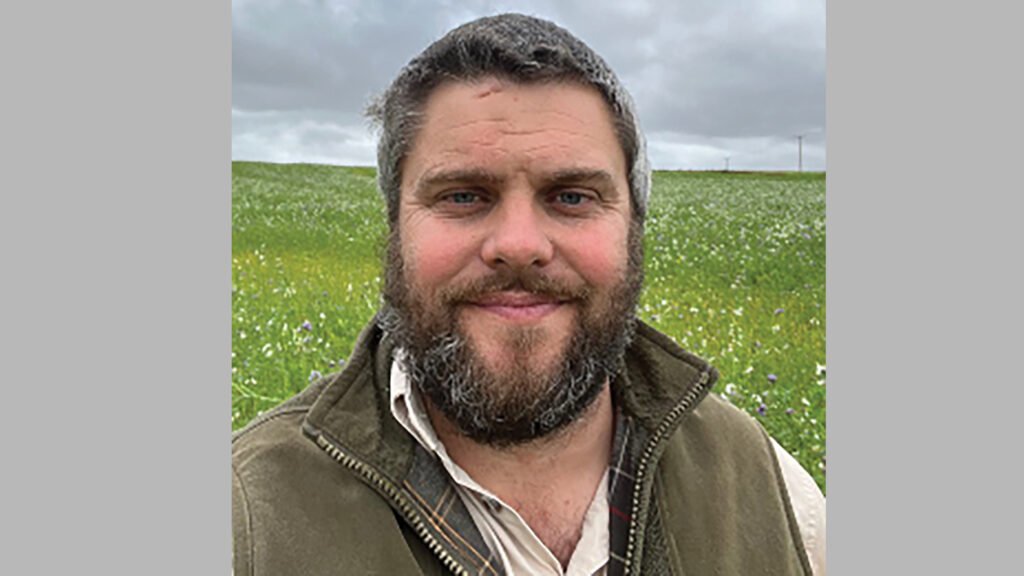
Andy Meecham © Andy Meecham
Grain moisture and protein tester
An infrared grain moisture meter that provides real-time protein analysis is the cherry on the cake for a major new investment at St Giles Farm on the Shaftebury Estate – a highly automated, multimillion-pound grain storage system designed to improve on-farm efficiency.
The spike in energy costs resulting from the war in Ukraine highlighted just how inefficient the previous storage system was, farm manager Andy Meecham explains.
“It was costing us around £80,000 a year just for the pleasure of moving grain around.
“We also had to move 2,000t of grain at harvest because we didn’t have enough storage, which meant we were dictated to on price.”
The review has resulted in 8,000t of new storage taking the total to about 11,000t, which is more than the farm needs currently, although it is going through the process to become TASCC registered so it can store other farmers’ grain and another income stream.
A 350t intake pit with two 350t holding bins feed a dryer into an automated system, including a cleaner processing around 60t/hour, and self-filling grain stores, Andy says.
“It’s reducing our labour requirements hugely, and means the need to push grain up with a JCB is minimal.”
With the extra storage capacity, it means Andy can analyse the first few loads from a new field for grain protein levels and decide where to store.
“If it is looking iffy, we sample every load, but usually once we’ve done the headlands and first main run in a field, you can usually guarantee the other samples will follow,” he says.
“It means we’re not waiting for a week to get results, and in the interim inadvertently messed up a bunker by putting low grade milling wheat into the middle of it.”
The farm is also now part of the UK grain network which, along with grain merchants, the new machine is ring-tested regularly for accuracy.
“Hopefully that reduces the risk of rejections.”
North West
Martin Caunce, Brow Farm, Lancashire
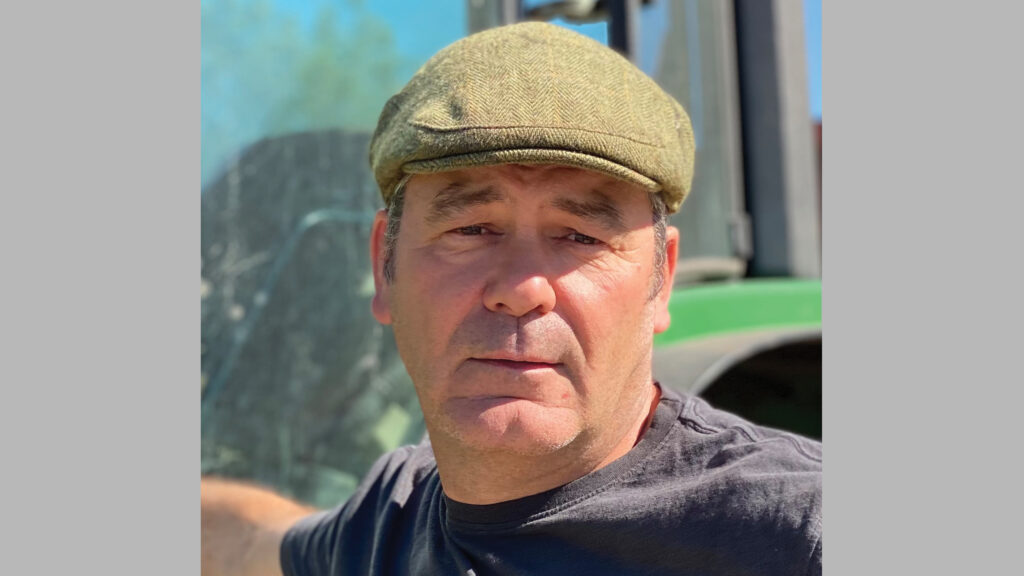
Martin Caunce © Martin Caunce
Drill modification
Modifying an old Vaderstad Rapid 400P drill to make it suitable for direct-drilling and applying compost extract has been an important step in advancing Martin Caunce’s regenerative farming approach, albeit one that is still being tweaked.
The first step was removing all the ground working equipment on the drill, so it just runs on the discs.
“Unfortunately, I can’t justify buying a proper no-till drill,” he says.
The drill has been further customised to apply Johnson Su compost extract at a rate of 100 litres/ha from a 300-litre tank fitted to the drill.
The set up includes a tube fastened to the back of the drill boot that dribbles the extract just behind the disc, so it falls into the furrow with the seed.
“We’re not bothered about it touching the seed because there’s nothing in it that would cause any harm, it will only do it good,” he says.
“The nearer we can get the biology to the seed the better.”
The system uses a pump to circulate the biology, with the extract run through a 250-micron mesh.
“I want to use a slightly larger sieve as I think I’m losing some of the fungi biology in the extract.”
But after trialling using a larger sieve this spring, he’s finding it can cause blockages, triggering a plan to rebuild the system using peristaltic pumps.
“At the moment, we’re putting the extract through a nozzle with a small hole to regulate the speed that it’s going on, and that’s where we have the blockages.”
Fitted to each row, the peristaltic pumps, which use positive displacement to move a fixed volume of liquid for every rotation of the pump, should alleviate that problem, Martin says.
East Midlands
Tess Lincoln, Burton Lazars Farm, Leicestershire

© Tess Lincoln
Electric fence winder
It’s a simple piece of kit, but for Tess Lincoln, an electric fence winder is making a world of difference to integrating sheep into the arable rotation.
“We don’t have any fences around any of our arable fields, and putting them in would be far too costly,” she says.
“So when we wanted to start grazing the crops with sheep, we initially bought a little wheelbarrow to wind the electric fences out and it was obviously impossible.
“It was fine for doing a little bit on a very small scale, but it was no way feasible on a larger scale.”
That led to a purchase of a Rappa RTV winder, which retails at around £1,700 and fits to the back of the farm’s buggy.
Driven by the rear wheel, it makes erecting and dismantling fences a one-person job, she says.
“We set out the corner posts, and then as you’re driving it unreels the wire while you throw the posts out at intervals.
“Then it’s another pass to set the posts up. Collecting it is a one-pass job. We can put out a fence within an hour.”
The farm operates a mob grazing strategy with its 250 head of Herdwick sheep, splitting the sheep into two smaller mobs.
Mobs are sometimes moved daily, depending on crop growth and ground conditions.
Tess says the fence winder is an essential piece of kit that requires little maintenance.
It’s used virtually every day between December and February, and weekly for the rest of the year when sheep graze herbal leys.
“It’s such a simple piece of kit, but it’s revolutionised the job.
“There’s no way we could move the sheep around the arable rotation without it.”

Staying sharp shouldn't be a chore