Two farmers help test on-farm nitrogen making project
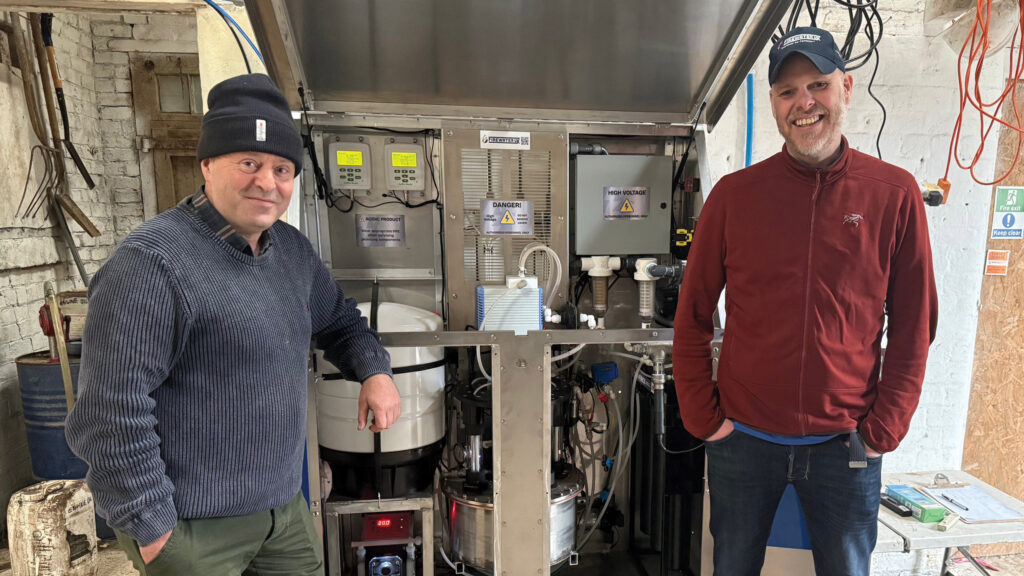 Tim Ellis and Simon Craven © Tim Ellis
 Achieving operational independence from global fertiliser pricing and supply chain risk is a key driver for two farmers who have teamed up to test a new fertiliser technology.
Developed by US agritech start up Firewater Ag, the technology mimics a lightning storm.
Lightning splits the nitrogen atoms in atmospheric nitrogen, which have very stubborn chemical bonds that need intense heat and energy to be broken.
See also: How funding is helping farmers with foliar nutrition efficacy
Once free in the air, this combines with oxygen, dissolving in rain into nitrate, which is the form plants take in.
The nitrogen boost is why fields often green up after a storm.
The project is part of an Innovate UK supported Defra Adopt project.
How it works
Firewater’s 7-Thunders machine creates lightning with the same premise, explains Zane Potter, the firm’s sales vice-president.
“It’s a glass reactor that makes thousands of lightning bolts per second inside little electrodes, with the water misted through the system catching the nitrogen made.”
The system can work 24 hours a day, with electricity and water the only inputs.
“Every 10 minutes it pumps into your storage tank through a standard three-quarter inch garden hose.”
Electricity consumption is minimal – about 0.5kW, while an integrated reverse osmosis system makes sure clean water is fed into the reactors.
“It costs most growers less than a penny per litre to make,” Zane claims.
The system is capable of making 378 litres of “plasma activated water” in a day that should store safely without degradation for up to a year, providing it is stored away from direct sunlight.
But there are some key differences between plasma activated water and a conventional fertiliser.
Not least that it only contains 50-100 ppm of nitrate or less than 0.01% in lab tests, although test strips can show 250-500 ppm, Zane says.
In trials in the US, around one gallon (3.8 litres) has replaced about 2-3lbs/acre of nitrogen (2.25 to 3.36kg/ha) in terms of yield performance.
“We’re still trying to figure out exact application rates, but we have a good idea of the boundaries – what’s too much or too little.
“But in general we’re seeing good results even with these low concentrations.”
It’s not a slow-release product compared with an ammonium nitrate prill, so will need applying multiple times during the season, he adds.
“Nitrate in this form needs spoon feeding, so you might apply it five or more times during a season, but it can be applied in combination with herbicides, for example.”
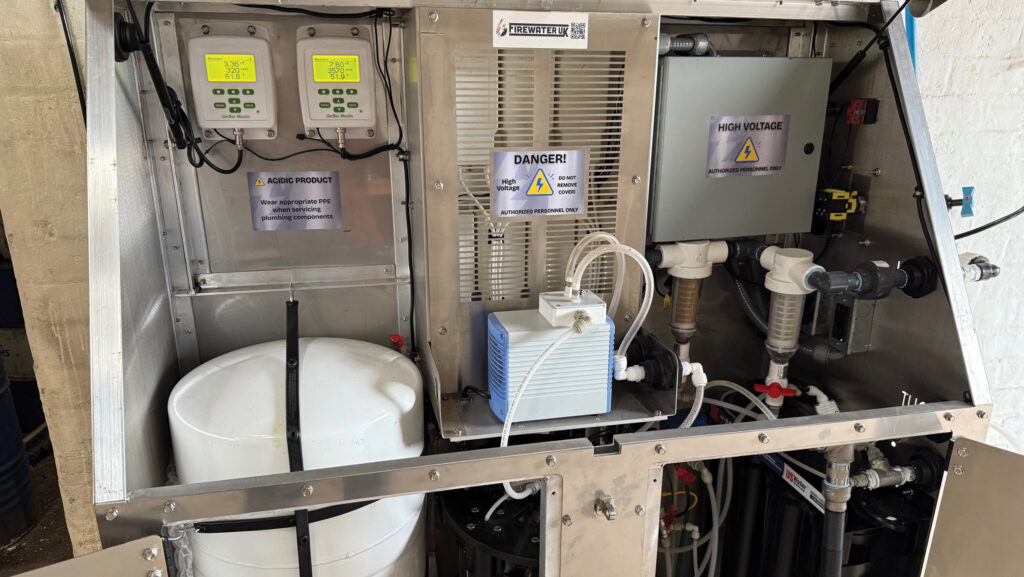
Firewater Ag’s 7-Thunders machine © Tim Ellis
Staffordshire farmer
Having come across the technology, Staffordshire farmer Tim Ellis was immediately interested in potentially bringing a machine, which costs around £50,000, to the UK.
This happened just as Defra’s first round of Adopt grants became available.
“A nitrogen replacement being made on farm sounds too good to be true,” he says.
“With any new venture there is risk involved, so Adopt seemed like a brilliant way to reduce that risk on farm.
And there was the added benefit that the project provides us with a good structure for validating whether it works, access to other areas of expertise, including independent expert Dr Daniel Kindred as our facilitator, and others in the industry.”
Tim, who grows a variety of combinable crops on his 132ha family farm, is reducing inputs, including fertiliser, as much as possible.
“I’m trying to make the farm sustainable and viable in the long term and keep as much farm income on the farm as possible.”
Potentially saving £20,000 on fertiliser bills in a season is a big draw for trialling the Firewater system, particularly with the added power that comes with much more certainty about the supply and cost of the nitrogen input, if it’s made on farm, he says.
“This seems a good idea to take some control over what we’re doing.”
Yorkshire farmer
Fellow farmer project member Simon Craven’s interest in plasma-activated water started some 20 years ago.
“While it looked interesting 20 years ago, it was only in the past five years that it started moving towards having a developed machine that would work on farm in a cost-effective manner.”
He farms about 250ha in the Vale of York growing potatoes, sugar beet, maize, vining peas and cereal crops, also using regenerative practices as much as possible, including livestock integration and the use of compost.
“We’re a sand land farm, so we suffer when it’s dry and don’t have high yields,” Simon says.
“That’s driven us towards minimal costs and we’ve reduced fertiliser down to around 150kg/ha of nitrogen on cereals, sugar beet to 25kgN/ha, and some potatoes receive no artificial fertiliser because they’re fed liquid organic digestate.”
If he underfeeds potatoes, he uses foliar nitrogen later in the season to boost the crop.
“I make reducing synthetic fertiliser work because I’m driven to make it work and because I don’t mind taking some risks.
“My hope with the Firewater machine is that I won’t need any synthetic nitrogen.”
Validate technology
The main objective for the Adopt project is to validate the technology, stresses Dr Daniel Kindred.
“The Adopt funding allows us to get the machine up and running on the two farms and conduct a techno-economic assessment.”
That will help prove the concept is viable and what it is capable of producing, both in terms of what’s in the plasma activated water, how much it can produce, and what inputs that requires.
Simple tramline-type trials are planned for this spring, depending on producing enough product to test.
On Tim’s farm, the plan is, after an initial soil applied urea ammonium nitrate application, that a field of wheat will be split into tramlines to compare using the Firewater plasma activated water directly against the farm standard approach, which totals around 180kgN/ha.
“Ideally, we’d also like to compare a foliar nitrogen approach too, but that might need to wait until next year’s trials.
“As a two-year project, the first year is finding our feet, with the aim to expand it further in year two,” Tim says.
On-farm trials
Simon is planning trials on some different crops, including spring barley, maize and potatoes.
“I’m hoping to be able to trial it on 4ha of potatoes.
“Some of the results from the US on potatoes have been amazing, so I’d like to demonstrate that immediately as part of the project.”
He’s planning to use the Firewater product in a similar way to how he currently uses foliar nitrogen sprays in the crop.
“Foliar nitrogen mixed with humic acids has been magic in potatoes. Put it on the crop canopy and you get a bloom that lasts at least a fortnight, and maybe 5-7.5t/ha yield increase most years.
“With the Firewater, we’re likely to add it to each blight spray, up to around eight passes.”
More rigorous trials are planned for a second Adopt project, if accepted, which is due to be submitted in the next round of applications.
Future trials are needed to conclusively prove that Firewater can reduce N fertiliser requirements, plus measurements to see whether plasma activated water improves plant health, disease and pest resistance.
“There are claims for this type of impact in literature about plasma activated water, so we would like to explore those mechanisms in future projects,” Daniel concludes.
What is Adopt?
Adopt – which stands for Accelerating Development of Practices and Technologies – is a grant funded by Defra through its £5m Farming Innovation Programme.
There have been six rounds of Adopt funding, which, so far, have been available for farmers to access.
The latest round closed on 8 April.

Staying sharp shouldn't be a chore