How agroforestry can help build a farm’s climate resilience
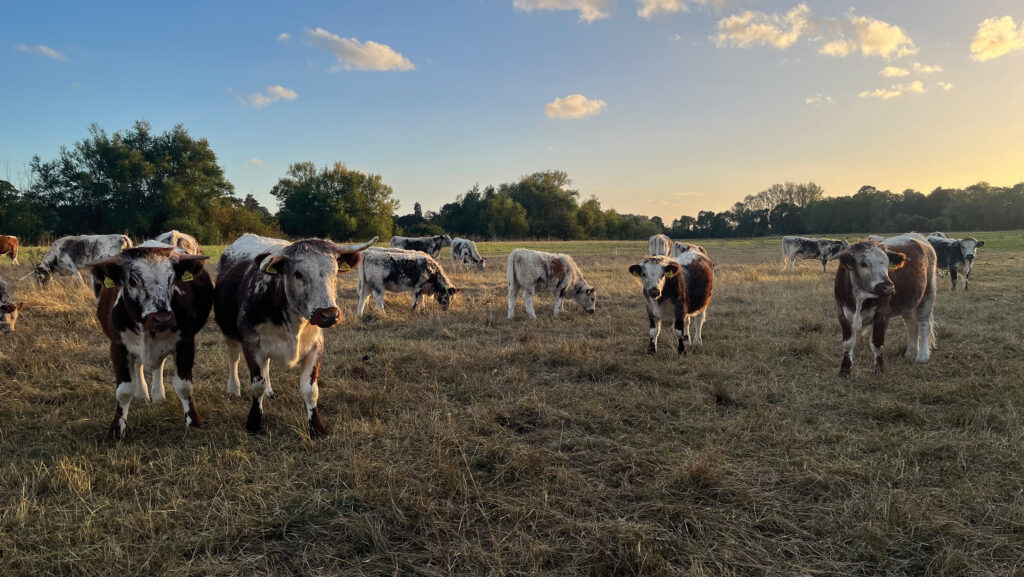 Trees will provide the shelter and shade that the Longhorn cattle will need as the climate changes © Louise Impey
 Building resilience into the farming system has been Tom Edmondson’s target since he took over the 120ha family farm near Milton Keynes in Buckinghamshire, but the increasing likelihood of hotter, drier summers now means that more change is coming.
Since 2012, Tom and his wife Mary have moved the business from being an intensive pig production and arable farm to a low-input, extensive mixed farm system, incorporating a market garden run on a share farming basis, along with a farm shop.
See also: Oxfordshire farm expands to be self-sufficient for wheat
They did this by adopting regenerative principles, putting soil health at the centre of what they do by integrating cover crops and livestock across the farm, as well as gradually moving to direct-drilling, applying biology and making fewer interventions.
As a result, input costs have fallen and their management time has eased, while biodiversity has flourished. “It’s also been more fun,” says Tom.
Agroforestry plans
Their next step is to make agroforestry an integral part of the business, as they continue to shape the farm to withstand climatic and economic pressures.
Trees will be planted in both grass and arable fields this winter, as a means of providing shelter, shade and more resilience – bringing weather protection and risk reduction, as well as water management.
New business opportunities and product sales are also part of the ambitious plan, as the trees will provide fruit and nuts that can be used for various food and drink products sold in the farm shop.
Some two-thirds of the current arable land will include 24m alley cropping with rows of fruit and nut trees, while low-lying permanent pasture adjoining the River Ouse will have both woodland pasture and a 20m woodland strip established.
Climate resilience
On the grassland, including tree species that are good for grazing and browsing, such as willow, alder and mulberry, will provide additional nutrition as well as providing the shelter and shade that his Longhorn cattle will increasingly need as the climate changes.
“In the wood pasture, there will be a tree every 20m for shade,” explains Tom. “That means a planting density of 25 stems per hectare.”
Community
Tom is also a mentor for Understanding Agriculture and a farming champion for the Nature Friendly Farming Network. He involves the local community in the farm as much as possible, running regular farm walks and using the farm shop as a venue.
Cactus tree guards will be used, so that the cattle can go into those areas straight away and no grazing land is lost.
A Trees for Climate grant is funding most of the work, which will completely change the farm, acknowledges Tom, but should create other opportunities.
This year’s heatwaves have been a reminder of what’s at stake and the importance of future-proofing, he adds.
“We’ve had just 95mm of rain since March, and although the grassland is still producing, thanks to our adaptive multi-paddock grazing system, regrowth has been poor.”
Soil protection
Soil temperatures taken at the height of the summer revealed the extremes, with bare ground being prepared for stubble turnips in May recording 48C. In contrast, recently mown land was 33C but temperatures at the bottom of the grass were 25C.
“That shows that this system of daily cattle moves is working. Armouring the soil surface through the trampling action of the cattle helped give the necessary protection in such a hot, dry summer.”
No sprays or fertiliser have been used on the permanent pasture since 2017, while veterinary and medicine costs have come right down.
© Louise Impey
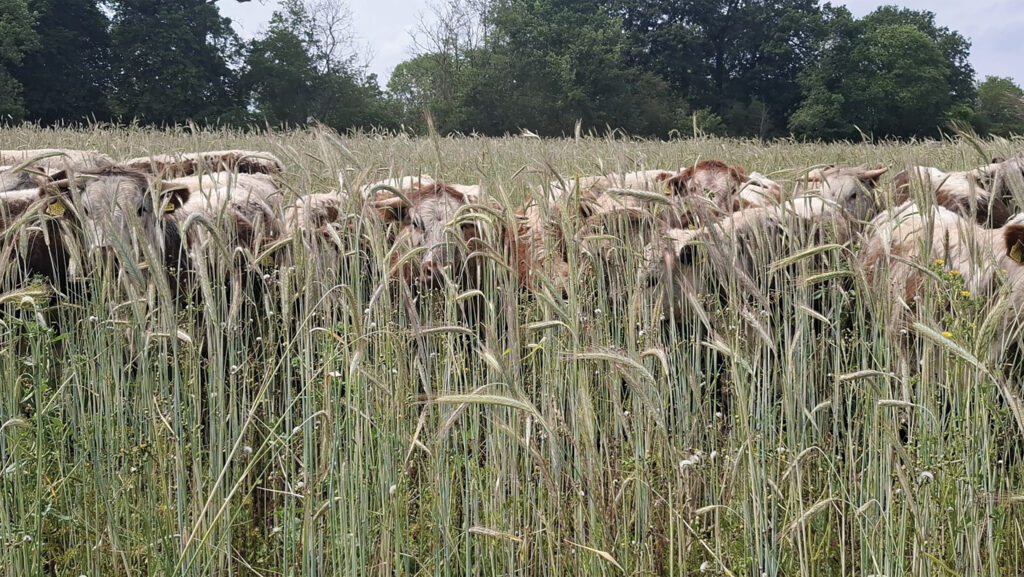
Longhorns were chosen for their suitability to a grass-based system and ability to largely look after themselves.
The woodland strip, which will be 20m wide and will split two fields lengthwise, is going to be a mix of timber hardwoods, including oaks, small leaved lime, hornbeam, sweet chestnut, alder and willow – the latter species being suited to wetter ground.
It will be fenced off until the trees are mature, with plastic guards used in the meantime to prevent pest damage.
Alley cropping
On the arable land, a mixture of fruit and nut trees will be planted in 3m grass strips in alleys with a width of 24m, so that crops can be grown between them and existing machinery used.
Having a tree every 5m will add to the farm’s output, while also bringing soil health benefits and guarding against weather shocks. Unproductive field corners will also be planted in woodland blocks.
The intention with the fruit and nut trees is to run a pick-your-own operation, as well as to sell produce in the on-site farm shop.
“Leftovers will be made into jams, chutneys, pies and juice, and then our pastured chickens will come in and do any tidying up.”
For the arable crops, margins are the focus. This year’s drought reduced the farm’s winter wheat yield to 5t/ha from a typical 7-8t/ha, but the crop still made a profit, stresses Tom.
“Now the soils are cycling nutrients effectively, our nitrogen use is down to 100kg of N/ha,” he explains.
One pre-emergence spray, a broad-leaved weed treatment and a T2 fungicide were the only other inputs, meaning expenditure was very low, he reveals.
“Our input use has come right down. By using cover crops, integrating livestock and reducing soil disturbance, soil structure and function is much better. Roots can penetrate and soils are working as they should be.”
Hot composting has been carried out on the farm for the past three years, with woodchip and clay mixed with farm manures before being windrowed and turned. Worms are then added, before it is allowed to stand.
“It’s not about applying nutrients, but adding biology. It helps the soil function efficiently without artificial inputs,” says Tom.
His current rotation is one year of winter cropping, followed by one year of cover crop – often grazed by both cattle and sheep.
When Tom’s current Sustainable Farming Incentive agreement comes to an end, he will consider whether arable reversion is the best option.
Farm shop
All of the beef, pork, lamb and eggs produced regeneratively on the farm go through the on-site farm shop, which is open three days a week.
Everything sold in the shop is raised, grown or made on the farm, under the premise of farm fresh food for the local community.
Tom’s wife Mary makes sourdough bread with regenerative white flour, some of which is produced from the farm’s wheat, baking freshly for the shop each week.
There are plans to open a bakery on the farm, to keep up with demand and expand the farm’s offering.
No dig, no spray vegetables are also available in the shop, thanks to the Liberte market garden on the farm, which is run on a share farming basis.
New directions
Arable businesses are facing one of the worst profitability challenges in living memory due to a combination of soaring input and machinery costs, poor crop prices and an uncertain future over government payments for environmental schemes.
This has left many farms struggling to make a profit on wheat crops this season.
However, some arable businesses are finding solutions to the slump, which include adding value, changing course or bringing in new income streams.
Read our other pieces in the series:
- Read how a Shropshire farm created new income streams
- Read how a Suffolk farm is looking to diversify into the hazelnut-growing market
- Read how an old grain store became an indoor ski slope diversification
- Read how an online shopping boom has created warehousing opportunities
- Oxfordshire farm expands to be self-sufficient for wheat