

Oxfordshire farm expands to be self-sufficient for wheat
 © GNP
© GNP A fully integrated mixed farm business is the aim for Blanchard Farms in Oxfordshire, where planned growth in the arable enterprise will ensure self-sufficiency, keep costs down and support its long-term direction.
With arable, pigs and beef across 730ha of owned and tenanted land, the livestock enterprises’ high straw demand and feed requirement of 130t/week of cereals means arable expansion makes sense for the future of the business.
As the livestock activities also produce plenty of farmyard manure, farming a bigger area will allow more resource recovery and better waste management – optimising nutrient cycling and reducing reliance on bagged fertiliser and feed.
See also: Warehouse boom an opportunity for farmers in prime locations
Currently, the business is exposed to the wheat market to the tune of 4,000t/year – something that the family partnership would like to reduce.
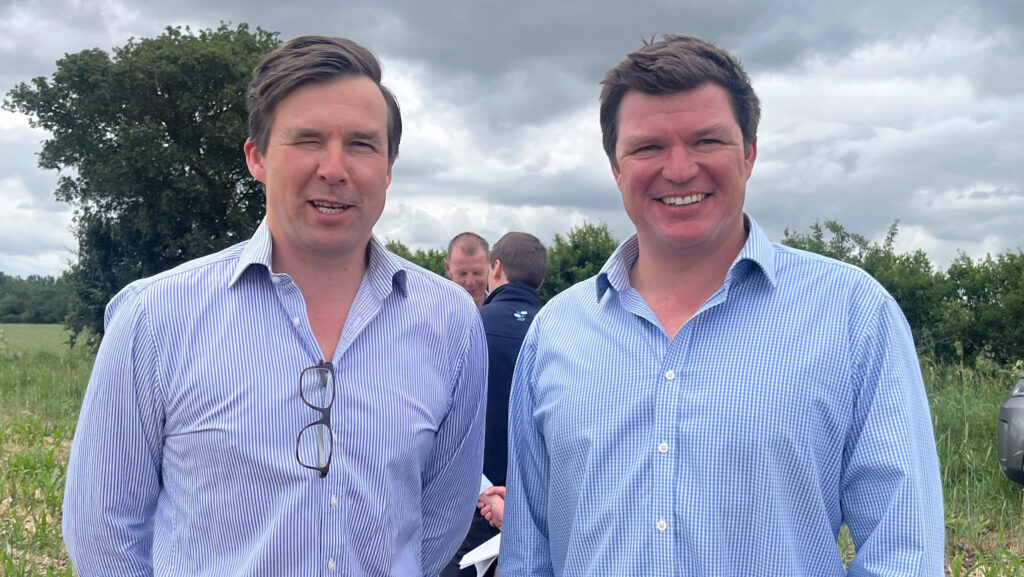
James and Ed Blanchard © Louise Impey
“Taking on more land would help us become self-sufficient and more circular at a time when volatility is through the roof,” says James Blanchard.
“It would also give us extra ground for muckspreading and provide us with the additional feedstock and straw that we need to be self-sustaining.”
Integration
An anaerobic digestion plant would be the perfect addition to the mix, acknowledges James, but the farm’s location at Southmoor, near Abingdon, is not close enough to the gas main.
“That would be the dream, so that we could produce our own energy too.”
Pigs have always featured on the farm, in both breeding and finishing units, with the finished animals going to Cranswick.
A mobile feed mill allows them to be independent and feed home-grown cereals, with the spring oat crop being the only one sold from the farm.
The beef finishing enterprise was set up last autumn in existing buildings on a neighbouring farm, on contract with Buitelaar.
Both the cattle and the pigs are run on straw-based systems, making the arable activities integral to their success.
“Dry years do put pressure on straw supplies, so that’s something we have to factor in as the weather becomes increasingly unpredictable.”
Diversification
Otherwise, the business converted buildings into offices more than 25 years ago and commercial storage units are also let, while self-storage and firewood enterprises were added as franchises.
“Franchises allow you to get up and running straight away, avoiding expensive mistakes and freeing up time,” explains James.
The firewood business is both wholesale and retail, with the farm supplying the local Co-op stores with bags of logs.
The self-storage is through Barnstore, which means 24-hour access has to be granted.
“We have a flexible approach to buildings. A big fire in 2010 meant that we had to rebuild a shed that had previously been used for hops. Self-storage was a good option.”
Risk management and resilience
Success in applying for a Farming Technology and Equipment grant, plus some funding help from Thames Water, means that Blanchard Farming is now the owner of a 10m Carre camera-guided hoe, which will be used as part of a grassweed control strategy.
The plan is to replace the use of a spring contact herbicide with a well-timed pass with the hoe, improving control and reducing chemical use.
“It adds to the armoury,” explains Ed Blanchard. “In a wet year, it may not be an option and we are still learning how to get the best from it, but it does also qualify for an SFI payment.”
Without funding support, they wouldn’t have been brave enough to go ahead with the hoe purchase, he acknowledges.
They drill at 25cm row widths to allow its use, he continues.
“We haven’t got on well with delayed drilling so this adds to the options we have at our disposal for weed control.”
Maize debut
This year, for the first time, maize is being grown following a forage rye/vetch cover crop mix.
The rye/vetch crop was drilled in September and then cut at the end of April, just before the rye was in ear.
That yielded 16-17t/ha. “It would have been a waste of the autumn growing season not to do it and as grass growth has been poor in the dry spring, it turned out to be the right thing to do.”
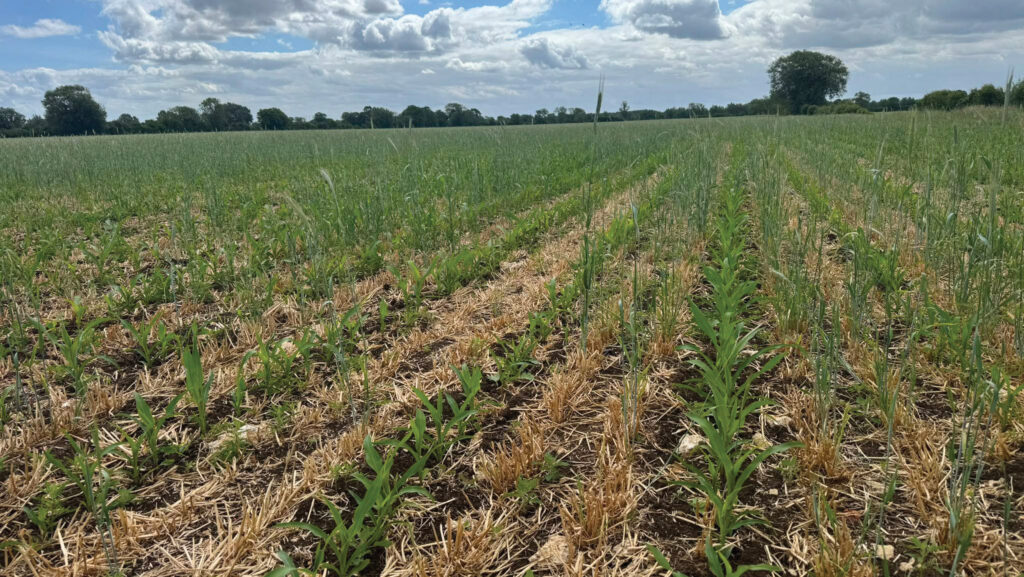
The Blanchards’ maize crop © Ceres Rural
The maize was then strip tilled into two-inch bands, treated with dirty water from the pig unit and received a post-emergence herbicide application as soon as the weather allowed.
“The volunteer rye between the rows has been a challenge but we haven’t done this before. It was cold when the maize emerged and then it went very hot and dry.”
Another first for the farm this year is that sheep were used to graze the winter barley, reducing disease pressure in the crop. “We are waiting to see whether that’s affected straw yield more than we would like.”
Looking ahead: SFI changes
The maximum funding cap of £100,000 per SBI that comes with the latest Sustainable Farming Incentive (SFI) offer means that Blanchard Farming will have to make considerable changes when its current agreement comes to an end.
Features that are already there, such as margins and hedges, will remain, as will practices that they would be doing anyway, predicts James. “We will also focus SFI actions on the poorer, more marginal land.”
The rotational actions are more of a challenge with a limited budget, as their current scheme is well over the cap, he admits.
“We’ve been making good use of the unharvested cereal headlands option, as well as using the low-input spring cereal action as a break crop.”
Given the changes announced, they will be rethinking their break crops and cover crops will go, he says.
“Cover crops come with challenges and we have very good soil organic matter levels anyway, so that’s an easy decision.”
Otherwise, more forage crops will be grown, in line with their self-sufficiency aim, as they have enough light land to grow maize.
On the home farm, where no muck is spread, both the no-till and the variable rate actions are currently in place.
“We’ve done very little cultivation for the last four years or so. Use of a low-disturbance subsoiler is allowed, so that’s been done where needed.”
The need to incorporate muck means that the no-till action isn’t appropriate on the other farms, explains James.
James and Ed Blanchard were talking to Farmers Weekly at a recent ‘On the Farm’ day organised by Ceres Rural
New directions
Arable businesses are facing one of the worst profitability challenges in living memory due to a combination of soaring input and machinery costs, poor crop prices and an uncertain future over government payments for environmental schemes.
This has left many farms struggling to make a profit on wheat crops this season.
However, some arable businesses are finding solutions to the slump which include adding value, changing course or bringing in new income streams.
Read our other pieces in the series:
- Read how a Shropshire farm created new income streams
- Read how a Suffolk farm is looking to diversify into the hazelnut-growing market
- Read how an old grain store became an indoor ski slope diversification
- Read how an online shopping boom has created warehousing opportunities
