

Advertiser content
How farmers can deliver for nature and their business
Balancing food production with delivering for nature is something many farmers are seeking to achieve.
And there are ways to make environmental improvements, while also benefiting the bottom line.
Practices like adding buffer strips within fields or alongside rivers and improving soil management can boost both resilience and profitability in farming businesses.
And when it comes to improved nutrient use and integrated pest management (IPM), these practices can cut chemical costs, slow run off and reduce erosion.
One farmer who has seen these benefits is arable producer Patrick Barker, who has 545ha at Lodge Farm near Westhorpe in Suffolk.
“Our main ethos is growing the best crops we possibly can on this land, while not having a negative impact on the environment,” says Patrick.
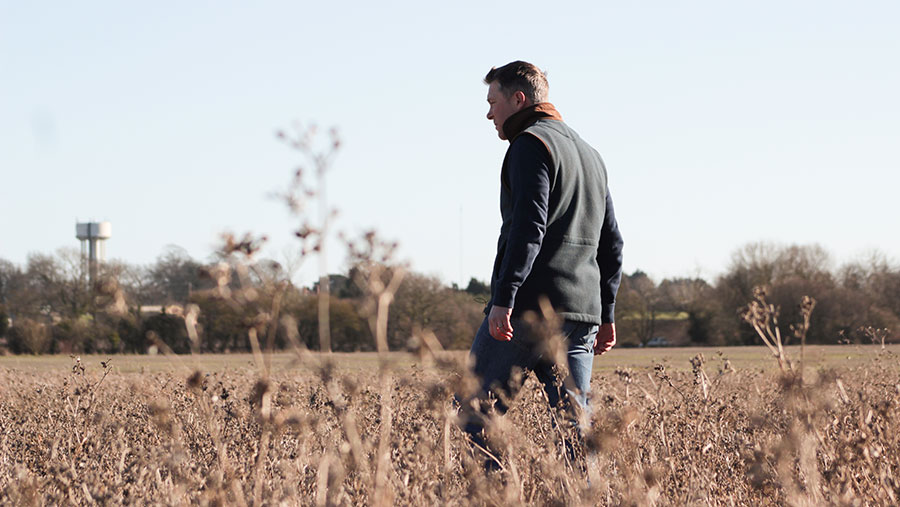
Patrick Barker © LEAF
He added buffer strips to some of his less productive land. “In between the winter wheat and the watercourse, we have a buffer, which means our farming operations are not affecting the clean water leaving the farm,” he says.
“Our yield maps tell us that the areas next to the watercourse are those which don’t yield as well anyway, so by taking away some of the least productive land, we have made the field more efficient.”
A report by the Nature Friendly Farming Network (NFFN) and The Wildlife Trusts found that removing 8% of land from production for wildlife habitats maintained yields at field scale, and even improved them in some cases.
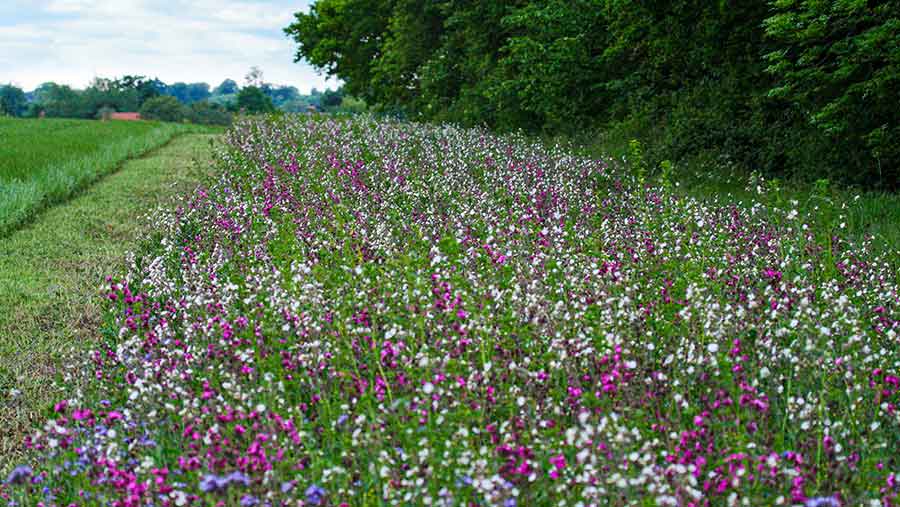
Patrick’s buffer strips are made up of multispecies swards to encourage biodiversity, like oxeye daisy, lucerne, birdsfoot trefoil, and red and white campion.
“It will be full of bees, wasps and butterflies all through the summer months,” he says.
“So not only are we bringing our farming operations away from the watercourse, we’re adding in an insect-rich habitat into our farming system.”
© DEFRA
Having an abundance of beneficial insects brings advantages when it comes to IPM.
“We need these habitats to become the breeding ground for insects which will go into the crops and eat aphids and other pests,” says Patrick.
IPM also reduces reliance on costly pesticides, with associated benefits to the bottom line.
In the same NFFN and Wildlife Trusts report, farm businesses improved their commercial returns by between 10% and 45% when outputs were reduced to a level where production relies on naturally available resources.
As well as increasing biodiversity, buffer strips boost efficiency, too. “We’re increasing our average yield because we’re only farming the bits we should be,” notes Patrick.
And the visual benefits of complying with water regulations are easy to see. “I can see all the gravel and stones at the bottom [of the watercourse] – the water is crystal clear.”
Over in Norfolk, near Aylsham, another arable farmer – Charlie Ennals – has introduced a range of practices to improve soil health, including herbal leys, grass-legume mixtures or cover crops, and reduced tillage.
Set in the 260-ha Blickling Estate, the farm’s soil is light, so building organic matter, to in turn boost resilience against unpredictable weather conditions, is something she wanted to achieve.
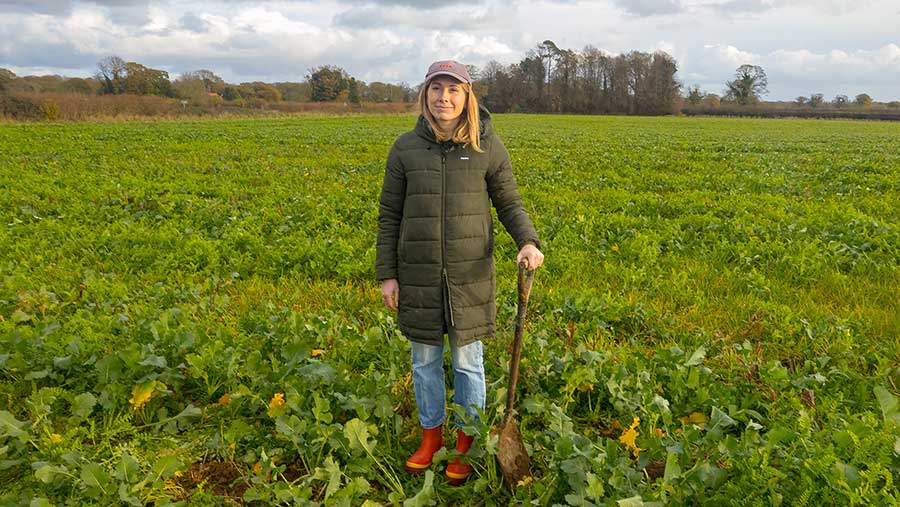
Charlie Ennals © DEFRA
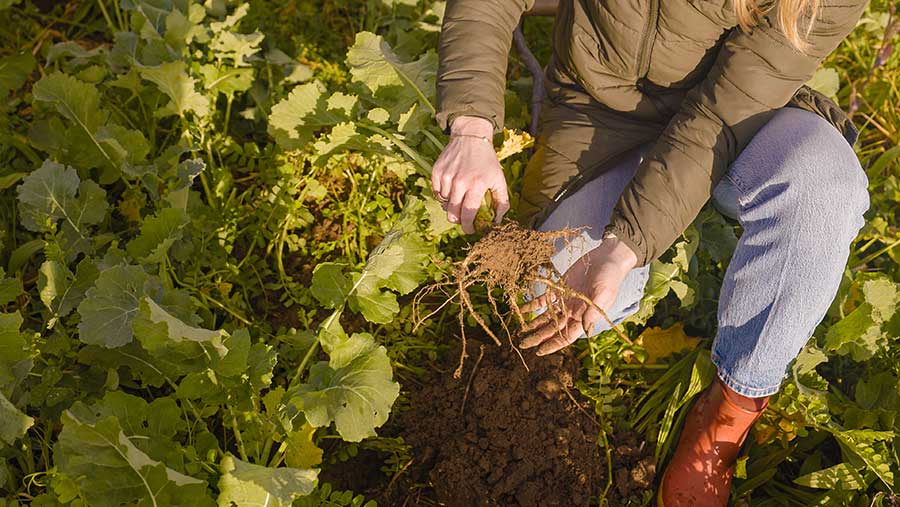
Introducing cover crops has done just that. “Keeping the living roots in the soil, and keeping the soil covered, helps to build resilience,” says Charlie.
“The cover crops are made up of multi-species crops. “The more diverse, the better; we have radishes, clovers, millet, vetch and plantain.”
According to Germinal, legumes like clover, when carefully managed, can help to naturally fix an average of 150kg/ha of nitrogen, per year, helping to reduce the use of artificial fertilisers.
Having a variety of species ensures a range of root depths, with longer roots enabling water to be stored further down the soil profile, as well as breaking up any compaction.
“The soil here isn’t compacted at all. If it was bare, it would be much more compacted. It also smells really fresh, so it’s definitely aerobic; there’s plenty of oxygen getting down into the soil,” says Charlie.
“Having the ground covered means we’re feeding the microbes in the soil, plus we’re fixing compaction, helping water to infiltrate, and improving the soil’s resilience – all of which results in better yields.”
As the soil can hold more water, there is reduced runoff. “Without the cover crop, we would see more runoff, which takes with it not only soil but nitrogen and other nutrients too.
© DEFRA
“So anything we can do to try and improve the organic matter in the soil will help us to retain that moisture, and see us through drought conditions in the spring and summer.”
Farmers in the East of England who want to explore introducing practices like buffer strips and cover crops can get free, impartial and confidential advice through Catchment Sensitive Farming (CSF).
This service is in partnership with Natural England, meaning there are advisers locally who can offer support.
Visit Farming for the future for further information.
Provided by
The Department for Environment, Food and Rural Affairs (Defra) is responsible for improving and protecting the environment. We aim to grow a green economy and sustain rural communities. We also support our food, farming and fishing industries.