

How nature-friendly practices built farm’s climate resilience
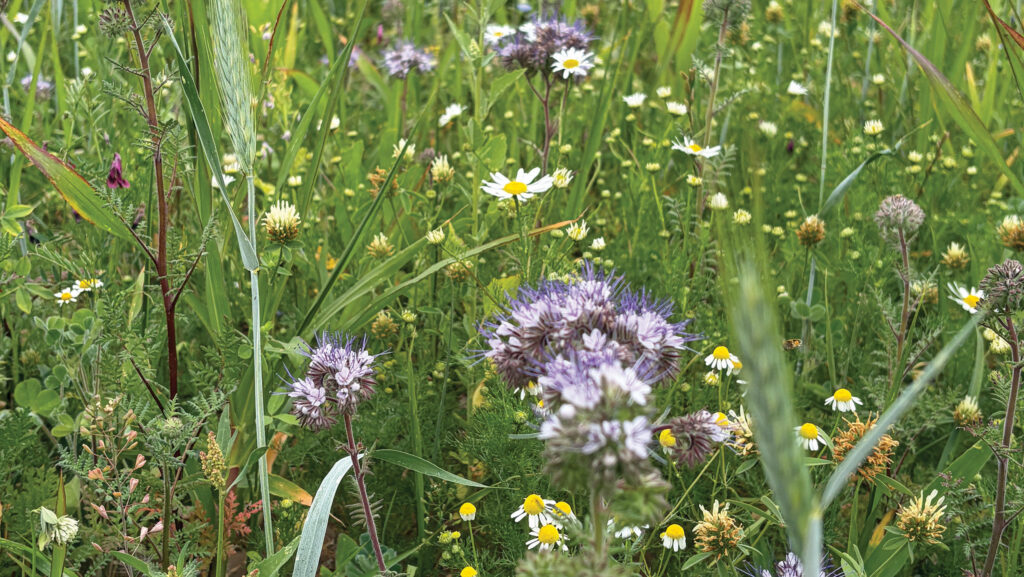 © MAG/Richard Allison
 Herbal leys, cover crops, contour cropping and 30m buffer areas are at the heart of Rob Atkin’s strategy to improve soil health, manage grassweeds and protect water quality on his farm in Staffordshire.
These nature-friendly actions are also making the farm more resilient to the greater extremes in weather being seen in recent seasons.
Water protection is a key priority on the 525ha mixed farm near Uttoxeter, with land running up to the river Blithe and close to a reservoir.
“Water predominantly drains into the Blithfield reservoir, hence our close work with the local water company,” he explains.
See also: When should regenerative growers cultivate?
Soil erosion is another risk, especially for the blow-away light alluvial soils. He farms three blocks with differing soil types: heavy Kuper marl at home, light black alluvial silts at Fradswell and a third block that is also lighter land.
On the home farm, soils have about 5% organic matter, while the black alluvial silts are higher at 9-11%.
The silts are quite challenging to farm, as pre-emergence herbicide struggle and they don’t hold on to nutrients, he explains.
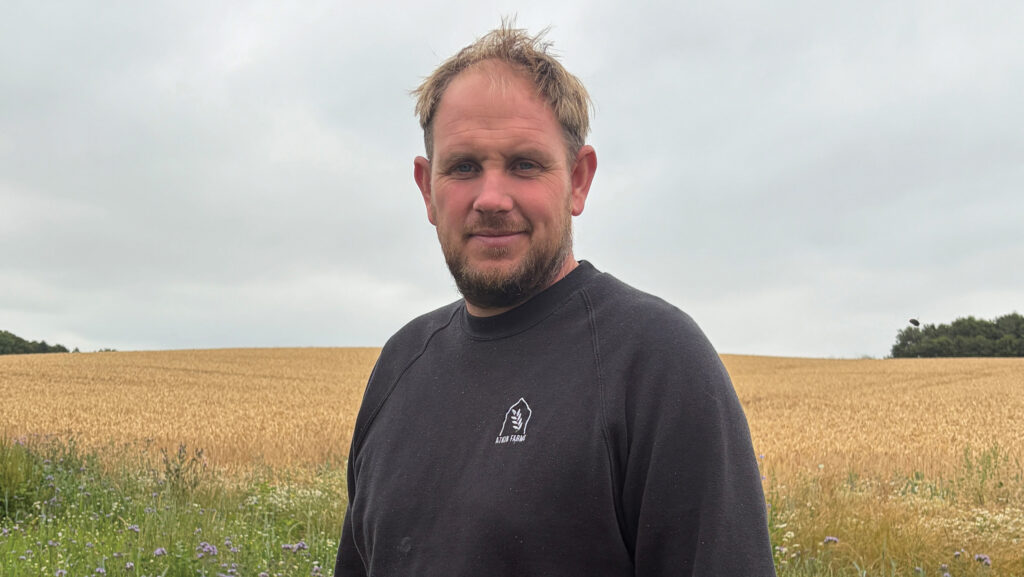
Rob Atkin © MAG/Richard Allison
Legume mixes
To help manage blackgrass on these high-organic soils and provide forage for the beef cattle, he grows three-in-four-year legume leys at Fradswell.
Leys include perennial ryegrass, red fescue, festulolium, red clover, sainfoin, timothy plus a range of herbs. The legumes fix nitrogen and the mix is improving soil health.
Rob takes two cuts for the cattle; the first is clamped and the second is baled and wrapped. The leys green up and lambs graze them for six weeks before they move on to stubble turnips for the winter.
Rob says he is finding that the legume leys are greening up quicker than normal grass leys this summer. “They seem to be more drought-resilient than pure grass leys.”
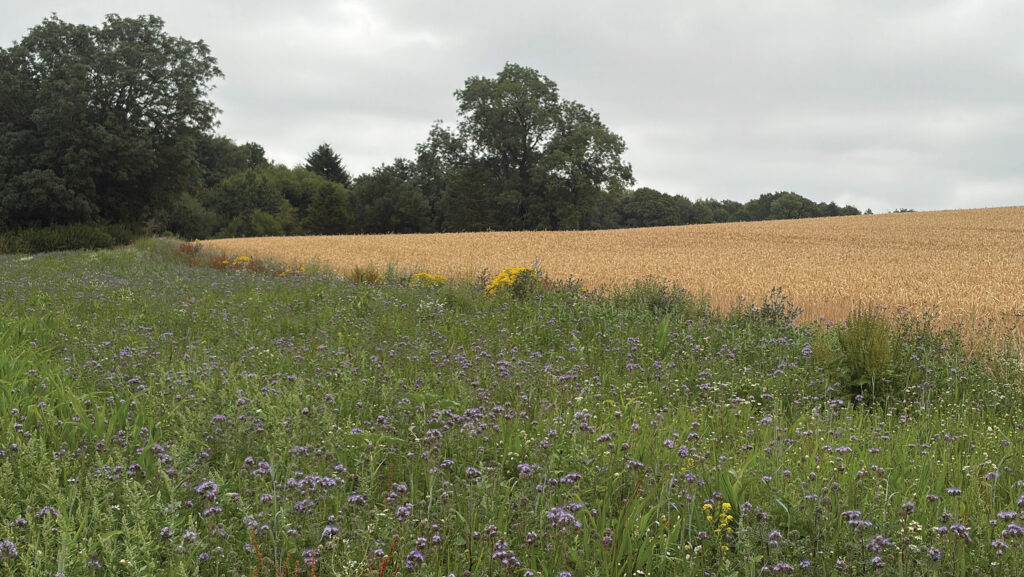
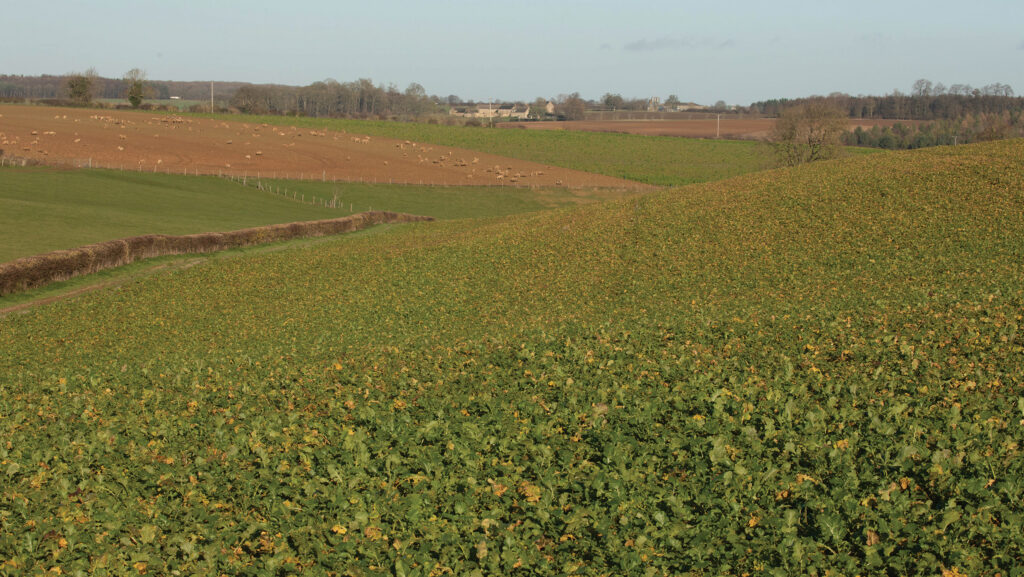
A margin at the bottom of a sloping field © MAG/Richard Allison
Cover crops
At home on the medium loams, instead of legume leys, he grows cover crops and stubble turnips ahead of spring cereals and maize, split 45:55%. Stubble turnips typically follow winter barley, while cover crops are after winter wheat.
“They [cover crops] act as water pumps. In winter, the land sits heavy and if it’s a slow spring, the land is sad and low.”
Having a cover crop seems to help and get things going a bit earlier. “It allows us to drill a little earlier and keeps soils in a more friable condition and active,” he says.
Cover crop mixes include vetch, pulses and phacelia, and he looks to establish them after harvest. If he is short of stubble turnips, he will graze with sheep like he did this spring before maize.
However, care is needed not to rob moisture ahead of maize drilling and, while the crop wasn’t affected this year, it’s something he is aware of.
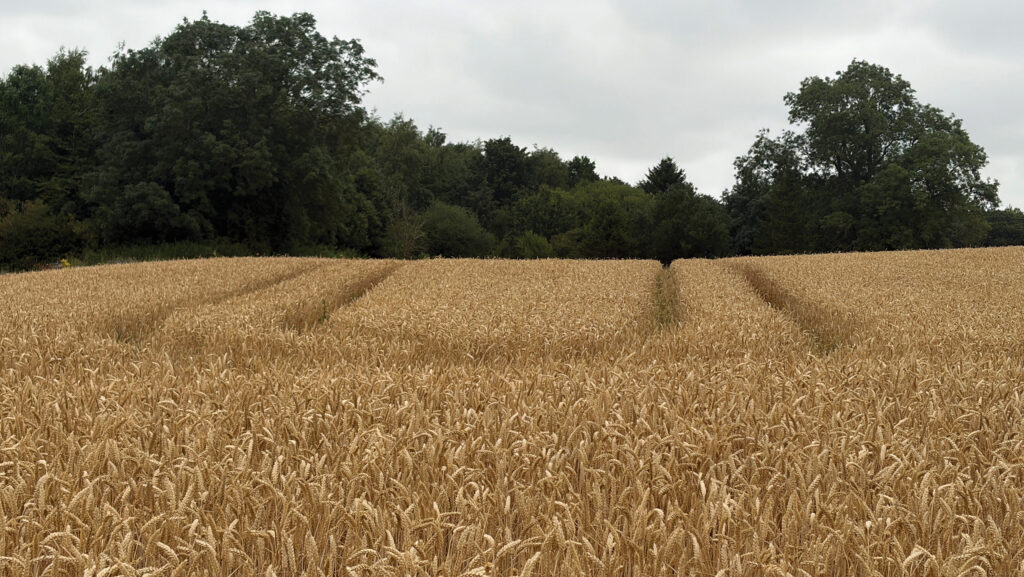
Cultivating across the slope © MAG/Richard Allison
Stubble turnips
The family has been growing stubble turnips for the past 20 years, bringing an extra income, and also putting organic matter back into the soil. Grazing helps to control any blackgrass and bromes that emerge in the turnips.
A key benefit of having a growing crop in cereal stubble is that it reduces the risk of run-off. This also influences how Rob grazes the stubble turnips.
“You often see farmers strip-grazing going up a slope, but we now graze down the slope so that there is living crop at the bottom instead of bare ground. So if there is any run-off, it flows into the crop and any sediment is trapped rather than moving into a ditch.”
Stubble turnip crop © Tim Scrivener
Measures and their role in resilience
- Mixed farming – spreads risk with arable and cattle incomes. Also soil health and diversity benefits
- Cover cropping, contour cropping and buffer strips help reduce run-off and soil losses from heavy rain
- Bird food margins (part of the buffer areas) reduce risk of run-off
- Cover crops and muck are improving soil health, helping it cope with extra rainfall in winter
- Legume mixes are more resilient than straight ryegrass in dry summers
Contour cropping
Contour cropping is another measure that Rob has implemented, totalling 86ha. He explains that farmers tend to cultivate up and down slopes, but this can result in run-off, especially in tramlines running down hills.
With a £10/ha incentive from the local water company, he cultivates across slopes and this reduces run-off down tramlines.
He explains that after talking to local farmers like himself, Staffordshire Water added the option in its spring scheme. “There is a little more hassle going across, so farmers need a little incentive.”
Rob has 86ha in the contour cropping option, but he points out that not all fields are suitable. “Some are too steep to combine across and there are also long, narrow fields.”
Instead, he has a 30m buffer at the bottom of the slope (to trap any soil and prevent it reaching ditches.
This consists of a 6m buffer strip next to a 24m bird food margin. The buffer strips are also part of the spring scheme, whereas the bird food margins are part of the Sustainable Farming Incentive/Mid-Tier stewardship.
Cattle help spread risk
Complementing the arable side is the 280 dairy-bred beef cattle, which are bought in as calves (aged about four weeks) and finished in 24 months. The arable area receives muck and produces the straw, grain and protein, while herbal leys are part of stewardship.
He recalls that four to five years ago, the farm had a bad year with cabbage stem flea beetle and lost 50% of the OSR and 50% of the stubble turnip crop. He realised he needed a backup. So he increased cattle numbers and also introduced the legume herbal leys.
The arable side provides straw for bedding, along with grain and protein for feed. In return, muck and the herbal leys improve soil health, with a proportion of the leys also earning stewardship payments.
Rob is a big believer in home-grown feed. “You can get a better return on feed barley by feeding it and going off farm as beef rather than going as grain.”
In addition to barley, he grows beans and maize. He started with 5ha maize and grew the area – now 50% – and sold to a neighbouring dairy farmer. Other crops include wheat, oilseed rape, spring barley and winter oats. A small area of hemp is being grown as part of a research project.
The most recent change is the addition of grass leys grown for a neighbour. This provides a consistent, non-arable income.
Looking forward
Looking to the future, while the farm is more resilient, more needs to be done in dealing with both dry springs/summers and wet winters.
Rob says second wheats may be dropped, as they are already marginal and the lighter land “doesn’t have the legs”. He also believes breeders have a role.
“They need to start looking at drought tolerance so that varieties can stand wetter winters and dry springs.”
He says his earlier-drilled wheats have performed better this season and questions the need for earlier-maturing varieties. “Do we drill earlier with early-maturing varieties to escape the worst of summer droughts?”
He may also look at the cropping mix. “Perhaps we will need to grow more maize with less reliance on water.”
Rob is involved in research looking at the potential of combinable hemp – a lower-input, more resilient break crop. “If we can successfully grow combinable hemp and develop the market, it could offer a break crop in maybe four to five years’ time.”
Stewardship income
Rob Atkin is in a mix of schemes – Sustainable Farming Incentive (a proportion of herbal leys and 15ha wild bird food margins), Mid-Tier stewardship and South Staffordshire Water’s Spring2 Environmental Protection Scheme (cover crops, 5.5ha grass margins and 86ha contour cropping).
He says the Spring2 scheme has greater flexibility than the government schemes. It is run on an annual basis and is rolled over to the next year. The only change is the area of cover cropping, which varies depending on the rotation. However, he points out that it is capped at £10,000/farm.
Soil Association climate resilience commentary
Government policy has not kept up with the climate challenges facing British farming, and it needs to prioritise nature-friendly approaches, according to a report from the Soil Association.
The report, No Drought About It: Farming Agroecologically for Climate, says with the right support, agroecological and organic approaches can build a food system that can withstand the effects of climate change.
While the report calls for a reduction in industrial livestock, it calls for more mixed farming systems all across the country to deliver resilience.
The Soil Association has called for government food and farming policy to better support soil health and reduce reliance on inputs, while also boosting production of climate-friendly foods, including UK-grown horticulture, beans and legumes.
Soil Association senior policy officer Hannah Blitzer says: “This summer has proven that climate change is the biggest threat to our food and farming system.
“While we do need to reduce the environmental impacts from livestock systems, the UK could seriously benefit from more mixed farming if farmers were supported to follow an agroecological approach. We need a farming system that supports wildlife and natural processes that help crops and livestock.”
She adds that if arable farmers can diversify their enterprises – bringing livestock and diverse pasture into the rotation, plus adding trees and horticulture crops – they can build resilience. “These methods can all help to reduce reliance on inputs while boosting biodiversity and delivering healthier soils, which are more drought- and flood-tolerant.”
However, farmers need the right support to make these changes, she says. “We need policies to join up to ensure both government and private markets incentivise agroecological farming, with fairer and shorter supply chains.”
The Soil Association’s report on climate resilience outlines a 10-point plan for how government can make resilient, nature-friendly farming profitable and scalable through agroecology.

Staying sharp shouldn't be a chore
Explore more / Transition
During the series we follow our group of 16 Transition Farmers through the challenges and opportunities as they seek to improve their farm businesses.
Transition is an independent editorial initiative supported by our UK-wide network of partners, who have made it possible to bring you this series.
Visit the Transition content hub to find out more.
