

Advice on feeding a home-mixed ration to pregnant ewes
 © Debbie James
 Sheep farmers are often cautious about adopting total mixed ration feeding, in the belief that a manufactured compound is best suited to ewe intakes in late pregnancy.
See also: Advice on forage intakes for pregnant ewes
But on farms capable of growing the ration, and with enough feed space to allow all ewes constant access to feed, switching to a total mixed ration (TMR) using home-grown ingredients can deliver multiple benefits.
Independent nutritionist Stephen Caldwell says if there is attention to detail in everything from feed presentation to the monitoring of intakes, it is a very effective alternative to bagged concentrates.
“It is simple and repeatable, and with ewe concentrates currently ranging in price from about £280/t to £340/t, it is cheaper too,” he says.
Stephen offers his tips to farmers contemplating making the switch.
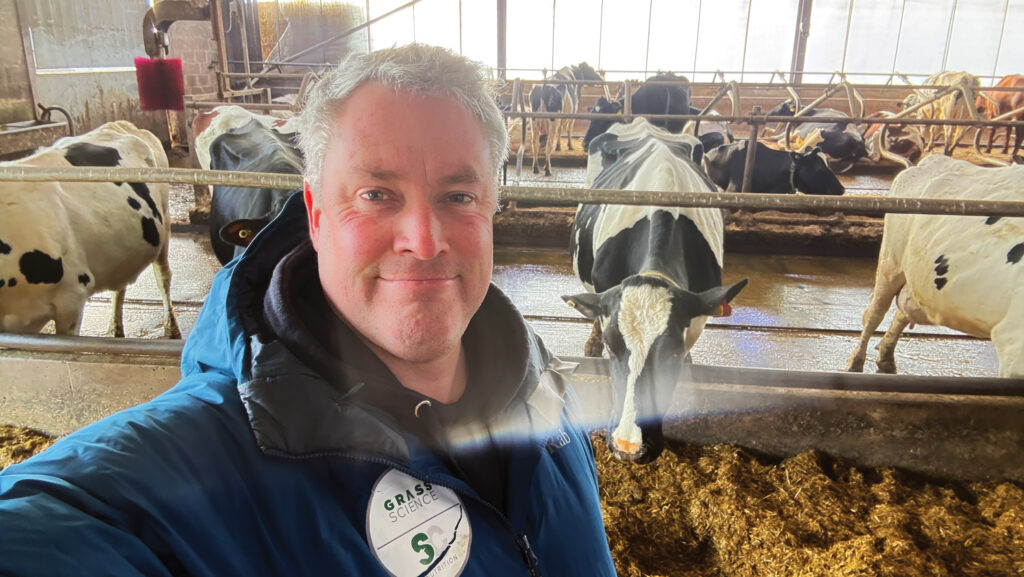
Stephen Caldwell © Stephen Caldwell
Infrastructure and equipment
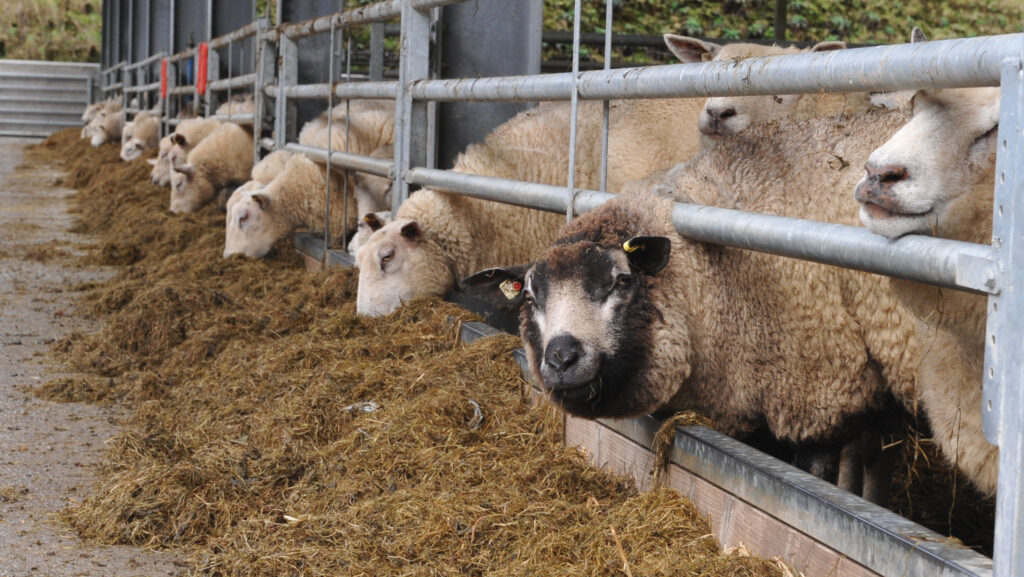
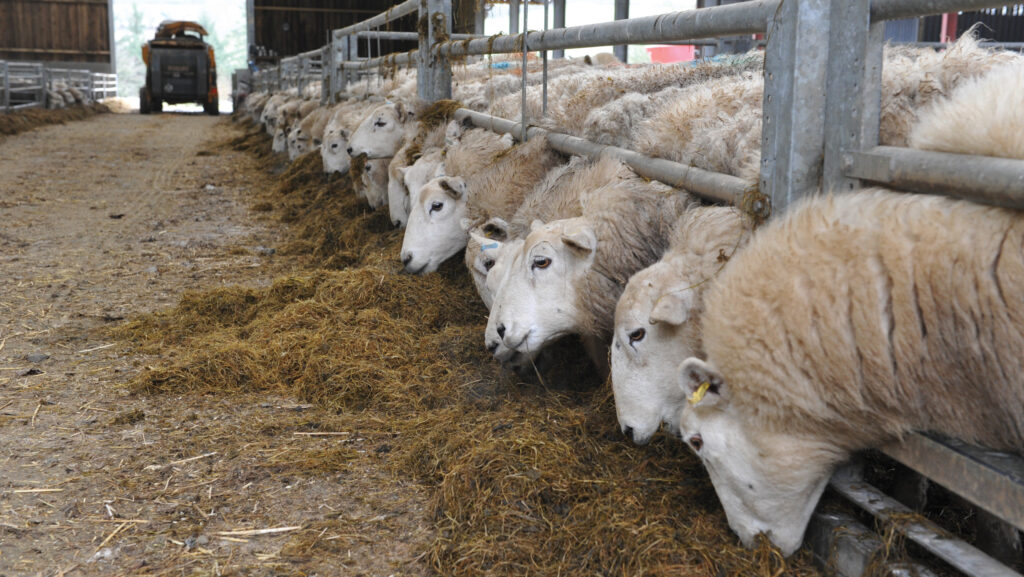
Adequate feed space for each ewe is essential if TMR feeding is to be done successfully. Depending on breed and size, 35-50cm a ewe maximises intakes and prevents bullying and gorging.
A scrum can ensue if all animals cannot eat at once. This has an adverse effect on intakes, rumen function and pH, stresses the ewes and can lead to lamb losses.
An alternative to offering the TMR as a complete mix is to place the forage element in troughs and the concentrate component in smaller troughs within pens.
© Debbie James
However, that concentrate should be topped up several times a day. For example, if the total daily requirement is 1kg a ewe, it could be offered across three feeds as she gets closer to lambing.
Ideally, the forage should be chopped and well-presented. If it is long and stringy, it will slow down digestion in the rumen and there will be less control over intakes.
However, over-processing the forage and concentrate mix should be avoided, as this will upset rumen function and pH.
Ingredients to include in a home-mix
Good-quality grass silage, analysed for nutritional value, provides the foundation, and the remaining components depend on what is grown on farm.
They could include barley, wheat or sugar beet, combined with a mineral and/or live yeast.
If including home-grown grain, it is a good idea to crimp it to make it rumen friendly. Uncrimped grain can be used, but if too much is fed, it can bring on acidosis fairly quickly in a heavily pregnant animal.
Using crimped grain over dry, rolled grain could allow up to 50% more crimped grain to be added to the rations, depending on the other ingredients and rumen function.
Quantities will vary according to requirements, body condition, forage dry matter (DM) and stability, and intakes.
“Cheaper ingredients such as wheatfeed and oatfeed can be included, but I would advise against these, because they don’t add anything to the feed values of the ration,” says Stephen.
Calculating the protein requirement of the ewes relies on knowing how many lambs the ewes are carrying, and on regular body condition scoring.
A robust forage test will give a clear guide to the protein being supplied from the forage element of the ration.
“You can’t go into this feeding system ad-hoc and just wing it; you have to know the protein requirement to understand what the ration needs to provide,” he stresses.
Regular conversations between the farmer and their nutritionist are important, as these will dictate what to include in the TMR from week to week, even from day to day.
Feed presentation
The better the mix is presented, the more the ewe will eat – particularly the forage – and the more consistent the rumen fill. A refusal rate of 5-8% should be factored in.
Ideally, intakes should be reviewed daily. “If you don’t monitor these, performance and body condition can change before you have the chance to react,” says Stephen.
“Intakes can be influenced by something as simple as having a spell of heavy rainfall, which makes the silage clamp face very wet and changes the dry matter value.
“If you are tracking intakes daily, issues like this will quickly be flagged up and mean that the chances of things going wrong are pretty slim.
“Adopt the mindset of a dairy farmer: the more frequently the mix is pushed up, the better the results.”
Body condition score ewes
The leaner the ewe, potentially the more she will eat.
Body condition scoring should be done regularly from tupping onwards to keep tabs on feed requirement, because as the ewe gets closer to lambing, there should be no big changes in her diet.
“It can be a tricky balance to strike between not stressing the ewe and getting her in to feel her back. Try to keep her as calm as possible,” he advises.
Six-point TMR checklist for pregnant ewes
- Group ewes correctly Split according to litter size (singles/twins/triplets) and body condition score; avoid overfeeding singles and underfeeding multiples.
- Know your forage Get a fresh forage analysis to establish dry matter (DM), metabolisable energy and protein levels, as total mixed rations (TMR) only work correctly if that base of the ration is known.
- Match nutrition to stage of pregnancy Energy and protein demand rises sharply in the last six to eight weeks of pregnancy; build the ration for foetal growth and colostrum production, not just ewe maintenance.
- Control intakes Set a target daily DM intake a ewe and ensure trough space is adequate so that shy ewes are not bullied off the feed.
- Balance minerals and vitamins Include a pre-lambing mineral to deliver selenium, iodine and vitamin E, and consider live yeast; care is needed on copper levels.
- Monitor and adjust the ration Body condition score ewes every two to three weeks and adjust the TMR if ewes are gaining or losing condition.
Case study: Plas Onn, Llansantffraidd, Powys
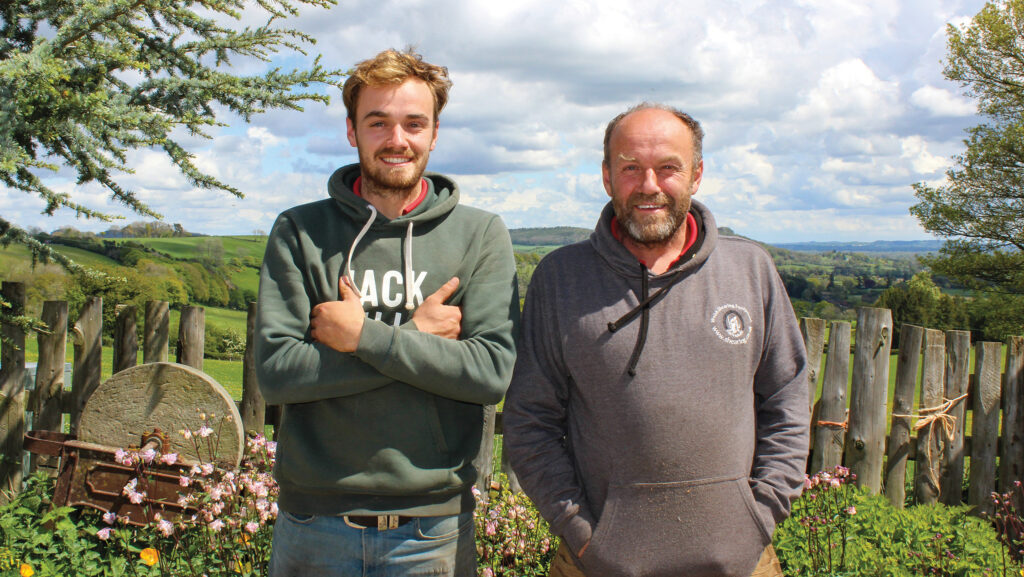
Gruff (left) and Martyn Jones © Kelvin Cave
Farm facts: Plas Onn, Llansantffraidd, Powys
- 121ha owned and rented
- 16ha barley and 8ha wheat
- Lambing from first week in March
- Flock scanning at average of 170%
- 80 beef cattle finished annually
- Lambs and finished cattle sold to ABP
- All work apart from combining done in-house
It is the third lambing season that ewes at Plas Onn, Llansantffraidd, are being fed a home-mix ration incorporating crimped barley, crimped wheat and grass silage, all grown on the farm.
Martyn and Eleri Jones, and their son and daughter-in-law, Gruff and Eluned, run a flock of 450 Welsh Mule ewes and historically fed an 18% protein nut for six weeks before lambing.
But that system did not give the Joneses control of the ingredients in the concentrate, or feed cost.
Since 2024, together with ad-lib clamp grass silage, they have fed a crimp-based, home-mixed concentrate at up to 0.8kg/day – starting at 0.1kg/day for single-bearing ewes when needed.
Without enough space in their sheep shed for all ewes to feed at once, they process the concentrate in 1t batches in a tub mixer.
This is fed in troughs in the three-sided pens, while silage is offered along the front of the pens.
A combination of 75% crimped barley and 25% crimped wheat is mixed with 50:50 rapeseed meal and maize distillers, and a mineral formulated by independent nutritionist Stephen Caldwell.
This is tailored to balance the forage analysis, which in 2025 showed 28% dry matter (DM), metabolisable energy (ME) of 10.7MJ/kg, 54.9% neutral detergent fibre, and 14.6% crude protein.
This is fed at a ratio of 60% forage and 40% concentrate.
The concentrate is formulated to deliver an ME of 13-13.5MJ/kg DM and a protein content of 18-18.5%, and works out at about £170-£210/t, including labour and machinery.
At housing, the concentrate is fed as a single feed for the first week and then split into two feeds.
“We were quite wary at first, being it seemed so simple, but it works and works well,” says Martyn.
Although there is a cost saving, it is not significant because a high-quality mineral is used, which he says is key. And the flock performs well on it, he adds.
“The ewes seem a lot more content on it too.”
It also makes full use of the land farmed and enables a rotation, with wheat or barley grown for two years followed by a root crop before a grass ley is established.